January 17, 2011

A narco submarine (also called a Bigfoot submarine) is a type of custom-made ocean-going self-propelled semi-submersible (SPSS) vessel built by drug traffickers to smuggle drugs. They are especially known to be used by Colombian drug cartel members to export cocaine from Colombia to Mexico, which is often then transported overland to the United States. First detected in 1993, they are popularly called submarines, though typically they are semi-submersibles since they cannot dive; most of the craft is submerged with little more than the cockpit and the exhaust gas pipes above the water.
However, in 2010 Ecuadorian authorities seized a fully functional, completely submersible submarine in the jungles bordering Ecuador and Colombia. This diesel electric submarine had a cylindrical fiberglass hull of 31 meters (102 ft) long, a 3 meter conning tower with periscope, and air conditioning. The vessel had the capacity for about 10 metric tons of cargo, a crew of five or six people, the ability to fully submerge down to 65 feet (20 m), and capable of long-range underwater operation.
Posted in Drugs, Politics, Technology |
Leave a Comment »
January 13, 2011

Nutraloaf, sometimes called prison loaf, disciplinary loaf, food loaf, confinement loaf, seg loaf, or special management meal, is a food served in United States prisons. It is similar to meatloaf in texture, but has a wider variety of ingredients. Prisoners may be served nutraloaf if they have assaulted prison guards or fellow prisoners with sharpened utensils. Prison loaf is usually exceedingly bland in taste or unpleasant, but prison wardens argue that it provides enough nutrition to keep prisoners healthy without requiring utensils to be issued. However, the American Correctional Association, which accredits prisons, discourages the use of food as a disciplinary measure.
There are many different recipes which include a range of food, from vegetables, fruit, meat, and bread or other grains. Some versions may be vegetarian or completely vegan. The ingredients are blended and baked into a solid loaf form. In some institutions it has no fixed recipe but is simply the regular prison meal (including drink) blended together. In one common version, it is made from a mixture of wheat bread, non-dairy cheese, various vegetables, and mixed with vegetable oil, tomato paste, powdered milk and dehydrated potato flakes.
Posted in Food, Politics |
Leave a Comment »
January 13, 2011

The Internet Corporation for Assigned Names and Numbers (ICANN) is a non-profit corporation headquartered in California that was incorporated in 1998 to oversee a number of Internet-related tasks previously performed directly on behalf of the U.S. Department of Defense, which created the Internet. ICANN manages the assignment of domain names and IP addresses. To date, much of its work is about making new generic top-level domains (e.g. .edu, .com, .gov, etc.).
Posted in Money, Politics, Technology |
Leave a Comment »
January 13, 2011

Network neutrality is a principle that restricts Internet Service Providers (ISP) and governments from giving some internet traffic (email, web, peer-to-peer, BitTorrent, etc.) priority over others. On a completely neutral network, all traffic is treated equally. On non-neutral network, ISPs could charge for access to types of traffic, instead of for access to the internet in general. Some degree of traffic management is necessary on any network, but where to draw the line is at issue presently. Many believe net neutrality to be primarily important as a preservation of current freedoms.
Vinton Cerf, considered a ‘father of the Internet’ and co-inventor of the Internet Protocol, Tim Berners-Lee, creator of the Web, and many others have spoken out in favor of network neutrality. Opponents of net neutrality contend that broadband service providers have no plans to block content or degrade network performance. In spite of this claim, some Internet service providers have intentionally slowed peer-to-peer communications. Still other companies have acted in contrast to these assertions of hands-off behavior and have begun to discriminate against P2P, FTP and online games, instituting a cell-phone style billing system of overages, free-to-telecom ‘value added’ services,’ and bundling.
Posted in Money, Politics, Technology |
Leave a Comment »
January 12, 2011

Creative Commons (CC) is a non-profit organization headquartered in San Francisco, devoted to expanding the range of creative works available for others to build upon legally and to share. The organization has released several copyright-licenses known as Creative Commons licenses free of charge to the public. These licenses allow creators to communicate which rights they reserve, and which rights they waive for the benefit of recipients or other creators. Wikipedia is one of the notable web-based projects using one of its licenses.
The organization was founded in 2001 with support of the Center for the Public Domain. The first set of copyright licenses were released in late 2002. Creative Commons is governed by a board of directors and a technical advisory board. Joi Ito is currently the chair of the board and CEO. Creative Commons has been described as being at the forefront of the copyleft movement, which seeks to support the building of a richer public domain by providing an alternative to the automatic ‘all rights reserved’ copyright.
Posted in Money, Politics |
Leave a Comment »
January 11, 2011

Fear, uncertainty and doubt (FUD) refers to a tactic of rhetoric and fallacy used in sales, marketing, public relations, politics and propaganda. FUD is generally a strategic attempt to influence public perception by disseminating negative and dubious/false information designed to undermine the credibility of their beliefs. The term originated in the computer hardware industry where IBM and later Microsoft were accused of using FUD tactics against their competitors, particularly open source software like Linux.
An individual firm, for example, might use FUD to invite unfavorable opinions and speculation about a competitor’s product; to increase the general estimation of switching costs among current customers; or to maintain leverage over a current business partner who could potentially become a rival.
Posted in Money, Politics, Technology |
Leave a Comment »
January 11, 2011


Avram Noam Chomsky (b. 1928) is an American linguist, philosopher, political activist, author, and lecturer. He is a professor emeritus of linguistics at MIT. Chomsky created one of the most important contributions to the field of linguistics made in the 20th century: the theory of generative grammar, a branch of theoretical linguistics that works to provide a set of rules that can accurately predict which combinations of words are able to make grammatically correct sentences. In the 1950’s he helped start the cognitive revolution in psychology through his review of B. F. Skinner’s work.
He challenged the behaviorist way of looking at behavior and language. His natural approach to the study of language also changed the philosophy of language and mind. He invented the Chomsky hierarchy, a way of looking at formal languages in terms of their power to explain language. In the 1960s he criticized the Vietnam War. Because of that, Chomsky became more widely known for his media criticism and politics. He is a key intellectual figure within the left wing of United States politics.
Posted in Language, Philosophy, Politics |
Leave a Comment »
January 11, 2011
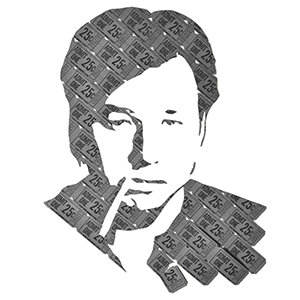
Bill Hicks (1961 – 1994) was an American stand-up comedian whose humor challenged mainstream beliefs, aiming to ‘enlighten people to think for themselves.’ Hicks used a ribald approach to express his material, describing himself as ‘Chomsky with dick jokes,’ while conceding that his humor was ‘caring.’ His material largely consisted of general discussions about society, religion, politics, philosophy, and personal issues. He was often controversial and his routine was steeped in dark comedy.
In both his stand-up performances and during interviews he criticized consumerism, superficiality, mediocrity, and banality within the media and popular culture, describing them as oppressive tools of the ruling class, meant to ‘keep people stupid and apathetic.’ Hicks died of pancreatic cancer in 1994 at the age of 32. In the years after his death, his work and legacy achieved the significant admiration and acclaim of numerous humorists.
read more »
Posted in Drugs, Humor, Politics |
Leave a Comment »
January 6, 2011


A hallmark is an official mark or series of marks struck on items made of precious metals — platinum, gold, silver and in some nations, palladium. In a more general sense, the term hallmark can also be used to refer to any distinguishing characteristic or trait Historically, hallmarks were applied by a trusted party: the ‘guardians of the craft’ or nowadays by an assay office.
Hallmarks are a guarantee of certain purity or fineness of the metal as determined by formal metal (assay) testing. Hallmarks are often confused with ‘trademarks’ or ‘maker’s mark.’ Hallmarks are an official mark of guaranteed metal content, trademarks are the mark of a manufacturer to distinguish his products from other manufacturers’ products.
Posted in Money, Politics |
Leave a Comment »
January 5, 2011

Guerrillero Heroico (‘Heroic Guerrilla’) is an iconic photo of Marxist revolutionary Che Guevara taken by Alberto Korda. It was taken on March 5, 1960, in Havana, Cuba, at a memorial service for victims of the La Coubre explosion and by the end of the 1960s turned the charismatic and controversial leader into a cultural icon. Korda has said that at the moment he shot the picture, he was drawn to Guevara’s facial expression, which showed ‘absolute implacability’ as well as anger and pain. Guevara was 31 at the time the photo was taken.
Versions of it have been painted, printed, digitized, embroidered, tattooed, silk-screened, sculpted or sketched on nearly every surface imaginable, leading the Victoria and Albert Museum to say that the photo has been reproduced more than any other image in photography.
Posted in Art, Politics |
Leave a Comment »
January 5, 2011
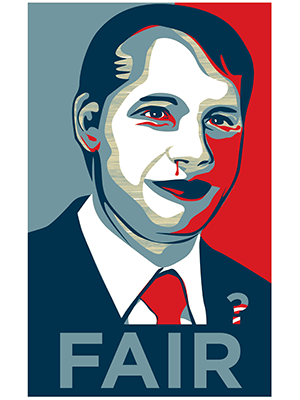
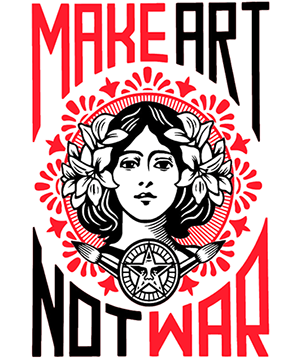
Shepard Fairey (b. 1970) is a contemporary artist, graphic designer, and illustrator who emerged from the American skateboarding scene. He first became known for his ‘André the Giant Has a Posse’ (…OBEY…) sticker campaign, in which he appropriated images from the comedic supermarket tabloid ‘Weekly World News.’ His work became more widely known in the 2008 U.S. presidential election, specifically his Barack Obama ‘HOPE’ poster.
Fairey’s first art museum exhibition, titled ‘Supply & Demand’ like his earlier book, was in Boston at the Institute of Contemporary Art in the summer of 2009. The exhibition featured over 250 works in a wide variety of media: screen prints, stencils, stickers, rubylith illustrations, collages, and works on wood, metal and canvas. As a complement to the ICA exhibition, Fairey created public art works around Boston. The artist explains his driving motivation: ‘The real message behind most of my work is ‘question everything.”
read more »
Posted in Art, Money, Politics |
Leave a Comment »
January 4, 2011

Derby’s dose was a form of torture used in Jamaica to punish slaves who attempted to escape. The runaway would be beaten, and salt pickle, lime juice, and bird pepper would be rubbed into his or her open wounds. Another slave would defecate into the mouth of the miscreant, who would then be gagged for four to five hours. The punishment was invented by Thomas Thistlewood, a plantation owner, and named for the slave, Derby, who was made to defecate on the victim.
Posted in Politics, World |
2 Comments »