November 19, 2010
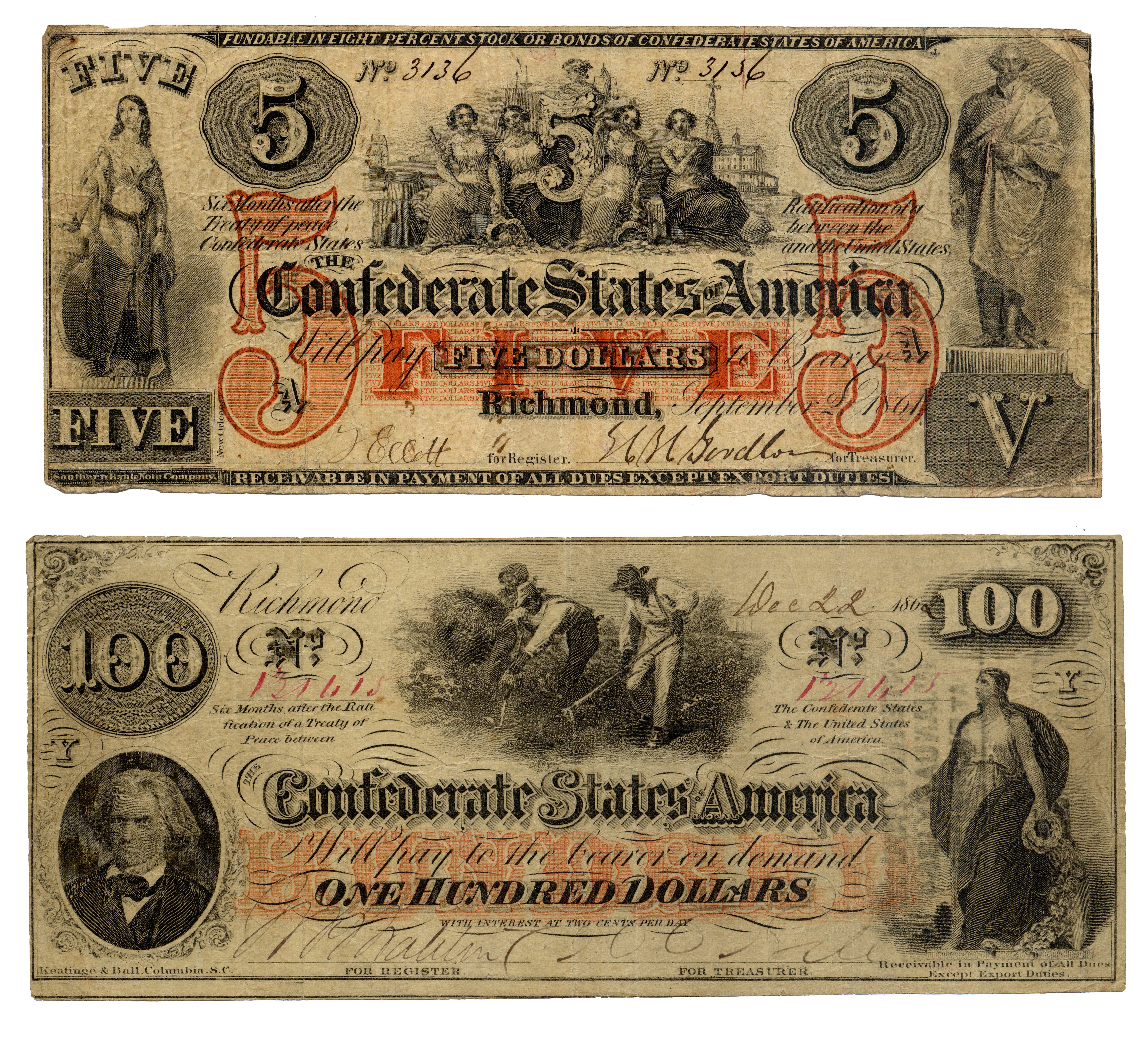
The Confederate States of America dollar was first issued into circulation in April 1861, when the Confederacy was only two months old, and on the eve of the outbreak of the Civil War. At first, Confederate currency was accepted throughout the South as a medium of exchange with high purchasing power. As the war progressed, however, confidence in the ultimate success waned, the amount of paper money increased, and their dates of redemption were extended further into the future.
The inevitable result was depreciation of the currency, and soaring prices characteristic of inflation. For example, by the end of the war, a cake of soap could sell for as much as $50 and an ordinary suit of clothes was $2,700. Near the end of the war, the currency became practically worthless as a medium of exchange. When the Confederacy ceased to exist as a political entity at the end of the war, the money lost all value as fiat currency.
Posted in Money, Politics, War |
3 Comments »
November 18, 2010

Cisgender [sis-jen-der] is a neologism that refers to individuals who are comfortable in the gender they were assigned at birth. It contrasts ‘transgender’ on the gender spectrum. A more popular term is ‘gender normative.’ The word has its origin in the Latin-derived prefix cis, meaning ‘on the same side’. In this case, ‘cis’ refers to the alignment of gender identity with assigned gender.
The word was coined in 1995 by Carl Buijs, a transsexual man from the Netherlands. Buijs said in a usenet posting, ‘As for the origin, I just made it up. I just kept running into the problem of what to call non-trans people in various discussions, and one day it just hit me: non-trans equals cis. Therefore, cisgendered.’
Posted in Language, Politics, Sex |
Leave a Comment »
November 18, 2010
The Goddess movement is a loose grouping of social and religious phenomena growing out of second-wave feminism, predominantly in North America, Western Europe, Australia and New Zealand in the 1970s, which spread to the metaphysical community as well.
Spurred by the perception that women were not treated equitably by mainstream religions, many women turned to a female deity, as more in tune with their beliefs and spiritual needs. Masculine gender and male imagery were, at the time, attached to deity to the exclusion of female gender and female imagery. A unifying theme of this diverse movement is the female-ness of the deity (as opposed and contrasted to a patriarchal, male God).
Posted in Philosophy, Politics, Sex |
Leave a Comment »
November 17, 2010
Numbers stations are shortwave radio stations of uncertain origin. They generally broadcast artificially generated voices reading streams of numbers, words, letters (sometimes using a spelling alphabet), tunes or Morse code. They are in a wide variety of languages and the voices are usually female, though sometimes male or children’s voices are used. Numbers stations appear and disappear over time (although some follow regular schedules), and their overall activity has increased slightly since the early 1990s.
Evidence supports popular assumptions that the broadcasts are used to send messages to spies. This usage has not been publicly acknowledged by any government that may operate a numbers station, but in 1892, the United States tried the Cuban Five for spying for Cuba. The group had received and decoded messages that had been broadcast from a Cuban numbers station. In 2009, the United States charged Walter Kendall Myers with conspiracy to spy for Cuba and receiving and decoding messages broadcast from a numbers station operated by the Cuban Intelligence Service.
Posted in Politics, Technology, War |
Leave a Comment »
November 17, 2010
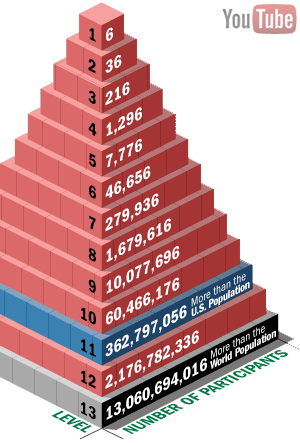
A pyramid scheme is a non-sustainable business model that involves promising participants payment primarily for enrolling other people into the scheme, rather than from any real investment or sale of products or services to the public. Pyramid schemes are a form of fraud. Pyramid schemes are illegal in many countries and have existed for at least a century, some with variations to hide their true nature.
Posted in Money, Politics |
Leave a Comment »
November 17, 2010


Multi-level marketing (MLM) is a marketing strategy in which the sales force is compensated not only for sales they personally generate, but also for the sales of others they recruit, creating a downline of distributors and a hierarchy of multiple levels of compensation. Other terms for MLM include network marketing, direct selling, and referral marketing. Although the products and company are supposed to be marketed directly to consumers and potential business partners by means of relationship referrals and word of mouth marketing, critics have charged that most MLMs are pyramid schemes.
MLM companies have been a frequent subject of criticism as well as the target of lawsuits. Criticism has focused on their similarity to illegal pyramid schemes, price-fixing of products, high initial start-up costs, emphasis on recruitment of lower-tiered salespeople over actual sales, encouraging if not requiring salespeople to purchase and use the company’s products, potential exploitation of personal relationships which are used as new sales and recruiting targets, complex and sometimes exaggerated compensation schemes, and cult-like techniques which some groups use to enhance their members’ enthusiasm and devotion. Not all MLM companies operate the same way, and MLM groups have persistently denied that their techniques are anything but legitimate business practices.
Posted in Money, Politics |
Leave a Comment »
November 17, 2010
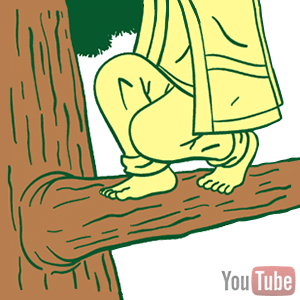
Luna, also called the ‘Stafford Giant,’ is a 600 to 1000-year-old redwood tree in Humboldt County, California, that activist Julia Butterfly Hill lived in for 738 days beginning in 1997. The name Luna was given to it in 1997 by a group of Earth First! members, who built a small platform from salvaged wood to serve as a tree-sit platform. Hill occupied the tree in order to save the grove from being clear-cut by the Pacific Lumber Company. Although many refer to the tree as ‘she,’ giant redwoods produce both male and female cones, and technically are neither male nor female, but monoecious.
In November of 2000, an unknown vandal used a chainsaw to cut halfway through the tree. Civil engineer Steve Salzman designed a system to help the tree withstand the extreme windstorms which frequent the Northern California hillside, at speeds which peak between 60 and 100 miles per hour. Tree climbers installed a steel cable ‘collar’ around Luna’s main trunk 100 feet above the ground. Four cables radiate from this collar and are attached with turnbuckles to four remote anchor points 100-150 feet away.
Posted in Politics |
Leave a Comment »
November 17, 2010
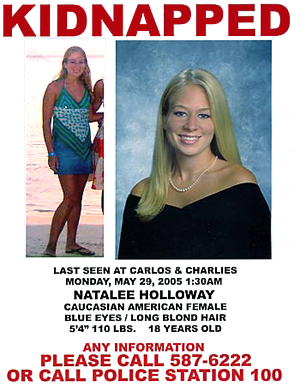
Missing white woman syndrome (MWWS) or missing pretty girl syndrome is a vernacular term for the alleged disproportionately greater degree of coverage in television, radio, newspaper and magazine reporting of a misfortune, most often a missing person case, involving a young, attractive, white, middle-class (or above) woman, compared with cases concerning a missing male, or missing females of other ethnicities or economic classes. Notable cases: Chandra Levy, Elizabeth Smart, Laci Peterson, and Natalee Holloway.
Posted in Politics |
Leave a Comment »
November 11, 2010
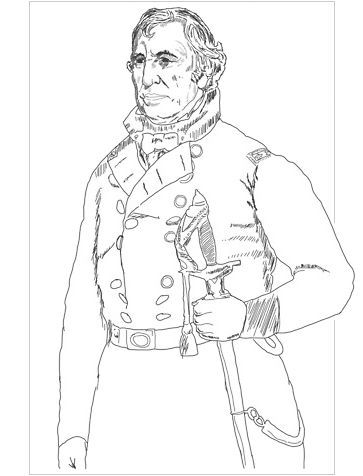
The Whig Party was a political party of the United States during the era of Jacksonian democracy (1833 – 1856). The party was formed in opposition to the policies of President Andrew Jackson and his Democratic Party to promote the strength of the presidency and executive branch at the expense of Congress. The Whigs advocated the supremacy of Congress over the presidency, and favored a program of modernization and economic protectionism. In its two decades of existence, the Whig Party saw two of its candidates, William Henry Harrison and Zachary Taylor, elected president.
read more »
Posted in Language, Politics |
Leave a Comment »
November 11, 2010
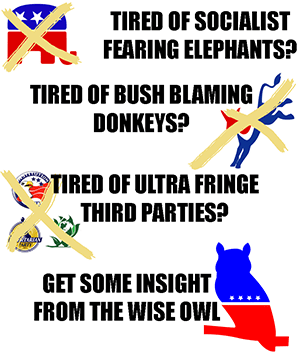
The Modern Whig Party is a United States political party whose stated intention is to be a ‘party for the rest of us.’ The Modern Whig Party describes itself as a mainstream, middle-of-the-road grassroots movement that caters to those voters who believe in various Republican issues but also believe in various other Democratic issues. Founded in 2008 by Iraq and Afghanistan veterans, the party has over 30,000 members nationally, with a sizable proportion affiliated with the American military. The general platform of the Modern Whig Party relates to fiscal responsibility, strong national defense, and social progress.
For its logo, the Modern Whig Party uses an owl, the symbol of the original Whig Party. As with the logos for the Democrats and the Republicans, a red, white, and blue color scheme is used, but with different meaning. Reportedly, the blue represents Democrats and the red, Republicans; the two colors are divided by a white band and four white stars. The party believes that the United States’ future lies in “meeting in the middle”, thus the placement of the stars in the middle of the owl.
Posted in Politics |
Leave a Comment »
November 11, 2010

Google Dashboard is a service launched by Google that allows a person with a Google Account to compile all the personal information associated with their account, or in their words, ‘Dashboard helps you answer the question: What information does Google have about me?’ The tool pulls together personal information from Google’s applications and services, such as Gmail, YouTube, or Blogger, and indicates whether the information is public or not. The service was launched in November, 2009.
Google created Dashboard in response to privacy concerns about how the company handles personal information. It launched the service at the 31st International Conference of Data Protection and Privacy Commissioners. The service allows a user to review and delete recent Google searches and view documents and other content created using Blogger, Picasa, Google Calendar, and other services.
Posted in Politics, Technology |
Leave a Comment »
November 8, 2010

In the novel Nineteen Eighty-Four, doublethink is the act of simultaneously accepting as correct two mutually contradictory beliefs. It is related to, but distinct from, hypocrisy and neutrality. Its opposite is cognitive dissonance, where the two beliefs cause conflict in one’s mind.
Posted in Language, Politics |
Leave a Comment »



 The Daily Omnivore