March 3, 2015

The Up Against the Wall Motherfuckers (often referred to as simply ‘The Motherfuckers,’ or UAW/MF) was an anarchist affinity group based in New York City. This ‘street gang with analysis’ was famous for its Lower East Side direct action and is said to have inspired members of the Weather Underground (a radical leftist group), as well as counterculture leader Abbie Hoffman’s Yippies.
The Motherfuckers grew out of a Dada-influenced art group called Black Mask with some additional people involved with the anti-Vietnam War ‘Angry Arts’ week, held in January 1967. Formed in 1966 by painter Ben Morea and the poet Dan Georgakas, Black Mask produced a broadside of the same name and declared that revolutionary art should be ‘an integral part of life, as in primitive society, and not an appendage to wealth.’ In May 1968, Black Mask changed its name and went underground. Their new name, ‘Up Against the Wall Motherfuckers,’ came from a poem by Amiri Baraka. Abbie Hoffman characterized them as ‘the middle-class nightmare… an anti-media media phenomenon simply because their name could not be printed.’
read more »
Posted in Art, Politics, War |
Leave a Comment »
March 2, 2015

The Brotherhood of Eternal Love was an organization of drug users and distributors that operated from the mid-1960s through the late 1970s in Orange County, California; they were dubbed the ‘Hippie Mafia.’ They produced and distributed drugs in hopes of starting a ‘psychedelic revolution’ in the US. The organization was started by spiritual guru John Griggs as a commune but by 1969 had turned to the manufacture of LSD and the importing of hashish. The group was known for it’s particular brand of highly potent acid dubbed ‘Orange Sunshine.’
In 1970, the Brotherhood hired the radical left organization the Weather Underground for a fee of $25,000 to help Harvard psychologist and LSD evangelist Timothy Leary make his way to Algeria after he escaped from prison, while serving a 5-year sentence for possession of marijuana. Their activities came to an end on August 5, 1972 in a drug raid where dozens of group members in California, Oregon, and Hawaii were arrested, though all of them were released within months; some who had escaped the raid continued underground or fled abroad. More members were arrested in 1994 and 1996, and the last of them in 2009.
Posted in Drugs, Love, Politics |
Leave a Comment »
February 23, 2015
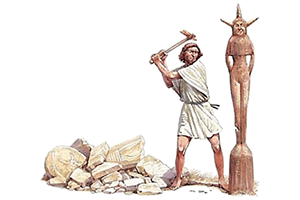

Aniconism [an-ahy-kuh-niz-uhm] is the practice of or belief in the avoiding or shunning of images of divine beings, prophets or other respected religious figures, or in different manifestations, any human beings or living creatures. The term ‘aniconic’ may be used to describe the absence of graphic representations in a particular belief system, regardless of whether an injunction against them exists.
An avoidance and repugnance of holy representations is called ‘iconophobia,’ its antonymic reaction being that of an ‘iconodule’ (one who is in favor of religious images or icons and their veneration). Aniconism can lead to iconoclasm, the destruction of sacred images as heretical. Aniconism can also lead to censorship, which takes place after a representation was already produced, but before, or shortly after, it is made public.
read more »
Posted in Art, Philosophy, Politics |
Leave a Comment »
February 22, 2015
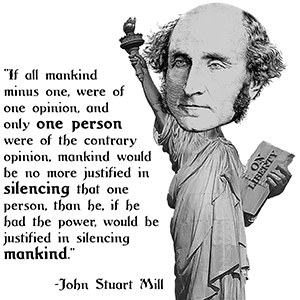
The ‘marketplace of ideas’ is a rationale for freedom of expression based on an analogy to the economic concept of a free market. The ‘marketplace of ideas’ belief holds that the truth will emerge from the competition of ideas in free, transparent public discourse. This concept is often applied to discussions of patent law as well as freedom of the press and the responsibilities of the media in a liberal democracy.
The general idea is that free speech should be tolerated because it will lead toward the truth. English poet John Milton suggested that restricting speech was not necessary because ‘in a free and open encounter,’ truth would prevail. President Thomas Jefferson argued that it is safe to tolerate ‘error of opinion … where reason is left free to combat it.’ Journalism professor Fredrick Siebert echoed the idea that free expression is self-correcting in ‘Four Theories of the Press’: ‘Let all with something to say be free to express themselves. The true and sound will survive. The false and unsound will be vanquished. Government should keep out of the battle and not weigh the odds in favor of one side or the other.’
read more »
Posted in Language, Money, Politics |
Leave a Comment »
January 22, 2015


The prosecutor’s fallacy is a fallacy of statistical reasoning, typically used by the prosecution to argue for the guilt of a defendant during a criminal trial (though some variants are utilized by defense lawyers arguing for the innocence of their client). The fallacy involves assuming that the prior probability of a random match is equal to the probability that the defendant is innocent. For instance, if a perpetrator is known to have the same blood type as a defendant and 10% of the population share that blood type, then to argue on that basis alone that the probability of the defendant being guilty is 90% makes the prosecutors’s fallacy.
Consider the case of a lottery winner accused of cheating based on the improbability of winning. At the trial, the prosecutor calculates the (very small) probability of winning the lottery without cheating and argues that this is the chance of innocence. The logical flaw is that the prosecutor has failed to account for the large number of people who play the lottery.
read more »
Posted in Politics, Science |
Leave a Comment »
December 26, 2014

Yank tank (or máquina) is a slang term referring to American cars, especially large models produced in the 1950s and 1960s common in Cuba today. In 1962 a US embargo against Cuba was introduced, effectively cutting trade between the two countries. This meant that the cars in Cuba could no longer receive new replacement parts when something broke. Currently, the only way to keep these cars on the road today is by using Cuban ingenuity to adapt household products and Soviet technology (such as train parts) for use in these vehicles.
If a car is unable to be repaired at the time, it is usually either ‘parked’ for future repair or ‘parted out’ (to produce extra income for the owner’s family) so that other cars can remain on the road. During the years of Soviet Union influence on Cuba, Ladas, Moskvitchs, and Volgas became the main cars imported by the communist regime, mainly for state use. As a result of these internal economic restrictions, to this day there is no such thing as a new or used private European or Asian automotive dealership branch in Cuba for independent purchasing by regular Cubans.
read more »
Posted in Politics, Technology, World |
1 Comment »
December 15, 2014


Creolization [kree-uh-lahy-zey-shuhn] is the process of two or more cultures mixing, as happened in in the Americas between people of indigenous, African, and European descent. Creolization is traditionally used to refer to the Caribbean but can be extended to represent other diasporas. The mixing of populations creates a cultural melting pot which ultimately leads to the formation of new identities. Creolization also is the mixing of the ‘old’ and ‘traditional,’ with the ‘new’ and ‘modern.’
Furthermore, creolization occurs when participants actively select cultural elements that may become part of or inherited culture. Social scientist Robin Cohen states that Creolization is a condition in which ‘the formation of new identities and inherited culture evolve to become different from those they possessed in the original cultures,’ and then creatively merge these to create new varieties that supersede the prior forms.
read more »
Posted in Language, Politics, World |
1 Comment »
December 6, 2014

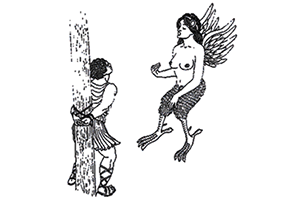
In economics, dynamic inconsistency, or time inconsistency, describes the situation: A decision-maker’s preferences change over time, in such a way that a preference, at one point in time, is inconsistent with a preference at another point in time. It is often easiest to think about preferences over time in this context by thinking of decision-makers as being made up of many different ‘selves,’ with each self representing the decision-maker at a different point in time. So, for example, there is my today self, my tomorrow self, my next Tuesday self, my year from now self, etc. The inconsistency will occur when somehow the preferences of some of the selves are not aligned with each other.
In the context of behavioral economics, time inconsistency is related to how each different self of a decision-maker may have different preferences over current and future choices. One common way in which selves may differ in their preferences is they may be modeled as all holding the view that now has especially high value compared to any future time. This is sometimes called the ‘immediacy effect’ or ‘temporal discounting.’ As a result the present self will care too much about herself and not enough about her future selves. Self control literature relies heavily on this type of time inconsistency, and it relates to a variety of topics including procrastination, addiction, efforts at weight loss, and saving for retirement.
read more »
Posted in Games, Money, Politics |
Leave a Comment »
December 5, 2014

Body worn video (BWV), including what is referred to as a body worn camera (BWC), is a video recording system that is typically utilized by law enforcement to record their interactions with the public, gather video evidence at crime scenes, and has been known to increase both officer and citizen accountability. BWCs are notable because their placement, often on the front of a shirt, provides for first person perspective and ultimately a more complete chain of evidence.
Body worn video was first adopted by British police in 2005, appearing in the form of small-scale tests conducted by the Devon and Cornwall Police. In 2006, the first significant deployments of BWV were undertaken as part of the Domestic Violence Enforcement Campaign. The basic command units equipped with the head cameras recorded everything that happened during an incident from the time of arrival which led to the ‘preservation of good-quality first disclosure evidence from the victim.’
read more »
Posted in Politics, Technology, World |
1 Comment »
November 29, 2014


Coffee culture describes a social atmosphere or series of associated social behaviors that depends heavily upon coffee, particularly as a social lubricant. The term also refers to the diffusion and adoption of coffee as a widely consumed stimulant by a culture. In the late 20th century, particularly in the Western world and urbanized centers on the globe, espresso has been an increasingly dominant form. Individuals that participate in cafe culture are sometimes referred to as ‘cafe au laiters’ and ‘espressonites.’
In many urban centers on the world, it is not unusual to see several espresso shops and stands within walking distance of each other or on opposite corners of the same intersection, typically with customers overflowing into parking lots. Thus, the term coffee culture is also used frequently in popular and business media to describe the deep impact of the market penetration of coffee-serving establishments.
read more »
Posted in Food, Politics, World |
1 Comment »
November 27, 2014

The tolerance paradox arises from a problem that a tolerant person might be antagonistic toward intolerance, hence intolerant of it. The tolerant individual would then be by definition intolerant of intolerance. American political philosopher Michael Walzer asks ‘Should we tolerate the intolerant?’ He notes that most minority religious groups who are the beneficiaries of tolerance are themselves intolerant, at least in some respects. In a tolerant regime, such people may learn to tolerate, or at least to behave ‘as if they possessed this virtue.’ Philosopher Karl Popper asserted, in ‘The Open Society and Its Enemies Vol. 1,’ that we are warranted in refusing to tolerate intolerance.
However, philosopher John Rawls concludes in ‘A Theory of Justice’ that a just society must tolerate the intolerant, for otherwise, the society would then itself be intolerant, and thus unjust. But, Rawls also insists, like Popper, that society has a reasonable right of self-preservation that supersedes the principle of tolerance: ‘While an intolerant sect does not itself have title to complain of intolerance, its freedom should be restricted only when the tolerant sincerely and with reason believe that their own security and that of the institutions of liberty are in danger.’
Posted in Philosophy, Politics |
Leave a Comment »
November 26, 2014
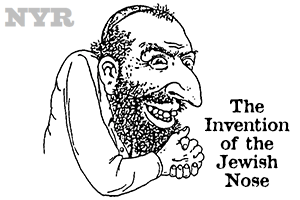

An aquiline [ak-wuh-lahyn] nose (also called a Roman nose or hook nose) is a human nose with a prominent bridge, giving it the appearance of being curved or slightly bent. The term is derived from the Latin word ‘aquilinus’ (‘eagle-like’) an allusion to the curved beak of an eagle. While some have ascribed the aquiline nose to specific ethnic, racial, or geographic groups, and in some cases associated it with other supposed non-physical characteristics (i.e. intelligence, status, personality, etc.), no scientific studies or evidence support any such linkage. As with many phenotypical expressions (i.e. ‘widow’s peak’, eye color, earwax type) it is found in many geographically diverse populations.
The aquiline nose was deemed a distinctive feature of some Native American tribes, members of which often took their names after their own characteristic physical attributes (i.e. The Hook Nose, or Chief Henry Roman Nose). In the depiction of Native Americans, for instance, an aquiline nose is one of the standard traits of the ‘noble warrior’ type. It is so important as a cultural marker, political scientist Renee Ann Cramer argued in ‘Cash, Color, and Colonialism’ (2005), that tribes without such characteristics have found it difficult to receive ‘federal recognition’ from the US government, resulting in failure to win benefits including tax-exempt status, reclamation rights, and (perhaps most significantly) the right to administer and profit from casinos.
read more »
Posted in Politics, Science, World |
1 Comment »




 The Daily Omnivore