July 1, 2014

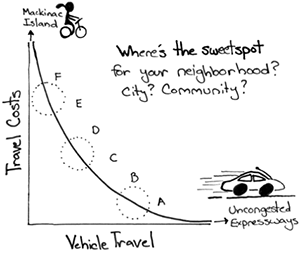
Induced demand, or latent demand, refers to the phenomenon that after supply increases, more of a good is consumed. This is entirely consistent with the economic theory of supply and demand; however, the idea has become important in the debate over the expansion of transportation systems, and is often used as an argument against widening roads, such as major commuter roads. It is considered by some to be a contributing factor to urban sprawl.
Latent demand has been recognized by road traffic professionals for many decades. J. J. Leeming, a British road-traffic engineer and county surveyor between 1924 and 1964, described the phenomenon is his 1969 book: ‘Motorways and bypasses generate traffic, that is, produce extra traffic, partly by inducing people to travel who would not otherwise have done so by making the new route more convenient than the old, partly by people who go out of their direct route to enjoy the greater convenience of the new road, and partly by people who use the towns bypassed because they are more convenient for shopping and visits when through traffic has been removed.’
read more »
Posted in Money, Politics, Technology |
Leave a Comment »
June 18, 2014
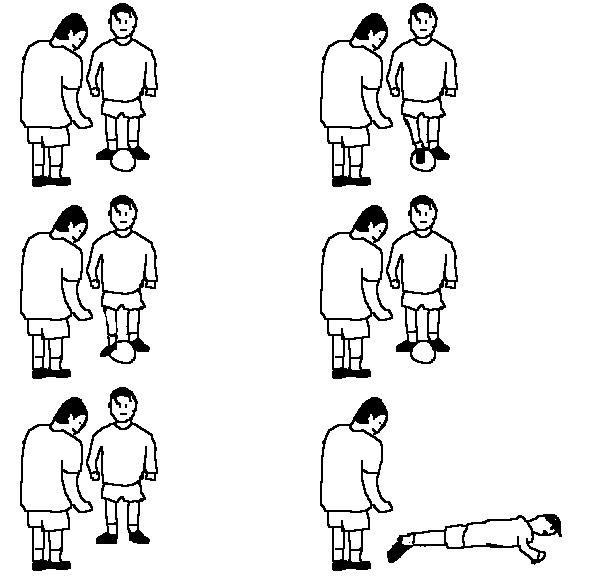

Gamesmanship is the use of dubious (although not technically illegal) methods to win or gain a serious advantage in a game or sport. It has been described as ‘Pushing the rules to the limit without getting caught, using whatever dubious methods possible to achieve the desired end.’ It may be inferred that the term derives from the idea of playing for the game (i.e., to win at any cost) as opposed to sportsmanship, which derives from the idea of playing for sport. The term originates from British author Stephen Potter’s humorous 1947 book, ‘The Theory and Practice of Gamesmanship (or the Art of Winning Games without Actually Cheating).’
Potter cites the origin of gamesmanship to be a tennis match in which he and the philosopher C. E. M. Joad competed against two younger and fitter men who were outplaying them fairly comfortably. On returning a serve, Joad hit the ball straight into the back-netting twelve feet behind the back-line. While the opponents were preparing for the next serve, Joad ‘called across the net, in an even tone: ‘Kindly state clearly, please, whether the ball was in or out.’ Being young, polite university students, their opponents offered to replay the point, but Joad declined. Because they were young and polite, the slight suggestion by Joad that their etiquette and sportsmanship were in question was extremely off-putting, and distracted them for the rest of contest. Potter and Joad went on to win the match.
read more »
Posted in Games, Politics |
Leave a Comment »
June 17, 2014
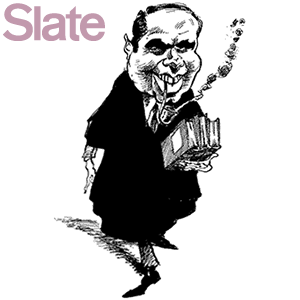
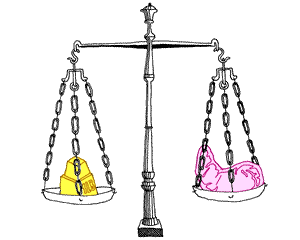
The letter of the law versus the spirit of the law is an idiomatic antithesis (a common expression where two opposites are introduced for contrasting effect): When one obeys the letter of the law but not the spirit, one is obeying the literal interpretation of the words (the ‘letter’) of the law, but not the intent of those who wrote the law. Conversely, when one obeys the spirit of the law but not the letter, one is doing what the authors of the law intended, though not necessarily adhering to the literal wording.
‘Law’ originally referred to legislative statute, but in the idiom may refer to any kind of rule. Intentionally following the letter of the law but not the spirit may be accomplished through exploiting technicalities, loopholes, and ambiguous language.
read more »
Posted in Language, Philosophy, Politics |
Leave a Comment »
June 13, 2014

Chronocentrism has been defined as ‘the egotism that one’s own generation is poised on the very cusp of history.’ The term had been used earlier in a study about attitudes to ageing in the workplace. Chronocentricity (‘only seeing the value of one’s own age cohort’) described the tendency for younger managers to hold negative perceptions of the abilities or other work-related competencies of older employees. This type of discrimination is a form of ageism.
Another usage is related to ethnocentrism (judging another culture solely by the values and standards of one’s own culture). By comparison, chronocentrism is perceiving and judging a culture’s historical values in terms of contemporary standards. An example of this usage is racism. In times prior to the advances of the civil rights movement, racist views and public expression were much more acceptable than they are today. This results in a tendency to judge those then making such statements in a harsher light.
Posted in Language, Philosophy, Politics |
1 Comment »
June 12, 2014
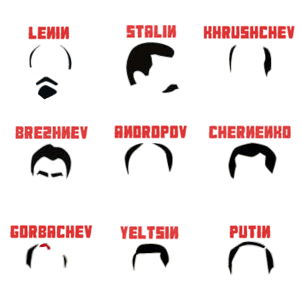
Bald–hairy is a common Russian joke that there is, apparently, a strict rule applying to the country’s politics for the latest two centuries: a bald (or balding) state leader is succeeded by a non-bald (‘hairy’) one, and vice versa. Whilst this pattern is most likely a coincidence, it has held true since 1825 (with the exception of Georgy Malenkov, who was Premier of the Soviet Union from 1953 to 1955), starting from Nicholas I. However, some videos of Joseph Stalin at the Potsdam Conference showed that he was balding.
Nicholas I’s son Alexander II formed the first ‘bald–hairy’ pair of the sequence with his father. The current pair of Russian rulers are the balding Vladimir Putin and the hairy Dmitry Medvedev. Putin was the president from 2000 until 2008, Medvedev held the post until 2012, and Putin became president again in 2012.
read more »
Posted in Humor, Politics, World |
1 Comment »
May 28, 2014


‘Thank God for Mississippi’ is a common adage in the US, particularly in the south, that is generally used when discussing rankings of states (e.g. educational achievement, overall health, poverty rate, quality of life). Since the state of Mississippi generally ranks at the bottom of such lists, residents of other states ranking near the bottom frequently proclaim, ‘Thank God for Mississippi,’ for sparing them from the shame of finishing in last place.
The saying has been attributed since before the induction of Alaska and Hawaii as states in 1959, and is especially common in Alabama, which shares significant cultural and historical ties with its neighbor and former Mississippi Territory co-constituent. Its use is also noted in nearby Arkansas and other frequently low-ranking states such as West Virginia and Texas.
Posted in Humor, Politics |
Leave a Comment »
May 14, 2014
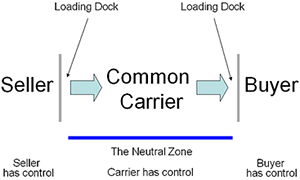
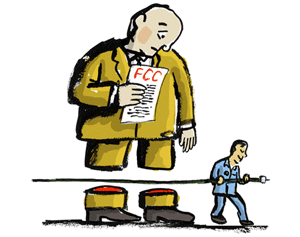
Common carrier is a legal term for a company that transports goods or people and is responsible for any loss in transit. Such services are offered to the general public under license or authority provided by a regulatory body, which may create, interpret, and enforce its regulations upon the common carrier (subject to judicial review) with independence and finality, as long as it acts within the bounds of the enabling legislation.
A common carrier is distinguished from a contract carrier, which transports goods for only a certain number of clients and that can refuse to transport goods for anyone else, and from a private carrier (a company that transports only their own goods). A common carrier holds itself out to provide service to the general public without discrimination (to meet the needs of the regulator’s quasi judicial role of impartiality toward the public’s interest) for the ‘public convenience and necessity.’
read more »
Posted in Money, Politics, Technology |
Leave a Comment »
May 13, 2014

Mirrors for princes refers to a genre of political writing during the Middle Ages (5th to the 15th century) and the Renaissance (14th to the 17th century). They are best known in the form of textbooks which directly instruct kings or lesser rulers on certain aspects of rule and behavior, but in a broader sense, the term is also used to cover histories or literary works aimed at creating images of kings for imitation or avoidance.
They were often composed at the accession of a new king, when a young and inexperienced ruler was about to come to power. They could be viewed as a species of self-help book. Possibly the best known European ‘mirror’ is ‘Il Principe’ (‘The Prince’) (c. 1513) by Machiavelli, although this was not a typical example.
Posted in Language, Politics |
Leave a Comment »
May 6, 2014

The Long Peace is a term for the historical period following the end of World War II in 1945. The ensuing half century was marked by the absence of major wars between the great powers of the period, the USA and the USSR, who were locked in a Cold War. Following the collapse of the Soviet Union in 1991 and the rise of China as a major power, there followed two decades of continued absence of direct conflict between major states, though lesser military conflicts occurred.
It is speculated that the obvious political errors leading to World War I and World War II with their consequent horrors and, thereafter, the acquisition of thermonuclear weapons by the opposing powers of the United States and the Soviet Union exerted a restraining influence on the leaderships of the major powers. A jockular expression in Europe to describe the strangely long stretch of peace is: ‘It has been 2,000 years since an army has not crossed the Rhine for so long a time.’
Posted in Politics, War, World |
Leave a Comment »
May 3, 2014


A cognitive radio is a transceiver that dynamically switches between optimal wireless channels in its vicinity. It automatically detects available channels, then accordingly changes its transmission or reception parameters to allow more concurrent wireless communications in a given spectrum band at one location. This process is a form of dynamic spectrum management.
The cognitive engine is capable of configuring waveform, protocol, operating frequency, and networking parameters. Units can exchange information about the environment with the networks it accesses and other cognitive radios (CRs). A CR ‘monitors its own performance continuously,’ in addition to ‘reading the radio’s outputs’; it then uses this information to ‘determine the RF environment, channel conditions, link performance, etc.’, and adjusts the ‘radio’s settings to deliver the required quality of service subject to an appropriate combination of user requirements, operational limitations, and regulatory constraints.’
read more »
Posted in Politics, Technology, World |
Leave a Comment »
April 29, 2014

An unconditional basic income (also called basic income, basic income guarantee, universal basic income, universal demogrant, or citizen’s income) is a proposed system of social security in which all citizens or residents of a country regularly receive an unconditional sum of money, either from a government or some other public institution, in addition to any income received from elsewhere.
A basic income is typically intended to be only enough for a person to survive on, so as to encourage people to engage in economic activity. A basic income of any amount less than the social minimum is sometimes referred to as a ‘partial basic income.’ On the other hand, it should be high enough so as to facilitate any socially useful activity someone could not afford to engage in if dependent on working for money to earn a living.
read more »
Posted in Money, Politics, World |
1 Comment »
April 28, 2014
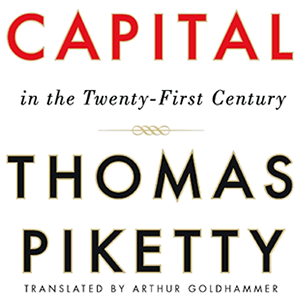
A wealth tax is a levy based on the aggregate value of all household assets (e.g. owner-occupied housing; cash, bank deposits, money funds, and savings in insurance and pension plans; investment in real estate and unincorporated businesses; and corporate stock, financial securities, and personal trusts). A wealth tax is a tax on the accumulated stock of purchasing power, in contrast to income tax, which is a tax on the flow of assets (a change in stock).
Some governments require declaration of the taxpayer’s balance sheet (assets and liabilities), and from that ask for a tax on net worth (assets minus liabilities), as a percentage of the net worth, or a percentage of the net worth exceeding a certain level. The tax is in place for both natural persons and, in some cases, legal persons such as corporations. In France, the net worth tax on natural persons is called the ‘solidarity tax on wealth.’ In other places, the tax may be called a ‘capital tax,’ an ‘equity tax,’ a ‘net worth tax,’ a ‘net wealth tax,’ or just a ‘wealth tax.’
read more »
Posted in Money, Politics, World |
Leave a Comment »



