September 10, 2014


Liebeck v. McDonald’s Restaurants, also known as the McDonald’s coffee case, was a 1994 product liability lawsuit that became a flash point in the tort reform debate in the US. A New Mexico civil jury awarded $2.86 million to plaintiff Stella Liebeck, a 79-year-old woman who suffered third-degree burns in her pelvic region when she accidentally spilled hot coffee in her lap after purchasing it from a McDonald’s restaurant. Liebeck was hospitalized for eight days while she underwent skin grafting, followed by two years of medical treatment.
Liebeck’s attorneys argued that at 180–190 °F coffee was defective, claiming it was too hot and more likely to cause serious injury than coffee served at any other establishment. The jury damages included $160,000 to cover medical expenses and $2.7 million in punitive damages. The trial judge reduced the final verdict to $640,000, and the parties settled for a confidential amount before an appeal was decided. The case was said by some to be an example of frivolous litigation; ABC News called it, ‘the poster child of excessive lawsuits,’ while legal scholar Jonathan Turley said it was ‘a meaningful and worthy lawsuit.’
read more »
Posted in Food, Money, Politics |
Leave a Comment »
September 2, 2014

The phrase ‘Nixon goes to China‘ or ‘It took Nixon to go to China’ is a historical reference to President Richard Nixon’s 1972 visit to the People’s Republic of China, where he met with Chairman Mao Zedong.
As a political metaphor, it refers to the ability of a politician with an unassailable reputation among his supporters for representing and defending their values to take actions that would draw their criticism and even opposition if taken by someone without those credentials. Although Nixon’s example is that of a hardliner taking steps toward peace with a traditional enemy (the most common application of the metaphor), it could also be applied to a reputedly cautious diplomat defying expectations by taking military action, or a political leader reforming aspects of the political system of which they have been strong supporters.
read more »
Posted in Politics, World |
1 Comment »
August 29, 2014

The True Believer: Thoughts On The Nature Of Mass Movements is a 1951 social psychology book by American moral philosopher Eric Hoffer that discusses the psychological causes of fanaticism. The book analyzes and attempts to explain the motives of the various types of personalities that give rise to mass movements; why and how mass movements start, progress and end; and the similarities between them, whether religious, political, radical or reactionary.
Hoffer argues that even when their stated goals or values differ mass movements are interchangeable, that adherents will often flip from one movement to another, and that the motivations for mass movements are interchangeable. Thus, religious, nationalist, and social movements, whether radical or reactionary, tend to attract the same type of followers, behave in the same way and use the same tactics and rhetorical tools. As examples, the book often refers to Communism, Fascism, National Socialism, Christianity, Protestantism, and Islam.
read more »
Posted in Health, Language, Politics |
Leave a Comment »
August 27, 2014

The term artistamp (a portmanteau of the words ‘artist’ and ‘stamp’) or artist’s stamp refers to a postage stamp-like art form used to depict or commemorate any subject its creator chooses. Artistamps are a form of ‘Cinderella stamp’ (unofficial stamps, not valid for postage), but they differ from forgeries or bogus Illegal stamps in that typically the creator has no intent to defraud postal authorities or stamp collectors.
Artistamp creators often include their work on legitimate mail, alongside valid postage stamps, in order to decorate the envelope with their art. In many countries this practice is legal, provided the artistamp isn’t passed-off as or likely to be mistaken for a genuine postage stamp. When so combined (and sometimes, less strictly speaking, even when not so) the artistamp may be considered part of the ‘mail art’ genre (a populist artistic movement centered around sending small scale works through the postal service, initially developed out of the Fluxus movement in the 1950s and 60s).
read more »
Posted in Art, Politics |
Leave a Comment »
August 13, 2014

Hendiatris [hen-die-uh-tris] (from the Greek: ‘one through three’) is a figure of speech used for emphasis, in which three words are used to express one idea (e.g. ‘sex, drugs and rock and roll’ to capture the life of a rock star). It is an isocolon, a sentence composed of two or more parts (cola) perfectly equivalent in structure, length and rhythm (called a bicolon, tricolon, or tetracolon depending on whether they are two, three, or four parts).
A well-known example of tricolon is Julius Caesar’s ‘Veni, vidi, vici’ (‘I came; I saw; I conquered’), which is also a hendiatris and known in English as a ‘tripartite motto.’ If the units involved are not single words, and if they are not in any way synonyms but rather circumnavigate the one idea expressed, the figure may be described more correctly, precisely, and succinctly as a ‘triad.’
read more »
Posted in Language, Politics, World |
1 Comment »
August 7, 2014


The right to be forgotten is a nascent legal concept arising from the need to ‘determine the development of [one’s] life in an autonomous way, without being perpetually or periodically stigmatized as a consequence of a specific action performed in the past.’ France law began recognizing this new right in 2010. Critics claim the laws are vague, unenforceable, and potentially a threat to open access to information, which is an existing legal right in many countries. There are also concerns about its interaction with the right to privacy and whether it would decrease the quality of the Internet through censorship and a rewriting of history.
Many nations have very strong domestic freedom of speech laws, which would be challenging to reconcile with the right to be forgotten. Some academics see that only a limited form of the right to be forgotten would be reconcilable with US constitutional law; the right of an individual to delete data that he or she has personally submitted. In this limited form, individuals could not have material removed that has been uploaded by others, as demanding the removal of information could constitute censorship and a reduction in the freedom of expression.
read more »
Posted in Politics, Technology, World |
1 Comment »
August 6, 2014

Imelda Marcos (b. 1929) is the widow of former Philippine President Ferdinand Marcos. In popular culture, she is remembered for her collection of more than a thousand pairs of shoes. She began her career as a local singer and model in Manila before meeting her husband. After the declaration of martial law in 1972, Imelda began holding positions in the national government that allowed her to travel the world and accumulate artwork and real estate. The couple consolidated their power allowing them to transport funds from the Philippine treasury into offshore accounts, such as banks in Switzerland.
President Marcos was accused of the assassination of Benigno Aquino, Jr., leading to the People Power Revolution which forced the Marcoses out of office and into exile in Hawaii. After the death of Ferdinand, Imelda and her family were given amnesty by then President Corazon Aquino, Benigno Jr’s widow. Her return to the Philippines has since allowed her to restore her political dynasty. Despite numerous cases involving alleged corruption, she has not been imprisoned and continues to wield influence. Her ability to survive upheavals in her life has led her to be called the ‘Steel Butterfly.’
read more »
Posted in Money, Politics, World |
Leave a Comment »
July 28, 2014


Historic recurrence is the repetition of similar events in history. The concept has been used to analyze the overall history of the world (e.g., the rise and fall of empires), repetitive patterns in the history of a given polity, and generally to any two specific events which bear a striking similarity. Professor of religious history Garry W. Trompf, in his book ‘The Idea of Historical Recurrence in Western Thought,’ traces historically recurring patterns of political thought and behavior in the west since antiquity. Historic recurrences can sometimes induce a sense of ‘convergence,’ ‘resonance,’ or déjà vu.
In the extreme, the concept assumes the form of the doctrine of Eternal Return (the belief that universe has been recurring, and will continue to recur, in a self-similar form an infinite number of times across infinite time or space), found in Indian philosophy and in ancient Egypt and was subsequently taken up by the Pythagoreans and Stoics (with the decline of antiquity and the spread of Christianity, the concept fell into disuse in the Western world, with the exception of existentialist philosopher Friedrich Nietzsche, who connected the thought to many of his other concepts, including ‘amor fati,’ love of one’s fate).
read more »
Posted in Philosophy, Politics, World |
Leave a Comment »
July 21, 2014


The nothing to hide argument broadly states that police surveillance is only adverse to those doing something wrong. By this line of reasoning, government data mining and surveillance programs do not threaten privacy unless they uncover illegal activities, and if they do, the guilty person does not have the right to keep them private. The motto ‘If you’ve got nothing to hide, you’ve got nothing to fear’ was used to advertise closed-circuit television programs in the UK.
Geoffrey Stone, a legal scholar, said that the use of the argument is ‘all-too-common.’ Cryptographer Bruce Schneier described it as the ‘most common retort against privacy advocates.’ He cites French statesman Cardinal Richelieu’s statement ‘If one would give me six lines written by the hand of the most honest man, I would find something in them to have him hanged,’ to describe how a state government can find aspects in a person’s life in order to prosecute, defame, or blackmail that individual. Schneier also argued ‘Too many wrongly characterize the debate as ‘security versus privacy.’ The real choice is liberty versus control.’
read more »
Posted in Politics, Technology |
1 Comment »
July 16, 2014

Napster was a peer-to-peer (P2P) music sharing application first developed in 1999 by Shawn Fanning at Northeastern University. The original program was available for three years before being shut down by a court order for copyright violations. The company’s brand and other assets was subsequently acquired at a bankruptcy proceeding by Roxio, maker of CD burning software. In its second incarnation Napster became an online music store until it was bought by music streaming site Rhapsody in late 2011.
Fanning lead the original company along with his uncle John Fanning and entrepreneur Sean Parker (who would go on to make billions as an early employee of Facebook). Later companies and projects successfully followed its P2P file sharing example such as Gnutella, Freenet, and many others. Some services, like LimeWire, Grokster, Madster and the original eDonkey network, were brought down or changed due to similar circumstances.
read more »
Posted in Money, Politics, Technology |
Leave a Comment »
July 14, 2014


Neo-Luddism is a philosophy opposing many forms of modern technology. According to a manifesto drawn up by the ‘Second Luddite Congress’ in 1996: Neo-Luddism is ‘a leaderless movement of passive resistance to consumerism and the increasingly bizarre and frightening technologies of the Computer Age.’ The name is based on the historical legacy of the British Luddites, textile artisans who rebelled against the Industrial Revolution and newly developed labor-saving machinery that threatened their livelihoods. Both the original Luddites and their modern counterparts are characterized by the practice of destroying or avoiding technological equipment as well as advocating simple living.
Neo-Luddism stems from the concept that technology has a negative impact on individuals, their communities and the environment. It also seeks to examine the unknown effects that new technologies might unleash. The modern Neo-Luddite movement has connections with the anti-globalization movement, anarcho-primitivism (a political critique of the origins and progress of civilization), radical environmentalism, and Deep Ecology (a contemporary environmental philosophy advocating for the inherent worth of living beings regardless of their instrumental utility to humans). The word Luddite is also used as ‘a derogatory term applied to anyone showing vague technophobic leanings.’
read more »
Posted in Politics, Technology |
Leave a Comment »
July 11, 2014
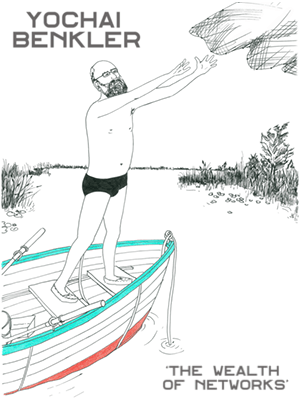

Open-source economics is an economic platform (a two-sided market with two distinct user groups that provide each other with network benefits) based on open collaboration for the production of software, services, or other products. First applied to the open-source software industry, this economic model may be applied to a wide range of enterprises. The system requires work or investment to be carried out without an expressed expectation of return; products or services are produced through collaboration between users and developers; there is no direct individual ownership of the enterprise itself.
The structure of open source is based on user participation. According to technology law professor Yochai Benkler, ‘networked environment makes possible a new modality of organizing production: radically decentralized, collaborative, and non-proprietary; based on sharing resources and outputs among widely distributed, loosely connected individuals who cooperate with each other without relying on either market signals or managerial commands.’
read more »
Posted in Money, Politics, Technology |
1 Comment »



