August 7, 2013

Honky is a racial slur for white people, predominantly heard in the United States. The first recorded use of honky in this context may date back to 1946, although the use of ‘Honky Tonk’ (a type of bar common in the South) appeared in films well before that time.
The exact origins of the word are generally unknown and postulations about the subject vary. Honky may derive from the term ‘xonq nopp’ which, in the West African language Wolof, literally means ‘red-eared person’ or ‘white person.’ The term may have been brought to the US by slaves.
read more »
Posted in Language, Politics |
Leave a Comment »
August 7, 2013
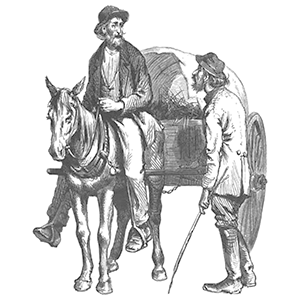
Cracker is a derogatory term for white people, especially poor rural whites in the Southern United States. In reference to a native of Florida or Georgia, however, it is sometimes used in a neutral or positive context and is sometimes used self-descriptively with pride as a form of reappropriation. There are multiple suggested etymologies for ‘cracker,’ most dating its origin to the 18th century or earlier.
One theory holds that the term derives from the ‘cracking’ of whips, either by slave foremen in the antebellum South against African slaves, or by rustics to guide their cattle. Those white foremen or rural poor who cracked their whips theoretically became known as ‘crackers.’ Another whip-derived theory is based on Florida’s ‘cracker cowboys’ of the 19th and early 20th centuries; distinct from the Spanish ‘vaquero’ and the Western ‘cowboy.’ Cracker cowboys did not use lassos to herd or capture cattle. Their primary tools were cow whips and dogs.
read more »
Posted in Language, Politics |
Leave a Comment »
August 2, 2013
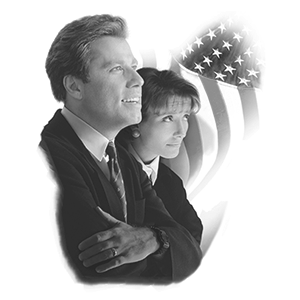
Primary Colors is a 1998 film based on the book ‘Primary Colors: A Novel of Politics,’ a roman à clef (novel about real life, overlaid with a façade of fiction) about Bill Clinton’s first presidential campaign in 1992, which originally had been published anonymously, but was revealed to have been written by journalist Joe Klein, who had been covering Clinton’s campaign for ‘Newsweek.’
The film was directed by Mike Nichols and starred John Travolta, Emma Thompson, Billy Bob Thornton, and Kathy Bates. Bates was nominated for an Academy Award for Best Supporting Actress for her performance, and the film itself was nominated for an Academy Award for Best Adapted Screenplay.
read more »
Posted in Art, Politics |
Leave a Comment »
August 2, 2013
‘Primary Colors: A Novel of Politics’ is a 1996 roman à clef, a work of fiction that purports to describe real life characters and events — namely, Bill Clinton’s first presidential campaign in 1992. It has been compared to two other novels about American politics; Robert Penn Warren’s ‘All the King’s Men’ (1946) and ‘O: A Presidential Novel’ (2011). The book was originally published by an anonymous author, who was later found to be columnist Joe Klein. Klein completed a sequel of sorts, ‘The Running Mate’ in 2000, focusing on the ‘Primary Colors’ character of Charlie Martin.
An early reviewer opined that the author wished to remain unknown because ‘Anonymity makes truthfulness much easier.’ Later commentators called the publishing of the book under an anonymous identity an effective marketing strategy that produced more publicity for the book, and thus more sales, without calling into question the author’s actual inside knowledge.
read more »
Posted in Language, Politics |
Leave a Comment »
July 25, 2013
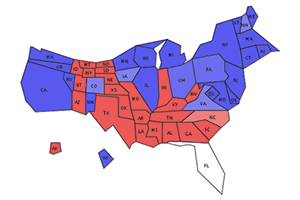
Sheng-Hung (Sam) Wang (b. 1967) is an American professor, neuroscientist and author known for the books ‘Welcome to Your Brain’ and ‘Welcome to Your Child’s Brain,’ as well as for the Princeton Election Consortium psephology (study of elections) web site. Wang was raised in California.
His parents emigrated from Taiwan to the United States in the 1960s. He attended the California Institute of Technology and graduated in 1986 with a B.S. in physics with honors at the age of 19, making him the youngest member of his graduating class. He went on to earn a Ph.D. in neuroscience at Stanford University.
read more »
Posted in Politics, Science |
1 Comment »
July 23, 2013

Technological determinism [dih-tur-muh-niz-uhm] is a reductionist theory that presumes that a society’s technology drives the development of its social structure and cultural values. The term is believed to have been coined by American economist and sociologist Thorstein Veblen (1857–1929). The most radical technological determinist in the United States in the twentieth century was most likely economist Clarence Ayres who was a follower of Veblen and American philosopher and psychologist John Dewey. Sociologist William Ogburn was also known for espousing theories of radical technological determinism.
Veblen’s contemporary, popular historian Charles A. Beard, said of the concept: ‘Technology marches in seven-league boots from one ruthless, revolutionary conquest to another, tearing down old factories and industries, flinging up new processes with terrifying rapidity.’
read more »
Posted in Philosophy, Politics, Technology |
1 Comment »
July 14, 2013
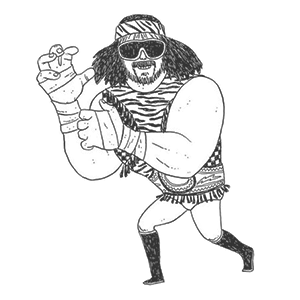
Machismo [mah-cheez-moh] is a negative descriptor of, for example, sexism, misogyny, chauvinism and hypermasculinity and hegemonic masculinity.
Scholars characterize such macho men as violent, rude, womanizing, and prone to alcoholism; domineering through intimidation, seducing and controlling women and children through violence and intimidation. However, some societies and academics place traditional gender roles – social norm for certain communities, followed by others by admiration or convention – as the most important component of machismo.
read more »
Posted in Politics, Sex, World |
1 Comment »
July 9, 2013
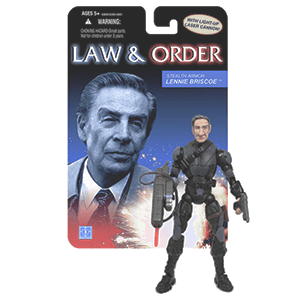
Lennie Briscoe is a fictional character on NBC’s long-running police procedural and legal drama television series ‘Law & Order.’ He was portrayed by Jerry Orbach for 12 season. The character was introduced in the 1992 episode ‘Point of View’ as the new senior detective in the NYPD’s 27th Detective Squad in the 27th Police Precinct’s Station House. His boss during his first season on the show is Capt. Don Cragen; a year later, Lt. Anita Van Buren takes over the 27th Squad.
He was previously assigned as a detective in the 116th Det. Squad in Queens. Briscoe joins the squad after Det. Mike Logan’s (Chris Noth) partner, Sgt. Phil Cerreta (Paul Sorvino), is shot by a black market arms dealer, and Logan transfers to a desk job in another precinct. After Logan is transferred to Staten Island in 1995, Det. Rey Curtis (Benjamin Bratt) becomes Briscoe’s partner. Four years later, Curtis goes into early retirement to take care of his multiple sclerosis–stricken wife, and he is replaced by Det. Ed Green (Jesse L. Martin) in 1999.
read more »
Posted in Art, Politics |
Leave a Comment »
July 3, 2013

An open secret is a concept or idea that is ‘officially’ secret or restricted in knowledge but is actually widely known; or it refers to something that is widely known to be true but which none of the people most intimately concerned is willing to categorically acknowledge in public.
The existence of the British Secret Intelligence Service (MI6) was widely known for several decades before the government’s official acknowledgement of the organization in 1994. Likewise, Delta Force, the elite US Army unit, can be considered an open secret, since its existence has been denied in the past by the government. Israel is widely acknowledged to possess nuclear weapons. This can be considered an open secret, because the Israeli government has never explicitly stated whether or not it possesses a nuclear stockpile, officially maintaining a policy of deliberate ambiguity.
read more »
Posted in Language, Politics, World |
1 Comment »
July 2, 2013

‘My Cousin Vinny‘ is a 1992 American comedy film written by Dale Launer (‘Dirty Rotten Scoundrels,’ ‘Ruthless People’), directed by Jonathan Lynn (‘Clue,’ ‘The Whole Nine Yards’), and starring Joe Pesci, Ralph Macchio, Marisa Tomei, and Fred Gwynne (best known for playing Herman Munster; the film was Gwynne’s final role before his death the following year).
‘My Cousin Vinny’ is the story of two young New Yorkers traveling through rural Alabama who are put on trial for a murder they did not commit, and the comic attempts of a cousin, Vincent Gambini, a newly minted lawyer, to defend them. Much of the humor comes from the contrasting personalities of the brash Italian-American New Yorkers, Vinny and his fiancée Mona Lisa Vito, and the more reserved Southern townspeople.
read more »
Posted in Art, Humor, Politics |
6 Comments »
June 12, 2013
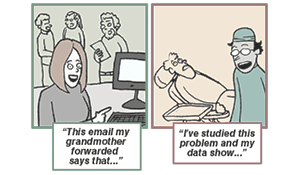

Today, false balance is used to describe a perceived or real media bias, where journalists present an issue as being more balanced between opposing viewpoints than the evidence actually supports.
Journalists may present evidence and arguments out of proportion to the actual evidence for each side, or may even actually suppress information which would establish one side’s claims as baseless. False balance is also often found in political reports, company press releases, and general information from organizations with special interest groups in promoting their respective agendas.
read more »
Posted in Language, Politics, Science |
Leave a Comment »
June 12, 2013
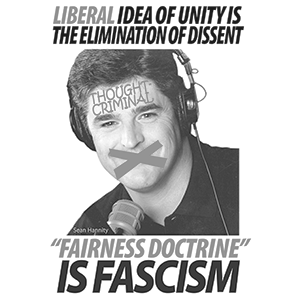
The Fairness Doctrine was a policy of the FCC, introduced in 1949, that required the holders of broadcast licenses to both present controversial issues of public importance and to do so in a manner that was, in the Commission’s view, honest, equitable and balanced (i.e. air contrasting views regarding those matters).
The FCC decided to eliminate the Doctrine in 1987, and in 2011, formally removed the language that implemented it. Stations were given wide latitude as to how to provide contrasting views: It could be done through news segments, public affairs shows, or editorials. The doctrine did not require equal time for opposing views but required that contrasting viewpoints be presented. (The Fairness Doctrine should not be confused with the ‘Equal Time’ rule, which deals only with political candidates.)
read more »
Posted in Language, Politics, Technology |
Leave a Comment »



