June 10, 2013

Chilling Effects is a collaborative archive created by Wendy Seltzer and founded along with several law school clinics and the Electronic Frontier Foundation (a digital rights group) to protect lawful online activity from legal threats.
Its website, ‘Chilling Effects Clearinghouse,’ allows recipients of cease-and-desist notices to submit them to the site and receive information about their legal rights and responsibilities. The archive was founded in 2001 by Internet activists who were concerned that the unregulated private practice of sending cease-and-desist letters seemed to be increasing and was having an unstudied, but potentially significant, ‘chilling effect’ on speech.
read more »
Posted in Money, Politics, Technology |
Leave a Comment »
June 10, 2013

There are a number of disputes relating to the Church of Scientology’s efforts to suppress material critical of Scientology on the Internet through the use of lawsuits and legal threats. In late 1994, the Church of Scientology began using various legal tactics to stop distribution of unpublished documents written by L. Ron Hubbard.
The Church of Scientology is often accused of barratry (litigation for the purpose of harassment or profit) through the filing of SLAPP suits (lawsuits intended to censor, intimidate, and silence critics by burdening them with the cost of a legal defense until they abandon their criticism or opposition). The official church response is that its litigious nature is solely to protect its copyrighted works and the unpublished status of certain documents.
read more »
Posted in Philosophy, Politics, Technology |
Leave a Comment »
June 7, 2013

Really Big Coloring Books, Inc (RBCB) is an American publisher based in St. Louis, Missouri. The company develops, publishes and distributes children’s coloring and activity books, many of which are over two feet tall. Some of their products have been controversial due to their political content.
The company was established in 1981 by publisher Wayne Bell. The company is best known for its politically themed coloring books, covering subjects such as Barack Obama, the Tea Party Movement, and Occupy Wall Street.
read more »
Posted in Art, Politics, Sex |
Leave a Comment »
June 6, 2013
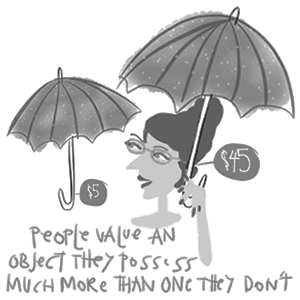
In behavioral economics, the endowment effect (also known as divestiture aversion) is the hypothesis that a person’s willingness to accept (WTA) compensation for a good is greater than their willingness to pay (WTP) for it once their property right to it has been established. People will pay more to retain something they own than to obtain something owned by someone else—even when there is no cause for attachment, or even if the item was only obtained minutes ago. This is due to the fact that once you own the item, foregoing it feels like a loss, and humans are loss-averse.
The endowment effect contradicts the Coase theorem (a theory of economic efficiency), and was described as inconsistent with standard economic theory which asserts that a person’s willingness to pay (WTP) for a good should be equal to their willingness to accept (WTA) compensation to be deprived of the good, a hypothesis which underlies consumer theory and indifference curves.
read more »
Posted in Money, Politics, Science |
1 Comment »
June 5, 2013

‘Born Rich‘ is a 2003 documentary film about growing up in the world’s richest families. It was created by Jamie Johnson, an heir to the Johnson & Johnson fortune. It consists primarily of Johnson interviewing his friends and peers about living life free of financial constraints. These interviews are offset by Johnson’s exploration of his own experience and family.
Interviewees include: Georgina Bloomberg, Stephanie Ercklentz (born to New York lawyer Enno W. Ercklentz Jr.), Christina Floyd (born to golfer Raymond Floyd), Juliet Hartford (born to A&P heir Huntington Hartford), Josiah Cheston Hornblower (born into Vanderbilt-Whitney lineage), S.I. Newhouse IV, Ivanka Trump, Cody Franchetti (heir to Milliken & Co), and Carlo von Zeitschel (German baron and Italian viscount, great grandson of Kaiser Wilhelm). Luke Weil (born to Scientific Games CEO A. Lorne Weil) sued unsuccessfully to remove his segments from the film.
Posted in Money, Politics |
Leave a Comment »
June 5, 2013

Lookism is a term used to refer to the positive stereotypes, prejudice, and preferential treatment given to physically attractive people, or more generally to people whose appearance matches cultural preferences.
The pejorative term ‘body fascism’ is also used as a synonym and educator and activist Warren Farrell has proposed the term ‘genetic celebrity’ to describe adoration of the attractive.
read more »
Posted in Language, Politics, Sex |
Leave a Comment »
June 4, 2013

Patent monetization refers to the generation of revenue or the attempt to generate revenue by a person or company by selling or licensing the patents it owns.
The so-called patent trolls—which is a pejorative term—attempt to generate revenue by buying and enforcing patents against one or more alleged infringers in a manner considered by the target or observers as unduly aggressive or opportunistic, often with no intention to further develop, manufacture or market the patented invention. Other persons or companies, which are not regarded as patent trolls, also try to make money from patents on inventions they develop, manufacture or market.
Posted in Money, Politics, Technology |
Leave a Comment »
June 4, 2013

Intellectual Ventures is a private company notable for being one of the top-five owners of U.S. patents, as of 2011. Its business model has a focus on buying patents and aggregating them into a large patent portfolio and licensing this ‘IV’ portfolio to companies.
Publicly, it states that a major goal is to assist small inventors against corporations. In practice, the vast majority of IV’s revenue comes from buying patents, aggregating them into a large portfolio and licensing this portfolio to other companies or filing lawsuits for infringement of patents, a controversial practice known as patent trolling.
read more »
Posted in Money, Politics, Technology |
Leave a Comment »
June 3, 2013

De-Stalinization refers to the process of eliminating the cult of personality, Stalinist political system and the Gulag labor-camp system created by Soviet leader Joseph Stalin. Stalin was succeeded by a collective leadership after his death in 1953. The central Soviet strongmen at the time were Lavrentiy Beria, head of the Ministry of the Interior; Nikita Khrushchev, First Secretary of the Central Committee of the Communist Party of the Soviet Union (CPSU); and Georgi Malenkov, Premier of the Soviet Union.
Contemporary historians regard the process of de-Stalinization as a significant turning point in the history of modern Russia. References to Stalin were embedded in the lyrics of the National Anthem of the Soviet Union, after which the Stalin-centric and World War II-era references were excised where an instrumental version was used.
read more »
Posted in Politics, War, World |
Leave a Comment »
June 3, 2013

Stetson Kennedy (1916 – 2011) was an American author and human rights activist. One of the pioneer folklore collectors during the first half of the 20th century, he is remembered for having infiltrated the Ku Klux Klan in the 1940s, exposing its secrets to authorities and the outside world.
His actions led to the 1947 revocation by the state of Georgia of the Klan’s national corporate charter. Kennedy wrote or co-wrote ten books.
read more »
Posted in Language, Politics |
Leave a Comment »
June 3, 2013

In 1946, human rights activist Stetson Kennedy infiltrated the KKK. Concerned that the organization had links to police forces, Kennedy decided to use his findings to strike at the Klan in a different way. He contacted the producers of the ‘Superman’ radio show and proposed a story where the superhero battles the Klan. Looking for new villains, the producers eagerly agreed.
To that end, he provided information—including secret codewords and details of Klan rituals—to the writers. The result was a series of episodes, ‘Clan of the Fiery Cross,’ in which Superman took on the Klan. Kennedy intended to strip away the Klan’s mystique. The trivialization of the Klan’s rituals and codewords was perceived to have had a negative impact on Klan recruiting and membership. Reportedly, Klan leaders denounced the show and called for a boycott of Kellogg’s products. However, the story arc earned spectacular ratings, and the food company stood by its support of the show.
Posted in Language, Politics |
Leave a Comment »
June 3, 2013
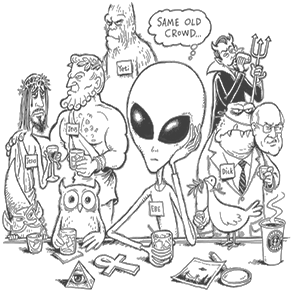
In the UFO conspiracy theory, disclosure is the revelation of suppressed evidence of extraterrestrial life by the United States government or other world governments. In 1993, ufologist Steven M. Greer founded the ‘Disclosure Project’ to promote the concept of disclosure.
In 2001, Greer held a press conference at the National Press Club in D.C that featured ’20 retired Air Force, Federal Aviation Administration and intelligence officers’ who demanded that Congress begin hearings on ‘secret U.S. involvement with UFOs and extraterrestrials’ and was described by an attending BBC reporter as ‘the strangest ever news conference hosted by Washington’s August National Press Club.’ Such arguments were met with by derision by skeptics and spokespeople for the U. S. Air Force who maintain that there is no convincing evidence for the speculation that UFOs are alien spacecraft.
read more »
Posted in Humor, Politics |
Leave a Comment »



