May 20, 2013
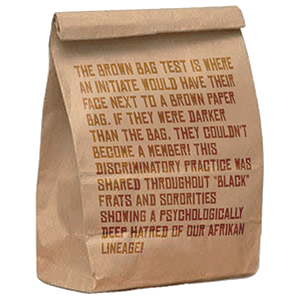
Paper bag parties are African-American social events at which only individuals with complexions at least as light as the color of a brown paper bag were admitted.
Hosts at many churches, fraternities and nightclubs would take a brown paper bag and hold it against a person’s skin. People whose skin was not lighter than a brown paper bag were denied entry The term also refers to larger issues of class and caste within the African-American population.
read more »
Posted in Politics |
Leave a Comment »
May 20, 2013
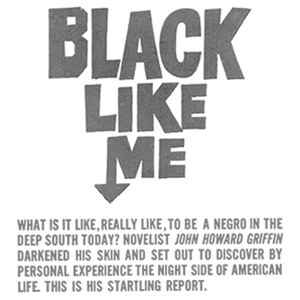
Racial passing refers to a person classified as a member of one racial group attempting to be accepted as a member of a different racial group.
The term was used especially in the U.S. to describe a person of mixed-race heritage assimilating into the white majority during times when legal and social conventions of hypodescent classified the person as a minority, subject to racial segregation and discrimination.
read more »
Posted in Politics, World |
Leave a Comment »
May 17, 2013

When a person receives unfair treatment or alienation due to a social stigma, the effects can be detrimental. Social stigmas are defined as any aspect of an individual’s identity that is devalued in a social context. These stigmas can be categorized as visible or invisible, depending on whether the stigma is readily apparent to others. Visible stigmas refer to characteristics such as race, age, gender, physical disabilities, or deformities; whereas invisible stigmas refer to characteristics such sexual orientation, gender identity, religious affiliation, early pregnancy, certain diseases, or mental illnesses.
When individuals possess invisible stigmas, they must decide whether or not to reveal their association with a devalued group to others. This decision can be an incredibly difficult one, as revealing one’s invisible stigma can have both positive and negative consequences depending on several situational factors. In contrast, a visible stigma requires immediate action to diminish communication tension and acknowledge a deviation from the norm. People possessing visible stigmas often use compensatory strategies to reduce potential interpersonal discrimination that they may face.
read more »
Posted in Health, Money, Politics |
Leave a Comment »
May 14, 2013
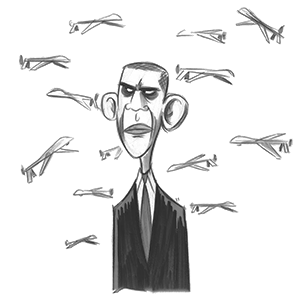
The Disposition Matrix is a database that United States officials describe as a ‘next-generation capture/kill list’ developed by the Obama Administration beginning in 2010. It is a blueprint for tracking, capturing, rendering, or killing terrorism suspects. It is intended to become a permanent fixture of American policy. The process determining criteria for killing is not public, but has been heavily shaped by presidential counterterrorism adviser John Brennan.
Under the Presidency of George W. Bush, Brennan served as top aide to CIA director George Tenet, where he defended the administration’s use of extraordinary rendition and enhanced interrogation, also described as torture. Brennan’s association with the CIA’s interrogation program was controversial, and forced him to withdraw his candidacy for directorship of the CIA or National Intelligence in 2008.
read more »
Posted in Death, Politics, War |
1 Comment »
May 14, 2013

‘The Constitution is not a suicide pact‘ is a phrase in American political and legal discourse which expresses the belief that constitutional restrictions on governmental power must be balanced against the need for survival of the state and its people. It is most often attributed to Abraham Lincoln, as a response to charges that he was violating the United States Constitution by suspending habeas corpus (the right of detainees to contest their imprisonment) during the American Civil War.
Although the phrase echoes statements made by Lincoln, and although versions of the sentiment have been advanced at various times in American history, the precise phrase ‘suicide pact’ was first used by Justice Robert H. Jackson in his dissenting opinion in ‘Terminiello v. Chicago,’ a 1949 free speech case. The phrase also appears in the same context in ‘Kennedy v. Mendoza-Martinez,’ a 1963 U.S. Supreme Court decision written by Justice Arthur Goldberg.
read more »
Posted in Death, Politics, War |
Leave a Comment »
May 7, 2013
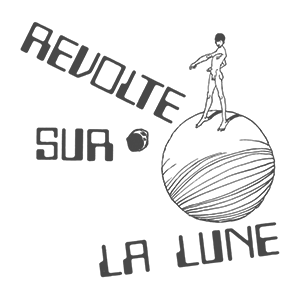
Libertarian science fiction is a sub-genre of science fiction that focuses on the politics and social order implied by libertarian philosophies with an emphasis on individualism and a limited state—and in some cases, no state whatsoever.
As a category, libertarian fiction is unusual because the vast majority of its authors are self-identified as science fiction authors. This contrasts with the authors of much other social criticism who are largely academic or mainstream novelists who tend to dismiss any genre classification.
read more »
Posted in Language, Politics, Science |
Leave a Comment »
May 7, 2013

Social science fiction is a subgenre of science fiction concerned less with technology and space opera and more with sociological speculation about human society. In other words, it ‘absorbs and discusses anthropology,’ and speculates about human behavior and interactions.
Exploration of fictional societies is a significant aspect of science fiction, allowing it to perform predictive (H. G. Wells, ‘The Final Circle of Paradise’) and precautionary (Ray Bradbury, ‘Fahrenheit 451’) functions, to criticize the contemporary world (Russian author Alexander Gromov’s ‘Antarctica-online’ ) and to present solutions (B.F. Skinner’s ‘Walden Two’), to portray alternative societies (World of the Noon, a fictional future setting for a number of hard science fiction novels written by Arkady and Boris Strugatsky) and to examine the implications of ethical principles (the works of Russian science fiction author Sergei Lukyanenko).
read more »
Posted in Politics, Science |
1 Comment »
May 7, 2013

Walden Two is a utopian novel written by behavioral psychologist B. F. Skinner, first published in 1948. In its time, it could have been considered to be science fiction, since science-based methods for altering people’s behavior did not yet exist. (Such methods exist now and are known as applied behavior analysis, formerly behavior modification).
‘Walden Two’ is controversial because it includes a rejection of free will, the proposition that human behavior is controlled by a non-corporeal entity, such as a spirit or a soul. The book embraces the proposition that the behavior of organisms, including humans, is determined by genetic and environmental variables, and that systematically altering environmental variables can generate a sociocultural system that very closely approximates utopia.
read more »
Posted in Language, Politics, Science |
Leave a Comment »
May 7, 2013

The term Dumbing down describes the deliberate diminishment of the intellectual level of the content of schooling and education, of literature and cinema, and of news and culture. The idea of and the term dumbing down originated in 1933 as slang, used by motion picture screenplay writers, to mean: ‘revise so as to appeal to those of little education or intelligence.’ Sociologist Pierre Bourdieu noted cultural capital as a means of social mobility, which is diminished by the processes of dumbing down.
The occurrences of dumbing down vary in nature, according to the subject matter under discussion and the purpose of the simplifier, but the dumbing-down usually involves the over-simplification of critical thought to the degree of conceptually undermining the intellectual standards of language and of learning of a society; by such simplistic means the writer and the speaker justifies the trivialization of cultural, artistic, and academic standards, as in the case of popular culture.
read more »
Posted in Education, Language, Politics |
Leave a Comment »
May 7, 2013

The subject of the damsel in distress, or persecuted maiden, is a classic theme in world literature, art, film and video games. She is usually a beautiful young woman placed in a dire predicament by a villain or monster and who requires a hero to achieve her rescue. She has become a stock character of fiction, particularly of melodrama.
Though she is usually human, she can also be of any other species, including fictional or folkloric species; and even divine figures such as an angel or deity. The word ‘damsel’ derives from the French ‘demoiselle,’ meaning ‘young lady,’ and the term ‘damsel in distress’ in turn is a translation of the French ‘demoiselle en détresse.’
read more »
Posted in Language, Politics, Sex |
1 Comment »
May 6, 2013

Escapism is mental diversion by means of entertainment or recreation, as an ‘escape’ from the perceived unpleasant or banal aspects of daily life. It can also be used as a term to define the actions people take to help relieve persisting feelings of depression or general sadness.
Entire industries have sprung up to foster a growing tendency for people to remove themselves from the rigors of daily life. Many activities that are normal parts of a healthy existence (e.g., eating, sleeping, exercise, sexual activity) can also become avenues of escapism when taken to extremes or out of proper context.
read more »
Posted in Health, Politics |
1 Comment »
May 2, 2013

The phrases ‘no homo‘ and ‘pause’ are slang terms. They parenthetically assert that the speaker of such does not have any homosexual intent and are usually used after an utterance that may have given that impression. The term originated in East Harlem slang of the early 1990s.
It was used by many to distance themselves from the stereotype of closeted gay and bisexual men. Several social commentators have criticized the use of both ‘no homo’ and ‘pause’ in hip hop and in the mainstream. It has been said that the phrases, ‘uphold an unhealthy relationship with homosexuality, a relationship based in fear.’ Fox News commentator Marc Lamont Hill encouraged the hip-hop community to stop using the terms.
read more »
Posted in Language, Politics, Sex |
Leave a Comment »


 The Daily Omnivore