April 29, 2013

An angry white male (AWM) is a pejorative reference to someone with what is typically known as a traditional conservative viewpoint, especially in the context of U.S. politics, characterized by opposition to racial quotas, political correctness, affirmative action, and other liberal policies.
The movies ‘Joe,’ ‘Falling Down,’ and Clint Eastwood’s performances in both the ‘Dirty Harry’ series and ‘Gran Torino’ have been described as definitive explorations of the angry white male. The protagonist of ‘Falling Down,’ a former defense worker who descends into a spiral of increasing rage and violence, was widely reported upon as a representative of the stereotype.
Posted in Language, Politics |
Leave a Comment »
April 29, 2013

First World privilege, similar to white privilege and male privilege, is the unearned advantages accrued by an individual by virtue of being a national of a First World country.
The concept is important for those considering advantages gained, due to institutional beliefs, prejudice and legal barriers, because of one’s nationality rather than one’s race or sex. Countries included in the first world class include Australia, Britain, Canada, New Zealand, United States, Japan and Western Europe.
read more »
Posted in Money, Politics, World |
Leave a Comment »
April 29, 2013

Reverse discrimination is discrimination against members of a dominant or majority group or in favor of members of a minority or historically disadvantaged group. Groups may be defined in terms of race, gender, ethnicity, or other factors.
This discrimination may seek to redress social inequalities where minority groups have been denied access to the same privileges of the majority group. In such cases it is intended to remove discrimination that minority groups may already face. Reverse discrimination may also be used to highlight the discrimination inherent in affirmative action programs.
read more »
Posted in Money, Politics, Sex |
Leave a Comment »
April 29, 2013
Reverse racism is a term which refers to racial prejudice or discrimination directed against members of one’s own race. The term came into use as the struggle for African-American rights divided the white community.
In 1966, Hosea Williams of the Southern Christian Leadership Conference (SCLC), publicly accused members of the Student Nonviolent Coordinating Committee (SNCC) of reverse racism in their efforts to exclude or expel whites from local government in Alabama to make room for blacks. Williams argued that SNCC’s (unsuccessful) ‘all-black’ campaign in Alabama would drive white moderates out of the civil rights movement. ‘Black racism’ was a more common term in this era, used to describe SNCC and groups like the Black Panthers.
read more »
Posted in Language, Politics, World |
2 Comments »
April 29, 2013

Whiteness studies is an interdisciplinary arena of academic inquiry focused on the cultural, historical and sociological aspects of people identified as ‘white,’ and the social construction of ‘whiteness’ as an ideology tied to social status. By the mid-1990s, numerous works across many disciplines analyzed whiteness, and it has since become a topic for academic courses, research and anthologies.
Pioneers in the field include W. E. B. Du Bois (‘Jefferson Davis as a Representative of Civilization,’ 1890), James Baldwin (‘The Fire Next Time,’ 1963), Ruth Frankenberg (‘White Women, Race Matters: The Social Construction of Whiteness,’ 1993), author and literary critic Toni Morrison (‘Playing in the Dark: Whiteness and the Literary Imagination,’ 1992) and historian David Roediger (‘The Wages of Whiteness,’ 1991).
read more »
Posted in Education, Politics, World |
Leave a Comment »
April 29, 2013

White guilt is the individual or collective guilt felt by white people for the racist treatment of people of color by whites both historically and presently. The term is generally used in a pejorative way (and in a partisan fashion within American political circles).
White guilt has been cited by some conservatives and libertarians as a way for liberals and others to induce white Americans to support the policies of affirmative action and redistribution of wealth. White guilt has been described as one of several psychosocial costs of racism for white individuals along with the ability to have empathic reactions towards racism, and fear of non-whites.
read more »
Posted in Politics, World |
Leave a Comment »
April 26, 2013
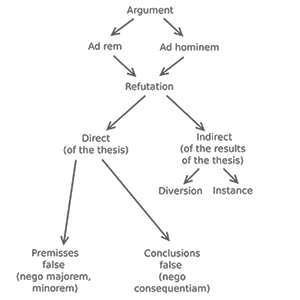
‘The Art of Being Right: 38 Ways to Win an Argument’ (1831) is an acidulous (biting) treatise written by the German philosopher Arthur Schopenhauer in sarcastic deadpan. He examines a total of thirty-eight methods of showing up one’s opponent in a debate. Schopenhauer introduces his essay with the idea that philosophers have concentrated in ample measure on the rules of logic, but have not (especially since the time of Immanuel Kant) engaged with the darker art of the dialectic, of controversy.
Whereas the purpose of logic is classically said to be a method of arriving at the truth, dialectic, says Schopenhauer, ‘…on the other hand, would treat of the intercourse between two rational beings who, because they are rational, ought to think in common, but who, as soon as they cease to agree like two clocks keeping exactly the same time, create a disputation, or intellectual contest.’
read more »
Posted in Humor, Language, Politics |
1 Comment »
April 26, 2013

An argument from ignorance, also known as ‘argumentum ad ignorantiam’ or ‘appeal to ignorance’ (where ‘ignorance’ stands for: ‘lack of evidence to the contrary’), is an inference that a proposition is false based on the absence of evidence.
For example, a man sitting in a warehouse with a tin roof can assume that it is not raining if he doesn’t hear rain drops without looking outside for any evidence of rain. Here ignorance about a particular form of evidence for rain (the noise) is used to assume a lack of rain; but the conclusion may fail if it is raining so softly that no noise is heard by the man, or if his hearing is impaired, etc.
read more »
Posted in Language, Philosophy, Politics |
Leave a Comment »
April 24, 2013

The Big Lie is a propaganda technique. The expression was coined by Adolf Hitler, when he dictated his 1925 book ‘Mein Kampf,’ about the use of a lie so ‘colossal’ that no one would believe that someone ‘could have the impudence to distort the truth so infamously.’
Hitler asserted the technique was used by Jews to unfairly blame Germany’s loss in World War I on German Army officer Erich Ludendorff.
read more »
Posted in Language, Politics, War |
Leave a Comment »
April 19, 2013
A hater is a person who expresses hatred in public forums, especially those found on the Internet such as YouTube. Haters are distinguished from trolls who seek to attract attention by making provocative comments.
Haters may become organized into groups and the seven stage model of hate crime developed by Schafer and Navarro for the FBI may explain their behavior: 1) the hater finds other with similar views to form a group; 2) the group develops symbols and rituals to identify itself; 3) the group shares its views to bond; 4) the target is taunted; 5) the target is attacked; 6) the target is attacked with weapons; and 7) the target is destroyed.
Posted in Language, Politics |
Leave a Comment »
April 16, 2013
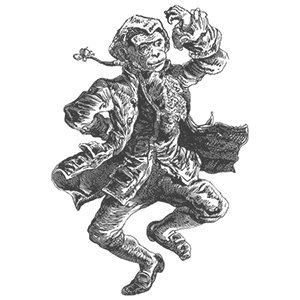
Signifyin’ (vernacular) is a practice in African-American culture, involving a verbal strategy of indirection that exploits the gap between the denotative and figurative meanings of words. According to African-American literary scholar Henry Louis Gates Jr., the practice derived from the Trickster archetype found in much African mythology, folklore, and religion: a god, goddess, spirit, man, woman, or anthropomorphic animal who plays tricks or otherwise disobeys normal rules and societal norms. In practice, signifyin’ often takes the form of quoting from subcultural vernacular, while extending the meaning at the same time through a rhetorical figure.
The expression itself derives from the numerous tales about the Signifying Monkey, a folk trickster figure said to have originated during slavery in the United States. In most of these narratives, the Monkey manages to dupe the powerful Lion by signifying. Signifyin(g) directs attention to the connotative, context-bound significance of words, which is accessible only to those who share the unique cultural values of a given speech community.
read more »
Posted in Humor, Language, Politics |
Leave a Comment »
April 15, 2013
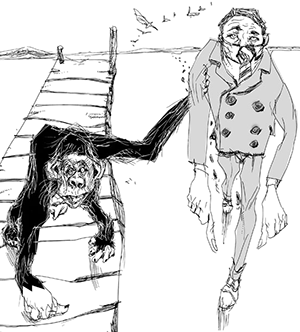
‘The Signifying Monkey: A Theory of African-American Literary Criticism’ is a work of literary criticism and theory by American scholar Henry Louis Gates Jr. first published in 1988. The book traces the folkloric origins of the African-American cultural practice of ‘signifying” and uses the concept to analyze the interplay between texts of prominent African American writers, specifically Richard Wright, Ralph Ellison, Zora Neale Hurston and Ishmael Reed.
Signifyin(g) is closely related to double-talk and trickery of the type used by the Monkey of these narratives, but, as Gates himself admits, ‘It is difficult to arrive at a consensus of definitions of signifyin(g).’ Bernard W. Bell defines it as an ‘elaborate, indirect form of goading or insult generally making use of profanity.’ Roger D. Abrahams writes that to signify is ‘to imply, goad, beg, boast by indirect verbal or gestural means.’ Signifyin(g) is a homonym with the concept of signification put forth by Semiotician Ferdinand de Saussure wherein the signifier (sound image) interacts with the signified (concept) to form one whole linguistic sign. Gates plays off this homonym and incorporates the linguistic concept of signifier and signified with the vernacular concept of signifyin(g).
read more »
Posted in Humor, Language, Politics |
Leave a Comment »



