February 5, 2013
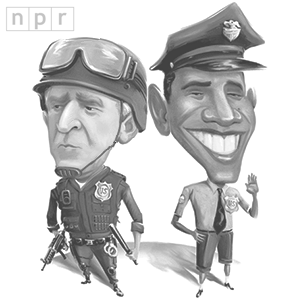
Pax Americana (Latin: ‘American Peace’) is a term applied to the historical concept of relative peace in the Western Hemisphere and later the Western world resulting from the preponderance of power enjoyed by the United States beginning around the start of the 20th century. Although the term finds its primary utility in the later half of the 20th century, it has been used in various places and eras, such as the post-Civil War era in North America and globally during the time between the World Wars.
Pax Americana is primarily used in its modern connotations to refer to the peace established after the end of World War II in 1945. In this modern sense, it has come to indicate the military and economic position of the United States in relation to other nations. The term derives from and is inspired by the Pax Romana of the Roman Empire, the Pax Britannica of the British Empire, and the Pax Mongolica of the Mongol Empire.
read more »
Posted in Politics, War, World |
Leave a Comment »
February 5, 2013
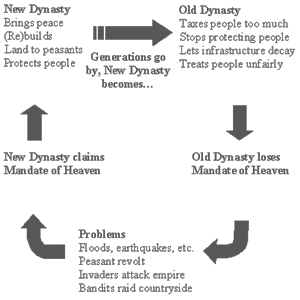
Social cycle theories are among the earliest social theories in sociology. Unlike the theory of social evolutionism, which views the evolution of society and human history as progressing in some new, unique direction(s), sociological cycle theory argues that events and stages of society and history are generally repeating themselves in cycles. Such a theory does not necessarily imply that there cannot be any social progress. In the early theory of ancient Chinese historian Sima Qian and the more recent theories of long-term (‘secular’) political-demographic cycles as well as in the Varnic theory of 20th century Indian philosopher P.R. Sarkar an explicit accounting is made of social progress.
The interpretation of history as repeating cycles of Dark and Golden Ages was a common belief among ancient cultures. The more limited cyclical view of history defined as repeating cycles of events was put forward in the academic world in the 19th century in historiosophy (a branch of historiography) and is a concept that falls under the category of sociology. However, Polybius, Ibn Khaldun, and Giambattista Vico can be seen as precursors of this analysis. The Saeculum (a length of time roughly equal to the potential lifetime of a person or the equivalent of the complete renewal of a human population) was identified in Roman times.
read more »
Posted in Politics, Science, World |
Leave a Comment »
February 5, 2013
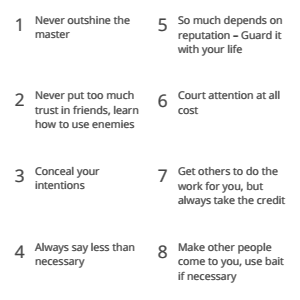
‘The 48 Laws of Power‘ (2000) is the first book by American author Robert Greene. The book, an international bestseller, is a practical guide for anyone who wants power, observes power, or wants to arm himself against power, and is popular with famous rappers, entrepreneurs, celebrities, athletes and actors including 50 Cent, Jay-Z, Kanye West, Dov Charney, Brian Grazer, Chris Bosh, and Will Smith. ‘The 48 Laws of Power’ is taught in business management classes and is one of the most requested books in American prison libraries.
The 48 Laws of Power are a distillation of 3,000 years of the history of power, drawing on the lives of strategists and historical figures like Niccolò Machiavelli, Sun Tzu, Carl von Clausewitz, Queen Elizabeth I, Henry Kissinger, and P.T. Barnum. The book is intended to show people how to gain power, preserve it, and defend themselves against power manipulators.
read more »
Posted in Language, Money, Politics |
Leave a Comment »
February 3, 2013

Sentiocentrism [sen-tee-oh-sen-triz-uhm] is the belief that sentient individuals are the center of moral concern; all and only sentient beings (animals that feel, including humans) have intrinsic value and moral standing; the rest of the natural world has instrumental value. Both humans and other sentient animals have rights and/or interests that must be considered.
The sentiocentrists consider the discrimination of sentient beings of other species to be speciesism, an arbitrary discrimination. Therefore, the coherent sentiocentrism means taking into consideration and respect all sentient animals, and often living a vegan lifestyle. The utilitarian criterion of moral standing is, therefore, all and only sentient beings (sentiocentrism).
read more »
Posted in Philosophy, Politics |
Leave a Comment »
February 3, 2013

In political theory and theology, to immanentize [im-uh-nuhnt-ize] the eschaton [ess-cah-ton] means trying to bring about the eschaton (the final, heaven-like stage of history) in the immanent world. It has been used by conservative critics as a pejorative reference to certain utopian projects, such as socialism, communism, and transhumanism. In all these contexts it means ‘trying to make that which belongs to the afterlife happen here and now (on Earth)’ or ‘trying to create heaven here on Earth.’
According to conservative columnist Jonah Goldberg, writing in ‘National Review Online’: ‘In modern parlance, the phrase was coined by Eric Voegelin in The New Science of Politics in 1952. In the 1950s and 1960s, thanks largely to William F. Buckley’s popularization of the phrase, Young Americans for Freedom turned it into a political slogan.’ Buckley was the most notable of many US conservative readers of Voegelin’s work. Voegelin, a German-born American political philosopher, identified a number of similarities between ancient Gnosticism and the beliefs held by a number of modernist political theories, particularly Communism and Nazism.
read more »
Posted in Philosophy, Politics, Technology |
Leave a Comment »
January 31, 2013
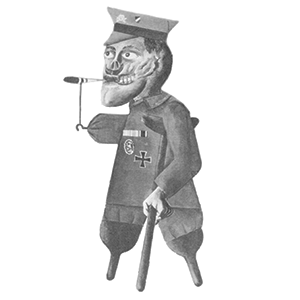
Degenerate [dih-jen-er-it] art is the English translation of the German ‘entartete Kunst,’ a term adopted by the Nazi regime in Germany to describe virtually all modern art. Such art was banned on the grounds that it was un-German or Jewish Bolshevist in nature, and those identified as degenerate artists were subjected to sanctions. These included being dismissed from teaching positions, being forbidden to exhibit or to sell their art, and in some cases being forbidden to produce art entirely.
‘Degenerate Art’ was also the title of an exhibition, mounted by the Nazis in Munich in 1937, consisting of modernist artworks chaotically hung and accompanied by text labels deriding the art. Designed to inflame public opinion against modernism, the exhibition subsequently traveled to several other cities in Germany and Austria. While modern styles of art were prohibited, the Nazis promoted paintings and sculptures that were traditional in manner and that exalted the ‘blood and soil’ values of racial purity, militarism, and obedience. Similarly, music was expected to be tonal and free of any jazz influences; films and plays were censored.
read more »
Posted in Art, Politics, War |
Leave a Comment »
January 30, 2013
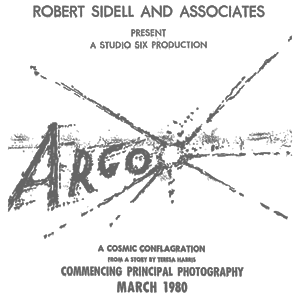
The ‘Canadian Caper‘ was the popular name given to the joint covert rescue by the Canadian government and the Central Intelligence Agency of six American diplomats who had evaded capture during the seizure of the United States embassy in Tehran, and taking of embassy personnel as hostages by Islamist students and militants on November 4, 1979.
The ‘caper’ involved CIA agents (Tony Mendez and a man known as ‘Julio’) joining the six diplomats to form a fake film crew made up of six Canadians, one Irishman and one Latin American who were finished scouting for an appropriate location to shoot a scene for the notional sci-fi film ‘Argo.’ The charade was carried off on the morning of Monday, January 28, 1980, at the Mehrabad Airport in Tehran. The eight Americans successfully boarded a Swissair flight to Zurich, Switzerland, and escaped Iran.
read more »
Posted in Politics, War, World |
Leave a Comment »
January 30, 2013
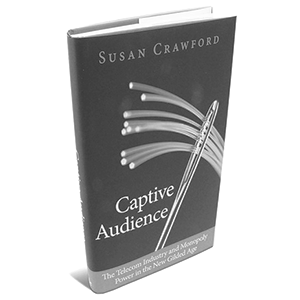
Susan P. Crawford (b. 1963) is a professor at the Benjamin N. Cardozo School of Law. She has served as President Barack Obama’s Special Assistant for Science, Technology, and Innovation Policy (2009) and is a columnist for ‘Bloomberg View.’
She is a former Board Member of ICANN (which regulates the Internet), the founder of OneWebDay (an annual day of Internet celebration and awareness held on September 22), and a legal scholar. Her research focuses on telecommunications and information law.
read more »
Posted in Money, Politics, Technology |
Leave a Comment »
January 28, 2013

Security through obscurity is a pejorative referring to a principle in security engineering, which attempts to use secrecy of design or implementation to provide security. A system relying on security through obscurity may have theoretical or actual security vulnerabilities, but its owners or designers believe that if the flaws are not known, then attackers will be unlikely to find them. The technique stands in contrast with security by design and open security, although many real-world projects include elements of several strategies.
Security through obscurity has never achieved engineering acceptance as an approach to securing a system, as it contradicts the principle of ‘keeping it simple.’ The United States National Institute of Standards and Technology (NIST) specifically recommends against security through obscurity in more than one document. Quoting from one, ‘System security should not depend on the secrecy of the implementation or its components.’
read more »
Posted in Politics, Technology, War |
Leave a Comment »
January 28, 2013

The First law of holes is a proverb attributed to British politician Denis Healey. It states, ‘If you find yourself in a hole, stop digging.’
The meaning behind this proverb is that if you find yourself in an undesirable situation (‘the hole’), such as an argument with others, you should not ignore the situation or attempt to continue what you were doing (the ‘digging’), as it can make the situation worse. It has been cited numerous times by other politicians and in books.
Posted in Humor, Language, Politics |
Leave a Comment »
January 25, 2013
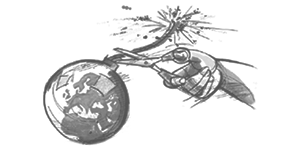

Torture has been used throughout history to force individuals to divulge vital information. It’s effectiveness is highly controversial, and some who oppose its use argue that it is violent, horrific, and useless.
On the subject, Ali Soufan, a former FBI agent and an expert on al-Qaeda operation says the following ‘Time and time again, people with actual experience with interrogating terror suspects and actual experience and knowledge about the effectiveness of torture techniques have come out to explain that they are ineffective and that their use threatens national security more than it helps.’ Whilst Prof. Dershowitz, a person morally opposed to torture, says that he believes law enforcement officials will employ torture in ‘ticking bomb’ cases, an article by Dr. Marvin Zalman says that ‘the problem is that the ‘ticking bomb’ scenario is a myth.’
read more »
Posted in Politics, War |
Leave a Comment »
January 22, 2013

A microexpression is a brief, involuntary facial expression made in reaction to an emotion. They usually occur in high-stakes situations, where people have something to lose or gain. Microexpressions occur when a person is consciously trying to conceal all signs of how he or she is feeling, or when a person does not consciously know how he or she is feeling. Unlike regular facial expressions, it is difficult to hide microexpression reactions. Microexpressions express the seven universal emotions: disgust, anger, fear, sadness, happiness, surprise, and contempt.
Nevertheless, in the 1990s, pyschologist Paul Ekman expanded his list of basic emotions, including a range of positive and negative emotions not all of which are encoded in facial muscles. These emotions are amusement, contempt, embarrassment, excitement, guilt, pride, relief, satisfaction, pleasure, and shame. They are very brief in duration, lasting only 1/25 to 1/15 of a second.
read more »
Posted in Health, Politics, Science |
1 Comment »


 The Daily Omnivore