December 10, 2012
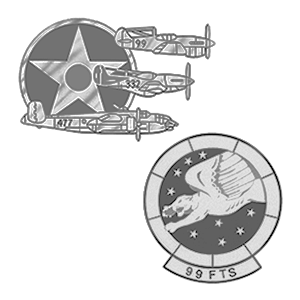
The Tuskegee [tuhs-kee-gee] Airmen is the popular name of a group of African-American pilots who fought in World War II. During World War II, African Americans in many U.S. states were still subject to discriminatory Jim Crow laws. The American military was racially segregated, as was the federal government. The Tuskegee Airmen were treated with prejudice both within and outside the army. Despite these adversities, they trained and flew with distinction. The Fighter Group saw action in Sicily and Italy, before being deployed as bomber escorts in Europe, where they were very successful.
The Tuskegee Airmen initially were equipped with Curtiss P-40 Warhawks fighter-bomber aircraft, briefly with Bell P-39 Airacobras, later with Republic P-47 Thunderbolts, and finally with the aircraft with which they became most commonly associated, the North American P-51 Mustang. When the pilots painted the tails of their P-47s and later, P-51s, red, the nickname ‘Red Tails’ was coined. Bomber crews applied a more effusive ‘Red-Tail Angels’ sobriquet. A B-25 bomb group, was forming in the U.S., but was not able to complete its training in time to see action.
read more »
Posted in Politics, War |
1 Comment »
December 5, 2012
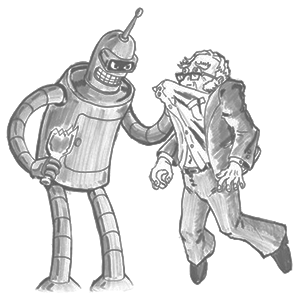
The Three Laws of Robotics are a set of rules devised by the science fiction author Isaac Asimov. The rules were introduced in his 1942 short story ‘Runaround,’ although they had been foreshadowed in a few earlier stories.
The Three Laws are: ‘A robot may not injure a human being or, through inaction, allow a human being to come to harm; A robot must obey the orders given to it by human beings, except where such orders would conflict with the First Law; and A robot must protect its own existence as long as such protection does not conflict with the First or Second Laws. These form an organizing principle and unifying theme for Asimov’s robotic-based fiction, appearing in his ‘Robot’ series, the stories linked to it, and his ‘Lucky Starr’ series of young-adult fiction.
read more »
Posted in Language, Politics, Technology |
1 Comment »
December 5, 2012

The term roboethics was coined by roboticist Gianmarco Veruggio in 2002, who also served as chair of an Atleier (workshop) funded by the European Robotics Research Network to outline areas where research may be needed. The road map effectively divided ethics of artificial intelligence into two sub-fields to accommodate researchers’ differing interests:
Machine ethics is concerned with the behavior of artificial moral agents (AMAs); and Roboethics is concerned with the behavior of humans, how humans design, construct, use and treat robots and other artificially intelligent beings.
read more »
Posted in Philosophy, Politics, Technology |
Leave a Comment »
December 5, 2012
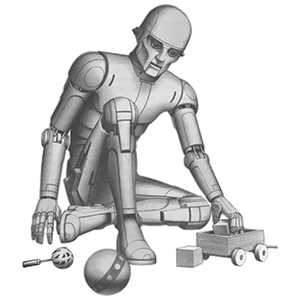
Machine Ethics is the part of the ethics of artificial intelligence concerned with the moral behavior of Artificial Moral Agents (AMAs) (e.g. robots and other artificially intelligent beings). It contrasts with roboethics, which is concerned with the moral behavior of humans as they design, construct, use and treat such beings.
In 2009, academics and technical experts attended a conference to discuss the potential impact of robots and computers and the hypothetical possibility that they could become self-sufficient and able to make their own decisions. They discussed the possibility and the extent to which computers and robots might be able to acquire any level of autonomy, and to what degree they could use such abilities to possibly pose any threat or hazard.
read more »
Posted in Philosophy, Politics, Technology |
Leave a Comment »
December 5, 2012
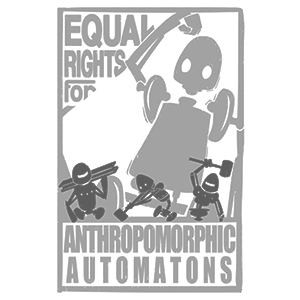
The ethics of artificial intelligence is the part of the ethics of technology specific to robots and other artificially intelligent beings. It is typically divided into Roboethics, a concern with the moral behavior of humans as they design, construct, use and treat artificially intelligent beings, and Machine Ethics, concern with the moral behavior of artificial moral agents (AMAs).
The term ‘roboethics’ was coined by roboticist Gianmarco Veruggio in 2002. It considers both how artificially intelligent beings may be used to harm humans and how they may be used to benefit humans. ‘Robot rights’ are the moral obligations of society towards its machines, similar to human rights or animal rights. These may include the right to life and liberty, freedom of thought and expression, and equality before the law.
read more »
Posted in Philosophy, Politics, Technology |
Leave a Comment »
December 4, 2012
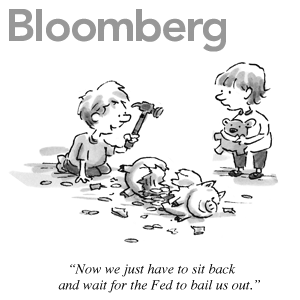
In economic theory, a moral hazard is a situation where the costs that could incur from a decision will not be felt by the party taking the risk. Knowing that the potential costs and/or burdens of taking such risk will be borne, in whole or in part, by others creates a moral hazard and invites high risk behavior.
For example, with respect to the originators of subprime loans, many may have suspected that the borrowers would not be able to maintain payments and that, for this reason, the loans were not, in the long run, going to be worth much. Still, because there were many buyers of these loans (or of pools of these loans) willing to take on that risk, the originators did not concern themselves with the potential long-term consequences of making these loans.
read more »
Posted in Money, Politics, World |
Leave a Comment »
December 4, 2012
‘Too big to fail‘ describes financial institutions that are so large and so interconnected that their failure is widely held to be disastrous to the economy, and which therefore must be supported by government when they face difficulty. The term was popularized by Congressman Stewart McKinney in a 1984 hearing discussing the FDIC’s intervention with a failing bank, Continental Illinois.
Proponents of this theory believe that the importance of some institutions means they should become recipients of beneficial financial and economic policies from governments or central banks. One of the problems that arises is moral hazard (where costs that could incur will not be felt by the party taking the risk), in this case companies insulated by protective policies will seek to profit by it, and take positions that are high-risk high-return, as they are able to leverage these risks based on the policy preference they receive.
read more »
Posted in Money, Politics |
Leave a Comment »
December 4, 2012
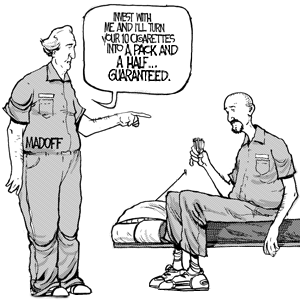
Commodity money is money whose value comes from a commodity of which it is made (e.g. precious metals, cigarettes). Unlike representative money (a certificate or token which can be exchanged for the underlying commodity) or fiat currency (money backed only by an assurance from the issuing government), commodity money consists of objects that have value in themselves as well as value in their use as money.
Examples of commodities that have been used as mediums of exchange include gold, silver, copper, peppercorns, Rai stones (large, circular stone disks carved out of limestone), decorated belts (wampum belts), shells, cigarettes, barley, laundry detergent, etc.
read more »
Posted in Money, Politics |
Leave a Comment »
December 3, 2012

Deprogramming is an attempt to force a person to abandon allegiance to a religious, political, economic, or social group. The person in question is may be taken against his/her will, which has led to controversies over freedom of religion, kidnapping, and civil rights, as well as the violence which is sometimes involved. Deprogramming is often commissioned by relatives, including parents of adult offspring, who object to someone’s membership in an organization or group.
It was started in the 1970s in the United States by Ted Patrick (widely considered to be the ‘father of deprogramming’). In addition to the ethics and legality, the efficacy of deprogramming has been questioned by scholars, as well as by members of the Christian countercult movement. Similar actions, when done without force, are called ‘exit counseling.’ Sometimes the word deprogramming is used in a wider (and/or ironic or humorous sense), to mean the freeing of someone (often oneself) from any previously uncritically assimilated idea.
read more »
Posted in Health, Philosophy, Politics |
Leave a Comment »
December 3, 2012

Mind control (also known as brainwashing, coercive persuasion, or menticide) refers to the use of unethically manipulative methods to persuade others to conform to the wishes of the manipulator(s), often to the detriment of the person being manipulated. The term has been applied to any tactic, psychological or otherwise, which can be seen as subverting an individual’s sense of control over their own thinking, behavior, emotions or decision making.
Theories of brainwashing and of mind control were originally developed to explain how totalitarian regimes appeared to succeed systematically in indoctrinating prisoners of war through propaganda and torture techniques. These theories were later expanded and modified by psychologists including Margaret Singer, to explain a wider range of phenomena, especially conversions to cults (new religious movements, NRMs). A third-generation theory proposed by sociologist Ben Zablocki focused on the utilization of mind control to retain members of NRMs.
read more »
Posted in Health, Philosophy, Politics |
1 Comment »
November 30, 2012

The South Butt, LLC was a clothing and accessories company founded in 2007 by Jimmy Winkelmann, a then 16-year-old student at Chaminade College Preparatory School. The company dissolved in 2011.
Winkelmann claimed the company was a parody of the The North Face, an American outdoor product company.
read more »
Posted in Humor, Money, Politics |
Leave a Comment »
November 29, 2012

The tragedy of the anticommons is a type of coordination breakdown, in which a single resource has numerous rightsholders who prevent others from using it, frustrating what would be a socially desirable outcome. It is a mirror-image of the older concept of tragedy of the commons, in which numerous rightsholders’ combined use exceeds the capacity of a resource and depletes or destroys it.
The concept covers a range of coordination failures including patent thickets, submarine patents, and nail houses. Overcoming these breakdowns can be difficult, but there are assorted means, including eminent domain, laches, patent pools, or other licensing organizations.
read more »
Posted in Money, Politics, Technology |
Leave a Comment »



