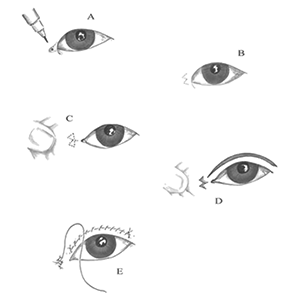
Asian blepharoplasty [blef-er-uh-plas-tee], also known as ‘double eyelid surgery,’ is a type of cosmetic surgery where the skin around the eye is reshaped. The purpose of the procedure is to create an upper eyelid with a crease (‘double eyelid’) from an eyelid that is naturally without a crease. The procedure has been a subject of controversy, and was described by opponents, such as author David Mura, as being ‘indoctrinated by white standards of beauty.’ New York based cosmetic surgeon Dr. Edward Kwak states that many patients who get the procedure done are ‘not trying to look white,’ but look like the many north and eastern Asians who naturally have an eyelid fold.
While there are some Asians with a double eyelid and some without, there is also a large variation in the crease position (double eyelid size) of the East Asian upper eyelid. The upper lid fold can range from 1 mm above the eyelash line to about 10 mm. Asian blepharoplasties have been reported to be the most common aesthetic procedure in Taiwan, South Korea, and other parts of East Asia. The procedure has been reported to have some risk of complications, but is generally quite safe if done by an expert plastic surgeon. A procedure to remove the epicanthal fold (near the tear duct) (i.e. an epicanthoplasty) is often performed in conjunction.
Asian Blepharoplasty
Vast Right-Wing Conspiracy

‘Vast right-wing conspiracy‘ was a theory advanced by then First Lady of the United States Hillary Rodham Clinton in 1998 in defense of her husband, President Bill Clinton, and his administration during the Lewinsky scandal, characterizing the Lewinsky charges as the latest in a long, organized, collaborative series of charges by Clinton’s political enemies. While popularized by Mrs. Clinton in her 1998 interview, the phrase did not originate with her.
In 1991 the ‘Detroit News’ wrote: ‘Thatcher-era Britain produced its own crop of paranoid left-liberal films. … All posited a vast right-wing conspiracy propping up a reactionary government ruthlessly crushing all efforts at opposition under the guise of parliamentary democracy.’ An AP story in 1995 also used the phrase, relating an official’s guess that the Oklahoma City bombing was the work of ‘maybe five malcontents’ and not ‘some kind of vast right-wing conspiracy.’
read more »
Trademark Dilution

Trademark dilution is a legal concept giving the owner of a famous trademark standing to forbid others from using that mark in a way that would lessen its uniqueness.
In most cases, trademark dilution involves an unauthorized use of another’s trademark on products that do not compete with, and have little connection with, those of the trademark owner. For example, a famous trademark used by one company to refer to hair care products might be diluted if another company began using a similar mark to refer to breakfast cereals.
read more »
A Moron in a Hurry


‘A moron in a hurry‘ is a hypothetical person against whom a claimant’s concern might be judged in an English law civil action for passing off or trademark infringement.
The expression is used to reject a claim that two items could reasonably be confused by a passer-by (i.e. that even a moron in a hurry would notice the difference), on the grounds that the items are so different that the goodwill and brand of the claimant’s item cannot genuinely be affected by the existence of the other.
read more »
@earth

@earth is a 2011 book made by London born (and based) photomontage artist Peter Kennard with Lebanese artist Tarek Salhany. It is a photo-essay told through photomontage with seven chapters exposing the current state of the earth, the conditions of life on it and the need to resist injustice. Apart from the title (which is also in different languages on its back cover) the pocket book contains no words and its story is told in sequences of constructed images. ‘@earth’ combines images created digitally over the past two years by Kennard with Salhany especially for the project, with Kennard’s earlier darkroom based photomontages (spanning over 40 years of work) some of which are part of the Tate Permanent Collection. They have been recontextualised for the book. The authors met whilst Kennard taught Salhany at the Byam Shaw School of Art in London.
‘@earth’ has received recognition from, amongst others, Naomi Klein (author of ‘No Logo’ and ‘The Shock Doctrine’) who has said: ‘This book perfectly captures the brutal asymmetries of our age: heavy weaponry trained on broken people, all-seeing technologies and disappearing identities, perpetually exhaling industry and an asphyxiating planet. If there’s a word that’s worth a thousand pictures, it’s ‘@earth.”
Gang Signal

A gang signal is a visual or verbal way gang members identify their affiliation. This can take many forms including slogans, tattoos or hand signs. Many of these, especially slogans and hand signs, have become part of popular culture. ‘Throwing up’ a gang sign (e.g., ‘Stacking,’ ‘walk’) with the hands is one of the most known and obvious forms of ‘claiming.’
It is used in many situations where other identifiers may not be possible or appropriate, and it can also show that a gang member is in the area to ‘do business’ as opposed to just passing through. Usually these signs are made by formation of the fingers on one or both hands to make some sort of symbol or letter. It can also serve to relay more specific information, such as what set they represent within a larger gang or in which activities they are currently taking part.
read more »
Hanna Rosin


Hanna Rosin is an American Journalist. Rosin was born in Israel and grew up in Queens, New York where her father was a taxi driver. She graduated from Stuyvesant High School in 1987. She graduated from Stanford University, and is married to ‘Slate’ editor David Plotz; they live in Washington, D.C. with their three children. She is a co-founder of ‘DoubleX,’ a women’s site connected to ‘Slate.’ She is also a writer for ‘The Atlantic.’ A character portrayed by actress Chloë Sevigny in the movie ‘Shattered Glass’ about Rosin’s colleague at ‘The New Republic,’ Stephen Glass, was loosely based on Rosin. Rosin has written a book based on her 2010 Atlantic story, ‘The End of Men.’
In the past she has specialized in writing about religious-political issues, in particular the influence of evangelical Christians on the 2004 U.S. presidential campaign. She is the author of ‘God’s Harvard: A Christian College on a Mission to Save America,’ published in 2007. Based on a ‘New Yorker’ story, the book follows several young Christians at Patrick Henry College, a new evangelical institution that teaches its students to ‘shape the culture and take back the nation.’ Rosin’s portrayals of the students are part of a larger attempt to chronicle the cultural and political history of the modern Christian right.
America

America is a 2012 studio album by American electronic musician Dan Deacon. The album cover is a photo of Lake Placid. America was recorded using both electronic sounds and live recordings.
An anechoic (echo-free) chamber was built in Baltimore to record the orchestral track ‘Rail.’ Deacon felt that electronic beats were limited by a lack of flaws; he said that he wanted the ‘slight imperfection in timing’ human musicians have.
read more »
Stuff White People Like
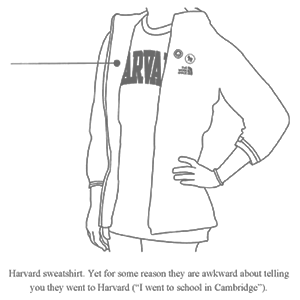
Stuff White People Like (SWPL) is a blog that takes a satirical aim at the interests of North American ‘left-leaning, city-dwelling, white folk.’ The blog was created in 2008 by a white Canadian, Christian Lander, a Los Angeles copywriter who grew up in Toronto and graduated from McGill University. Lander co-authored the site with his Filipino Canadian friend Myles Valentin, after Valentin teased Lander for watching the HBO television series ‘The Wire.’
Although the blog ‘has spurred an outpouring from those who view it as offensive and racist,’ it is not about the interests of all white people, but rather a stereotype of affluent, environmentally and socially conscious, anti-corporate white North Americans, who typically hold a degree in the liberal arts. Lander claims to be lampooning contemporary versions of bohemian/hipster culture, and jokingly refers to other classes and subcultures of white people as ‘the wrong kind of white people.’ Despite the site’s satirical edge, Lander regards the people he describes with affection and numbers himself among them, describing himself as ‘a self-aware, left-wing person who’s not afraid to recognize the selfishness and contradictions that come on the left.’
Pain in Crustaceans

The question of whether or not crustaceans can experience pain is unresolved. Because of the ambiguous nature of pain, most people who contend that crustaceans do have this capacity approach the issue using ‘argument by analogy’ – that is, they hold that certain similarities between crustacean and human biology or behaviour warrant an assumption that crustaceans can feel pain.
In vertebrates, endogenous opioids are neurochemicals that moderate pain by interacting with opioid receptors. Opioid peptides (chains of amino acids) and opioid receptors occur naturally in crustaceans, and although ‘at present no certain conclusion can be drawn,’ some have interpreted their presence as an indication that crustaceans may be able to experience pain. Lobsters’ opioids may ‘mediate pain in the same way’ as in vertebrates.
read more »
Ad Filtering

Ad filtering or ad blocking is removing or altering advertising content in a webpage. Advertising can exist in a variety of forms including pictures, animations, embedded audio and video, text, or pop-up windows. Very often it employs autoplay of audio and video.
It is a known problem with most web browsers that restoring sessions often plays multiple embedded ads at once. All browsers offer some solution to the problem, either by targeting technologies (Flash/Shockwave, Window Media files, etc.) that are used to deliver ads, targeting URLs that are the source of ads, or targeting behavior characteristic of ads (such as the use of HTML5 autoplay of both audio and video).
read more »
Commercial Skipping

Commercial skipping is an advanced feature in some digital video recorders that makes it possible to automatically skip commercials in recorded programs. This feature has created controversy, with major television networks and movie studios claiming it violates copyright and should be banned. For many years, video recorders manufactured for the Japanese market have been able to skip advertisements automatically, which is done by detecting when foreign language audio overdub tracks provided for many programs go silent, as advertisements were broadcast with a single language only.
The first DVR which had a built-in Commercial skipping feature was ReplayTV with its ‘4000 Series’ and ‘5000 Series’ units. In 2002 five owners of the ReplayTV DVR sued the main television networks and movie studios, asking the federal judge to uphold consumers’ rights to record TV shows and skip commercials claiming that features like commercial skipping help parents protect their kids from excessive consumerism. ReplayTV ended up filing for bankruptcy in 2003 after fighting a copyright infringement suit over the ReplayTV’s ability to skip commercials.
read more »


 The Daily Omnivore