April 18, 2012

A spectrum auction is a process whereby a government uses an auction system to sell the rights (licences) to transmit signals over specific bands of the electromagnetic spectrum and to assign scarce spectrum resources. Depending on the specific auction format used, a spectrum auction can last from a single day to several months from the opening bid to the final winning bid.
With a well-designed auction, resources are allocated efficiently to the parties that value them the most, the government securing revenue in the process. Spectrum auctions are a step toward market-based spectrum management, and are a way for governments to allocate scarce resources. Alternatives to auctions include administrative licensing, such as the comparative hearings conducted historically (sometimes referred to as ‘beauty contests’), or lotteries.
read more »
Posted in Money, Politics, Technology |
Leave a Comment »
April 18, 2012

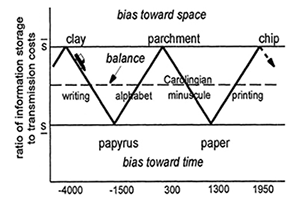
The Canadian economic historian Harold Innis developed the concept of monopolies of knowledge in his later writings on communications; they arise when ruling classes maintain political power through control of key communications technologies. In ancient Egypt, for example, a complex writing system conferred a monopoly of knowledge on literate priests and scribes. Mastering the art of writing and reading required long periods of apprenticeship and instruction, confining knowledge to this powerful class.
This theory suggests that monopolies of knowledge gradually suppress new ways of thinking. Entrenched hierarchies become increasingly rigid and out of touch with social realities. Challenges to elite power are often likely to arise on the margins of society. The arts, for example, are often seen as a means of escape from the sterility of conformist thought.
read more »
Posted in Education, Money, Politics |
Leave a Comment »
April 17, 2012

Media Consolidation is a process whereby progressively fewer individuals or organizations control increasing shares of the mass media. As of 2010, The Walt Disney Company is the largest media conglomerate in the US, with News Corporation, Time Warner, and Viacom ranking second, third and fourth respectively. Net neutrality is at stake when media mergers are occurring. Net neutrality involves a lack of restrictions on content on the internet, however, with big businesses supporting campaigns financially they tend to have influence over political issues, which can translate into their mediums.
Critics of consolidation raise the issue of whether monopolistic or oligopolistic control of a local media market can be fully accountable and dependable in serving the public interest. On the local end, reporters have often seen their stories refused or edited beyond recognition. An example would be the repeated refusal of networks to air ‘ads’ from anti-war advocates to liberal groups like MoveOn.org, or religious groups like the United Church of Christ. Journalists and their reports may be directly sponsored by parties who are the subject of their journalism leading to reports which favor the sponsor. Consequently, if the companies dominating a media market choose to suppress stories that do not serve their interests, the public suffers, since they are not adequately informed of some crucial issues that may affect them.
Posted in Money, Politics, World |
Leave a Comment »
April 17, 2012

Eric Klinenberg is an American sociologist and a scholar of urban studies, culture, and media. He is best known for his contributions as a public sociologist. He is currently Professor of Sociology, Public Policy, and Media, Culture, and Communications at New York University, as well as the editor of the journal ‘Public Culture.’ Klinenberg’s first book, ‘Heat Wave: A Social Autopsy of Disaster in Chicago,’ was published by the University of Chicago Press in 2002.
It was praised as ‘trenchant, persuasive tale of slow murder by public policy.’ Klinenberg’s second book, ‘Fighting for Air: The Battle to Control America’s Media,’ was called ‘a must-read for those who wonder what happened to good radio, accurate reporting and autonomous public interest.’ Since its publication, he has testified before the FCC and briefed Congress on his findings. His latest book, ‘Going Solo: The Extraordinary Rise and Surprising Appeal of Living Alone,’ was published in 2012.
Posted in Language, Politics, Science |
Leave a Comment »
April 17, 2012

Katie Piper (b. 1983) is a former model and television presenter from the UK. Piper had hoped to have a full-time career in the media, but in 2008 sulfuric acid was thrown in her face. The attack, which blinded Piper in one eye, was arranged by Piper’s ex-boyfriend, Daniel Lynch, and carried out by an accomplice, Stefan Sylvestre. Lynch and Sylvestre were arrested and are serving life sentences in prison for their crimes.
Surgeons removed all the skin from her face before rebuilding it with a skin substitute and then a skin graft. The procedure was the first of its kind to be completed in a single operation. In 2009, Piper chose to give up her anonymity and attempt to increase awareness about burn victims. The Channel 4 documentary ‘Katie: My Beautiful Face’ was first aired that autumn.
Posted in Health, Politics |
Leave a Comment »
April 17, 2012

Prison–industrial complex is a term used to attribute the rapid expansion of the US inmate population to the political influence of private prison companies and businesses that supply goods and services to government prison agencies. The term is analogous to the military–industrial complex that President Dwight D. Eisenhower warned of in his famous 1961 farewell address.
Such groups include corporations that contract prison labor, construction companies, surveillance technology vendors, lawyers, and lobby groups that represent them. Activists have described the prison industrial complex as perpetuating a belief that imprisonment is a quick fix to underlying social problems such as homelessness, unemployment, drug addiction, mental illness, and illiteracy.
read more »
Posted in Money, Politics |
Leave a Comment »
April 13, 2012
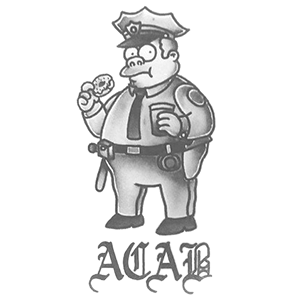
A.C.A.B. stands for ‘All Cop[per]s Are Bastards.’ Dating from at least the 1940s, and used as a slogan during the UK miners’ strike, A.C.A.B. is an abbreviation often integrated into prison tattoos in the United Kingdom, it is most commonly rendered with one letter between the knuckle and first joint of each finger, alternatively sometimes seen as symbolic small dots across each knuckle.
The British Oi! punk band, the 4-Skins, popularized the acronym in their 1980s song of the same name. It is currently in common usage as a phrase and tattoo amongst some ultras ( a type of sports fans renowned for their fanatical and elaborate displays of ‘support’) groups in Europe, particularly in Eastern Europe where most groups are more akin to hooligans than ultras.
Posted in Language, Politics, World |
Leave a Comment »
April 13, 2012

HWDP [ha-voo-de-pe] is a frequently used acronym of a Polish vulgar phrase ‘chuj w dupę policji,’ meaning literally ‘a dick up the police’s ass.’ It can be best compared to the English-language phrase ACAB (‘All Cops Are Bastards’), known in western English-language countries, painted on walls by aggressive football fans already in the 1960s. It is also commonly used as a tattoo among some of the Latino prisoners in the United States of America, who claim it stands for ‘Always Carry A Bible,’ when asked about it by the authorities. Another English counterpart of this Polish vulgar phrase is FTP, an acronym of the phrase ‘fuck the police.’
This vulgar slogan, often written on walls, is used by a part of the youth as a form of provocation against the police, but also one of its ‘trademarks.’ Writing of the HWDP characters, visible from far, is a de facto form of aggressive vandalism, which reasonably lowers the value of the flats near the marked objects. The habit of using the HWDP slogan is particularly popular amongst aggressive football fans, called pseudokibice, of the beginning of the 21st century. It is a specific expression of protest against the authorities and the entire surrounding system, although it isn’t an ideological rebellion, but instead, a characteristic sign of the additude to the surrounding reality.
Posted in Language, Politics, World |
Leave a Comment »
April 12, 2012

A stand-your-ground law states that a person may use force in self-defense when there is reasonable belief of a threat, without an obligation to retreat first. In some cases, a person may use deadly force in public areas without a duty to retreat. Under these legal concepts, a person is justified in using deadly force in certain situations and the ‘stand your ground’ law would be a defense or immunity to criminal charges and civil suit. The difference between immunity and a defense is that an immunity bars suit, charges, detention, and arrest. A defense permits a plaintiff or the state to seek civil damages or a criminal conviction.
More than half of the states in the United States have adopted the Castle doctrine, stating that a person has no duty to retreat when their home is attacked. Some states go a step further, removing the duty of retreat from any location. ‘Stand Your Ground,’ ‘Line In The Sand,’ or ‘No Duty To Retreat’ laws thus state that a person has no duty or other requirement to abandon a place in which he has a right to be, or to give up ground to an assailant. Under such laws, there is no duty to retreat from anywhere the defender may legally be. Other restrictions may still exist; when in public, a person must be carrying the firearm in a legal manner, whether concealed or openly.
read more »
Posted in Death, Politics |
Leave a Comment »
April 12, 2012

A Castle Doctrine is an American legal doctrine that designates a person’s abode (or, in some states, any place legally occupied, such as a car or place of work) as a place in which the person has certain protections and immunities and may in certain circumstances attack an intruder without becoming liable to prosecution. Typically deadly force is considered justified, and a defense of justifiable homicide applicable, in cases ‘when the actor reasonably fears imminent peril of death or serious bodily harm to himself or another.’ The doctrine is not a defined law that can be invoked, but a set of principles which is incorporated in some form in the law of most states.
The term derives from the historic English common law dictum that ‘an Englishman’s home is his castle.’ This concept was established as English law by 17th century jurist Sir Edward Coke, in his ‘The Institutes of the Laws of England’ (1628). This was carried by colonists to the New World, who later removed ‘Englishman’ from the phrase, which thereby became simply the Castle Doctrine. The term has been used to imply a person’s absolute right in England to exclude anyone from their home, although this has always had restrictions, and since the late twentieth century police have also had increasing powers of entry.
read more »
Posted in Death, Politics, World |
Leave a Comment »
April 12, 2012

Good Copy Bad Copy is a documentary about copyright and culture in the context of Internet, peer-to-peer file sharing and other technological advances, directed by Andreas Johnsen, Ralf Christensen, and Henrik Moltke. It features interviews with copyright lawyers, producers, artists, and filesharing service providers.
A central point of the documentary is that ‘creativity itself is on the line’ and that a balance needs to be struck, or that there is a conflict, between protecting the right of those who own intellectual property and the rights of future generations to create. Artists interviewed include Girl Talk and Danger Mouse, popular musicians of the mashup scene who cut and remix sounds from other songs into their own. The interviews with these artists reveal an emerging understanding of digital works and the obstacle to their authoring copyright presents.
read more »
Posted in Money, Politics, Technology |
1 Comment »
April 11, 2012

‘Free Culture: How Big Media Uses Technology and the Law to Lock Down Culture and Control Creativity’ is a 2004 book by law professor Lawrence Lessig that was released on the Internet under the Creative Commons Attribution/Non-commercial license.
The book documents how copyright power has expanded substantially since 1974 in five critical dimensions: duration (from 32 to 95 years), scope (from publishers to virtually everyone), reach (to every view on a computer), control (including “derivative works” defined so broadly that virtually any new content could be sued by some copyright holder as a ‘derivative work’ of something), and concentration and integration of the media industry.
read more »
Posted in Money, Politics, Technology |
Leave a Comment »