October 11, 2011

A Friendly Artificial Intelligence or FAI is an artificial intelligence (AI) that has a positive rather than negative effect on humanity. Friendly AI also refers to the field of knowledge required to build such an AI. This term particularly applies to AIs which have the potential to significantly impact humanity, such as those with intelligence comparable to or exceeding that of humans (e.g. superintelligence, strong AI, technological singularity).
This specific term was coined by Eliezer Yudkowsky of the Singularity Institute for Artificial Intelligence as a technical term distinct from the everyday meaning of the word ‘friendly,’ however, the concern is much older.
read more »
Posted in Politics, Technology |
Leave a Comment »
October 11, 2011
‘Why the future doesn’t need us‘ is an article written by Bill Joy (then Chief Scientist at Sun Microsystems) in the April 2000 issue of ‘Wired’ magazine. In the article, he argues (quoting the sub title) that ‘Our most powerful 21st-century technologies — robotics, genetic engineering, and nanotech — are threatening to make humans an endangered species.’ Joy warns: ‘The experiences of the atomic scientists clearly show the need to take personal responsibility, the danger that things will move too fast, and the way in which a process can take on a life of its own. We can, as they did, create insurmountable problems in almost no time flat. We must do more thinking up front if we are not to be similarly surprised and shocked by the consequences of our inventions.’
While some critics have characterized Joy’s stance as obscurantism (the practice of deliberately preventing the facts or the full details of some matter from becoming known) or neo-Luddism, others share his concerns about the consequences of rapidly expanding technology.
read more »
Posted in Money, Politics, Technology |
Leave a Comment »
October 7, 2011
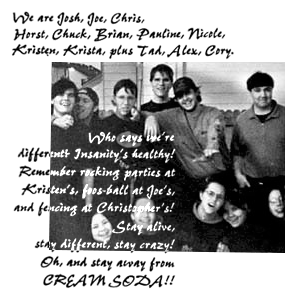
Eric Harris and Dylan Klebold were American high school seniors who committed the Columbine High School massacre. They killed 13 people and injured 24 others, before committing suicide. According to early accounts of the shooting, Harris and Klebold were very unpopular students and frequent targets of bullying at their high school. They eventually began to bully other students; writing journal entries about how they themselves had bullied younger students and ‘fags.’ Initially, the shooters were believed to be members of a clique that called themselves the Trenchcoat Mafia, a small group of Columbine’s self-styled outcasts who wore heavy black trench coats.
The Trenchcoat Mafia was originally a group of gamers who hung out together and started wearing trenchcoats after one of the members received a cowboy duster as a Christmas Gift. They adopted the name Trenchcoat Mafia after jocks began to call them that. Investigation revealed that Harris and Klebold were only friends with one member of the group, and that most of the primary members of the Trenchcoat Mafia had left the school by the time that Harris and Klebold committed the massacre. Most did not know the shooters and none were considered suspects in the shootings or were charged with any involvement in the incident.
Posted in Death, Education, Politics |
Leave a Comment »
September 28, 2011

From the late 1860s until the 1970s, several American cities had ugly laws making it illegal for persons with ‘unsightly or disgusting’ disabilities to appear in public. Some of these laws were called Unsightly Beggar Ordinances. The goal of these laws was seemingly to preserve the quality of life for the community, similar in spirit to current homeowners association regulations and by-laws: ‘No person who is diseased, maimed, mutilated or in any way deformed so as to be an unsightly or disgusting object or improper person to be allowed in or on the public ways or other public places in this city, or shall therein or thereon expose himself to public view, under a penalty of not less than one dollar nor more than fifty dollars for each offense.’
Many states’ ugly laws were not repealed until the mid 1970s. Omaha repealed its Ugly Law in 1967. Columbus withdrew its in 1972. Chicago was the last to repeal its Ugly Law as late as 1974. The recantation of Ugly Laws were tied to the passing of the Americans with Disabilities Act of 1990 where certain rights were granted to people with disabilities: ‘Individuals with disabilities are a discrete and insular minority who have been faced with restrictions and limitations, subjected to a history of purposeful unequal treatment, and relegated to a position of political powerlessness in our society, based on characteristics that are beyond the control of such individuals and resulting from stereotypic assumptions not truly indicative of the individual ability of such individuals to participate in, and contribute to, society.’
Posted in Humor, Politics |
Leave a Comment »
September 28, 2011

The Statue of Responsibility is a proposed structure to be built on the West Coast of the United States. The prototype, sculpted by project artist Gary Lee Price, consists of a pair of clasped hands oriented vertically, symbolizing the responsibility that comes with liberty. The person who suggested the statue was scholar Viktor Frankl in his book ‘Man’s Search for Meaning.’ He recommended ‘that the Statue of Liberty on the East Coast should be supplemented by a Statue of Responsibility on the West Coast.’ His thought was that ‘Freedom, however, is not the last word. Freedom is only part of the story and half of the truth. Freedom is but the negative aspect of the whole phenomenon whose positive aspect is responsibleness. In fact, freedom is in danger of degenerating into mere arbitrariness unless it is lived in terms of responsibleness.’
The project is being managed by the non-profit foundation. The project has progressed slowly, but in 2010, the Utah state legislature unanimously declared their support for the project and declared Utah (Mr. Price’s home state) the Birthplace of the Statue of Responsibility. The statue foundation would like to build it in one of five cities: Long Beach, San Diego, Los Angeles, San Francisco, or Seattle.
Posted in Art, Politics, War |
1 Comment »
September 27, 2011

An eponym [ep-uh-nim] is a word, usually a person’s name, that is used to name something else. One who is referred to as eponymous is someone who gives his or her name to something, e.g., John Schnatter, the eponymous owner of Papa John’s Pizza. A common nonstandard usage is that something eponymous is named after a particular person, e.g., Julian’s eponymous restaurant. In contemporary English, the term self-titled is often used to mean eponymous in the case of a work with the same name as the person or persons who created it (e.g., the song ‘Black Sabbath,’ from the album ‘Black Sabbath,’ by the band Black Sabbath).
In intellectual property law an eponym can refer to a genericized trademark or brand name, a form of metonymy (a figure of speech used in which a thing or concept is not called by its own name, but by the name of something intimately associated with that thing or concept — e.g. ‘Kleenex’ for all tissues).
read more »
Posted in Language, Money, Politics |
Leave a Comment »
September 27, 2011

Nazi chic refers to the approving use of Nazi-era style, imagery, and paraphernalia in clothing and popular culture, especially when used for taboo breaking or shock value rather than out of genuine nazist sympathies. Its use began in the mid-seventies with the emergence of the punk movement in London; during the Sex Pistols’ first television appearance a person of their entourage was seen wearing a swastika. Nazi chic was later appropriated by the fashion industry.
In the 1970s punk subculture, several items of clothing designed to shock and offend The Establishment became popular. Among these punk fashion items was a T-shirt displaying a Swastika, an upside-down crucifix and the word ‘DESTROY’– which was worn by Johnny Rotten, seen in the video for ‘Pretty Vacant.’ Rotten wore the swastika another time with a gesture that looked like a Nazi salute.
read more »
Posted in Art, Politics, War |
Leave a Comment »
September 22, 2011

Michael Murdock (b. 1946) is a televangelist and pastor of the Wisdom Center ministry based in Fort Worth, Texas. His father, J.E. Murdock, is also a pastor. Murdock was educated in LaGrange High School in Lake Charles, and in Southwestern Assemblies of God University in Waxahachie for three semesters. He received an honorary doctorate from International Seminary in Florida which is not accredited. Murdock preaches around the world and is best known for his promotion of prosperity theology, whose claim the Bible teaches that financial blessing is the will of God for Christians.
He often preaches with Benny Hinn and has also preached with Tammy Faye Bakker. Additionally, he hosts the Wisdom Keys with Mike Murdock television program. Mike Murdock preached his first public sermon at the age of eight and began full-time evangelism at the age of 19. Murdock receives hundreds of invitations to speak in churches, colleges, and business corporations. He has a weekly television program, Wisdom Keys with Mike Murdock. Murdock is a Founding Trustee on the Board of International Charismatic Ministries along with the late Dr. Oral Roberts.
read more »
Posted in Money, Philosophy, Politics |
Leave a Comment »
September 22, 2011

Nymwars is the name given to the conflicts over policies mandating that users of internet service identify using real names. They began in the summer of 2011 when nascent social networking site Google+ began enforcing such a policy by suspending the accounts of users it deemed in breach. Pseudonyms, nicknames, and non-standard real names (for example, mononyms or names that include scripts from multiple languages) have all been blocked.
The term was coined from ‘pseudonym’ and appears to have gained prominence as the hashtag ‘#nymwars’ on Twitter. The resulting discussions has raised many issues regarding naming, cultural sensitivity, public and private identity, and the role of social media in modern discourse. At the time of launch, the site’s user content and conduct policy stated, ‘To help fight spam and prevent fake profiles, use the name your friends, family or co-workers usually call you.’
read more »
Posted in Money, Politics, Technology |
2 Comments »
September 22, 2011

The Jolly Roger is any of various flags flown to identify a ship’s crew as pirates. The flag most usually identified as the Jolly Roger today is the skull and crossbones, a flag consisting of a human skull above two long bones set in an x-mark arrangement on a black field. This design was used by several pirates, including Captains Edward England and John Taylor. Some Jolly Roger flags also include an hourglass, another common symbol representing death in 17th- and 18th-century Europe. Despite its prominence in popular culture, plain black flags were often employed by most pirates of that era. Historically, the flag was flown to frighten pirates’ victims into surrendering without a fight, since it conveyed the message that the attackers were outlaws who would not consider themselves bound by the usual rules of engagement—and might, therefore, slaughter those they defeated (since captured pirates were usually hanged, they did not have much to gain by asking quarter if defeated). The same message was sometimes conveyed by a red flag.
It is assumed by most that the name Jolly Roger comes from the French words jolie rouge, meaning ‘pretty red’ and referring to a plain red flag which was flown to indicate that the ship would fight to the death, with no quarter given or expected. During the Elizabethan era ‘Roger’ was a slang term for beggars and vagrants who ‘pretended scholarship.’ ‘Sea Beggars’ had been a popular name for Dutch privateers since the 16th century. Another theory states that Jolly Roger is an English corruption of Ali Raja, supposedly a 17th century Tamil pirate. Yet another theory is that it was taken from a nickname for the devil, ‘Old Roger.’ The ‘jolly’ appellation may be derived from the apparent grin of a skull.
Posted in Death, Politics, War |
1 Comment »
September 21, 2011

Transparency International (TI) is a non-governmental organization that monitors and publicizes corporate and political corruption in international development. It publishes an annual Corruption Perceptions Index, a comparative listing of corruption worldwide. The headquarters is located in Berlin, Germany but operates through more than 70 national chapters around the world.
TI was founded in 1993 through the initiative of Peter Eigen, a former regional director for the World Bank. In 1995, TI developed the Corruption Perceptions Index (CPI). The CPI ranked nations on the prevalence of corruption within each country, based upon surveys of business people. The CPI was subsequently published annually. It was criticized for poor methodology and unfair treatment of developing nations, while also being praised for highlighting corruption and embarrassing governments.
read more »
Posted in Money, Politics, World |
Leave a Comment »
September 15, 2011

Lewis Hine (1874 – 1940) was an American sociologist and photographer. Hine used his camera as a tool for social reform. His photographs were instrumental in changing the child labor laws in the United States. Born in Oshkosh, Wisconsin in 1874. After his father died in an accident, he began working and saved his money for a college education.
Hine studied sociology at the University of Chicago, Columbia University and New York University. He became a teacher in New York City at the Ethical Culture School, where he encouraged his students to use photography as an educational medium. The classes traveled to Ellis Island in New York Harbor, photographing the thousands of immigrants who arrived each day. Between 1904 and 1909, Hine took over 200 plates (photographs), and eventually came to the realization that his vocation was photojournalism.
read more »
Posted in Money, Politics, Science |
Leave a Comment »



 The Daily Omnivore