October 18, 2011


Borf was a graffiti campaign seen in and around Washington, D.C. during 2004 and 2005, carried out by John Tsombikos while studying at the Corcoran College of Art and Design. This four letter word was ubiquitous around the Northwest quadrant of Washington, and ranged from simple tagging to complete sentences to two-color stencils to the massive defacement on an overhead exit sign from the Theodore Roosevelt Bridge to Constitution Avenue. Tsombikos was arrested after tips led police to his latest tag.
The campaign attracted widespread attention without first explaining its motivations. According to Tsombikos and subsequent Borf communiqués, both the nickname ‘Borf’ and the Borf face belonged to Bobby Fisher, a close friend of Tsombikos’ who had committed suicide. In a video shown in 2006, the Borf Brigade – the group claiming responsibility for the graffiti spree – asserted that capitalism and the culture of aesthetics created alienation and feelings of worthlessness that contributed to the 16-year-old’s suicide. The group said that they used other peoples’ property to commemorate and pay homage to their deceased friend. The graffiti usually had overtones of anti-authority sentiments and youth liberation.
read more »
Posted in Art, Politics |
Leave a Comment »
October 17, 2011

The Spamhaus Project is an international organization (founded by Steve Linford in 1998) to track e-mail spammers and spam-related activity. It is named for the anti-spam jargon term coined by Linford, ‘spamhaus,’ a pseudo-German expression for an ISP or other firm which spams or willingly provides service to spammers.
Spamhaus is responsible for a number of very widely used anti-spam DNS-based Blocklists (DNSBLs) and Whitelists (DNSWLs). Many internet service providers and Internet networks use these services to reduce the amount of spam they take on. The Spamhaus blocks 80 billion spam emails per day globally on the internet (almost 1 million spams per second). Like all DNSBLs, their use is considered controversial by some.
read more »
Posted in Money, Politics, Technology |
Leave a Comment »
October 16, 2011

The Tinkerbell effect is a term describing things that are thought to exist only because people believe in them. The effect is named for Tinker Bell, the fairy in the play Peter Pan who is revived from near death by the belief of the audience.
Claimed cases include: private property; the value of a nation’s money in a fiat system; the value of gold; civil society; and the ‘rule of law.’
Posted in Humor, Money, Politics |
Leave a Comment »
October 15, 2011

The Chewbacca defense is a fictional legal strategy used in an episode of ‘South Park’ in1998. The aim of the argument is to deliberately confuse the jury by making use of the fallacy known as ignoratio elenchi, or a red herring. It starts by stating that Chewbacca lives on the planet Endor (doubly incorrect: No longer sedentary, he used to live on a different planet, Kashyyyk.). The argument continues from there, the false premise leading to a series of nonsense conclusions. The concept satirized attorney Johnnie Cochran’s closing argument defending O. J. Simpson in his murder trial. The Associated Press noted it as an example of Cochran’s position in popular culture. The concept has become a minor Internet phenomenon, used frequently as a running gag on satirical sites and in forums as a form of rhetoric.
‘Why would a Wookiee, an 8-foot-tall Wookiee, want to live on Endor, with a bunch of 2-foot-tall Ewoks? That does not make sense! But more important, you have to ask yourself: What does this have to do with this case? Nothing. Ladies and gentlemen, it has nothing to do with this case! It does not make sense! Look at me. I’m a lawyer defending a major record company, and I’m talkin’ about Chewbacca! Does that make sense? Ladies and gentlemen, I am not making any sense! None of this makes sense! And so you have to remember, when you’re in that jury room deliberatin’ and conjugatin’ the Emancipation Proclamation, does it make sense? No! Ladies and gentlemen of this supposed jury, it does not make sense! If Chewbacca lives on Endor, you must acquit! The defense rests.’
Posted in Humor, Politics |
Leave a Comment »
October 15, 2011

A facial composite is a graphical representation of an eyewitness’s memory of a face, as recorded by a composite artist. Facial composites are used mainly by police in their investigation of (usually serious) crimes. Construction of the composite was originally performed by a trained artist, through drawing, sketching, or painting, in consultation with a witness or crime victim. In the 1960s techniques were devised for use by those less artistically skilled, employing interchangeable templates of separate facial features, such as ‘Photofit’ in the UK and Smith & Wesson’s ‘Identi-Kit’ in the US. In the last two decades, a number of computer based facial composite systems have been introduced, amongst the most widely used systems are ‘Identi-Kit 2000,’ ‘FACES,’ and ‘E-FIT.’ In the U.S. the FBI maintains that hand-drawing is its preferred method for constructing a facial composite. Many other police agencies, however, use software, since suitable artistic talent is often not available.
Until quite recently, the facial composite systems used by international police forces were exclusively based on a construction methodology in which individual facial features (eyes, nose, mouth, eyebrows, etc.) are selected one at a time from a large database and then electronically ’overlaid’ to make the composite image. Such systems are often referred to as feature-based since they essentially rely on the selection of individual features in isolation. However, after a long period of research and development work conducted largely within British Universities, systems based on a rather different principle are finding increasing use by police forces. These systems may be broadly described as holistic or global in that they primarily attempt to create a likeness to the suspect through an evolutionary mechanism in which a witness’s response to groups of complete faces (not just features) converges towards an increasingly accurate image.
Posted in Politics, Technology |
Leave a Comment »
October 15, 2011


The ring of steel is the popular name for the security and surveillance cordon surrounding the City of London, installed to deter the IRA and other threats. The term was borrowed from an earlier stage of the Troubles when the centre of Belfast was fortified against attacks, the perimeter of which was known as the ring of steel. Roads entering the City are narrowed and have small chicanes to force drivers to slow down and be recorded by CCTV cameras. These roads typically have a concrete median with a sentry box where police can stand guard and monitor traffic. City planners call these types of precautions ‘fortress urbanism.’
Initially the ring of steel consisted of plastic cones and on duty policemen which the locals described as the ‘ring of plastic.’ It served the purpose of providing a visible sign to the public that the City authorities were taking the threats of more attacks by the IRA seriously. This was replaced by more permanent structures consisting of concrete barriers, checkpoints and thousands of video cameras. Following IRA ceasefires the police presence was curtailed. However, following the September 11 attacks, and a reported increased terrorist threat to the United Kingdom, security was stepped up again somewhat, with occasional spot checks on vehicles entering the cordon, although not to previous levels.
Posted in Politics, Technology, World |
Leave a Comment »
October 15, 2011

Violent crime in New York City has decreased in the last fifteen years, and the murder rate in 2007 was at its lowest since at least 1963 when reliable statistics were first kept. Crime rates spiked in the 1980s and early 1990s as the crack epidemic hit the city. During the 1990s the NYPD adopted CompStat, broken windows policing and other strategies in a major effort to reduce crime. The city’s dramatic drop in crime has been attributed by criminologists to these policing tactics, the end of the crack epidemic and demographic changes. Most of the crime remaining occurs in poor areas, which tend to be outlying.
Organized crime has long been associated with New York City, beginning with the Forty Thieves and the Roach Guards in the Five Points in the 1820s. The 20th century saw a rise in the Mafia dominated by the Five Families. Gangs including the Black Spades and Supreme Team also grew in the late 20th century. Numerous major riots have occurred in New York City since the mid 19th century, including the Draft Riots in 1863, the Stonewall riots, multiple riots at Tompkins Square Park, and in Harlem. The serial killings by the ‘Son of Sam,’ which began in 1976 and terrorized the city for the next year.
read more »
Posted in Politics, World |
Leave a Comment »
October 14, 2011

Future Shock is a book written by the futurist Alvin Toffler in 1970. In the book, Toffler defines the term ‘future shock’ as a certain psychological state of individuals and entire societies. His shortest definition for the term is a personal perception of ‘too much change in too short a period of time.’ The book, which became an international bestseller, grew out of an article ‘The Future as a Way of Life’ in ‘Horizon’ magazine in 1965.
Toffler argues that society is undergoing an enormous structural change, a revolution from an industrial society to a ‘super-industrial society.’ This change will overwhelm people, the accelerated rate of technological and social change leaving them disconnected and suffering from ‘shattering stress and disorientation’ – future shocked. Toffler stated that the majority of social problems were symptoms of the future shock. In his discussion of the components of such shock, he also popularized the term ‘information overload.’
Posted in Language, Politics, Technology |
1 Comment »
October 13, 2011

The Zihuatanejo Project was an intentional community created during the summers of 1962 and 1963 by Timothy Leary and Richard Alpert under the umbrella of their nonprofit group, the International Federation for Internal Freedom (IFIF). The community was located in Zihuatanejo, Mexico, and took up residence at the Catalina Hotel. The idea for the community was based on the fictional story from Aldous Huxley’s 1962 novel, ‘Island.’ Immigration officials were tipped off to the project when the Mexican media began reporting stories about an ‘LSD Paradise.’ In the summer of 1963, after only six weeks the Mexican authorities shut the community down.
More than 5,000 people applied to the IFIF in the hopes of joining the project in Zihuatanejo. Out of this pool of applicants, a small, select group of people were chosen. Amenities cost $200 a month per person, including food and lodging in bungalows near a secluded beach. Fishermen supplied a bounty of fresh fish from the bay. Leary and 35 guests rented the Catalina Hotel for a month using the ‘Tibetan Book of the Dead’ as a guide book for LSD sessions, while Ralph Metzner and Richard Alpert helped manage the group. Group LSD sessions began in the morning with the consumption of liquid LSD, with a dosage of 100 to 500 micrograms ingested by participating individuals; the experience would usually last until late afternoon.
Posted in Drugs, Philosophy, Politics |
1 Comment »
October 11, 2011

A Friendly Artificial Intelligence or FAI is an artificial intelligence (AI) that has a positive rather than negative effect on humanity. Friendly AI also refers to the field of knowledge required to build such an AI. This term particularly applies to AIs which have the potential to significantly impact humanity, such as those with intelligence comparable to or exceeding that of humans (e.g. superintelligence, strong AI, technological singularity).
This specific term was coined by Eliezer Yudkowsky of the Singularity Institute for Artificial Intelligence as a technical term distinct from the everyday meaning of the word ‘friendly,’ however, the concern is much older.
read more »
Posted in Politics, Technology |
Leave a Comment »
October 11, 2011
‘Why the future doesn’t need us‘ is an article written by Bill Joy (then Chief Scientist at Sun Microsystems) in the April 2000 issue of ‘Wired’ magazine. In the article, he argues (quoting the sub title) that ‘Our most powerful 21st-century technologies — robotics, genetic engineering, and nanotech — are threatening to make humans an endangered species.’ Joy warns: ‘The experiences of the atomic scientists clearly show the need to take personal responsibility, the danger that things will move too fast, and the way in which a process can take on a life of its own. We can, as they did, create insurmountable problems in almost no time flat. We must do more thinking up front if we are not to be similarly surprised and shocked by the consequences of our inventions.’
While some critics have characterized Joy’s stance as obscurantism (the practice of deliberately preventing the facts or the full details of some matter from becoming known) or neo-Luddism, others share his concerns about the consequences of rapidly expanding technology.
read more »
Posted in Money, Politics, Technology |
Leave a Comment »
October 7, 2011
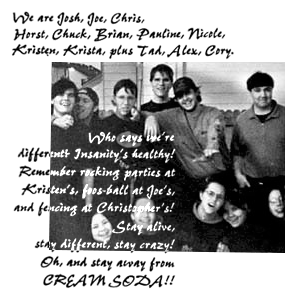
Eric Harris and Dylan Klebold were American high school seniors who committed the Columbine High School massacre. They killed 13 people and injured 24 others, before committing suicide. According to early accounts of the shooting, Harris and Klebold were very unpopular students and frequent targets of bullying at their high school. They eventually began to bully other students; writing journal entries about how they themselves had bullied younger students and ‘fags.’ Initially, the shooters were believed to be members of a clique that called themselves the Trenchcoat Mafia, a small group of Columbine’s self-styled outcasts who wore heavy black trench coats.
The Trenchcoat Mafia was originally a group of gamers who hung out together and started wearing trenchcoats after one of the members received a cowboy duster as a Christmas Gift. They adopted the name Trenchcoat Mafia after jocks began to call them that. Investigation revealed that Harris and Klebold were only friends with one member of the group, and that most of the primary members of the Trenchcoat Mafia had left the school by the time that Harris and Klebold committed the massacre. Most did not know the shooters and none were considered suspects in the shootings or were charged with any involvement in the incident.
Posted in Death, Education, Politics |
Leave a Comment »



