March 29, 2011

The Bradley effect is a theory proposed to explain observed discrepancies between voter opinion polls and election outcomes in some US government elections where a white candidate and a non-white candidate run against each other. The theory proposes that some voters will tell pollsters they are undecided or likely to vote for a black candidate, while on election day they vote for the white candidate. It was named after Los Angeles Mayor Tom Bradley, an African-American who lost the 1982 California governor’s race despite being ahead in voter polls going into the elections.
The effect theorizes that the inaccurate polls were skewed by the phenomenon of social desirability bias. Specifically, some white voters give inaccurate polling responses for fear that, by stating their true preference, they will open themselves to criticism of racial motivation. Some analysts have dismissed that theory, or argued that it may have existed in past elections, but not in more recent ones. Others believe that it is a persistent phenomenon. Similar effects have been posited in other contexts, notably the Shy Tory Factor and spiral of silence.
Posted in Politics |
Leave a Comment »
March 29, 2011

Groupthink is a type of thought within a deeply cohesive group whose members try to minimize conflict and reach consensus without critically testing, analyzing, and evaluating ideas. Research psychologist, Irving Janis studied a number of ‘disasters’ in American foreign policy, such as failure to anticipate the Japanese attack on Pearl Harbor (1941), the Bay of Pigs fiasco (1961), and the prosecution of the Vietnam War (1964–67) by President Lyndon Johnson. He concluded that in each of these cases, the decisions were made largely due to the cohesive nature of the committees which made them. Moreover, that cohesiveness prevented contradictory views from being expressed and subsequently evaluated.
Individual creativity, uniqueness, and independent thinking are lost in the pursuit of group cohesiveness, as are the advantages of reasonable balance in choice and thought that might normally be obtained by making decisions as a group. Members of the group avoid promoting viewpoints outside the comfort zone of consensus thinking to avoid being seen as foolish, or to avoid embarrassing or angering other members of the group. Groupthink may cause groups to make hasty, irrational decisions, where individual doubts are set aside, for fear of upsetting the group’s balance. The term is frequently used pejoratively, in hindsight, and was coined by journalist William H. Whyte in a 1952 ‘Fortune’ magazine article.
Posted in Money, Politics, Science |
Leave a Comment »
March 28, 2011

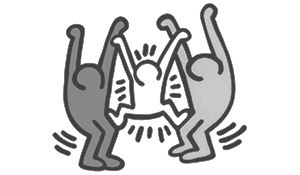
Keith Haring [hah-ring] (1958 – 1990) was an artist and social activist whose work responded to the New York City street culture of the 1980s. Born in Reading, Pennsylvania, at age 19 he moved to NYC, where he was inspired by graffiti art, and studied at the School of Visual Arts. Haring achieved his first public attention with chalk drawings in the subways. The exhibitions were filmed by the photographer Tseng Kwong Chi. Around this time, ‘The Radiant baby’ became his symbol. His bold lines, vivid colors, and active figures carry strong messages of life and unity. Starting in 1980, he organized exhibitions in Club 57, a performance venue.
He participated in the Times Square Exhibition and drew, for the first time, animals and human faces. In 1981 he sketched his first chalk drawings on black paper and painted plastic, metal and found objects. Haring died of AIDS-related complications. By expressing concepts of birth, death, love, sex and war, his imagery has become a widely recognized visual language of the 20th century. His work was featured in several of the Red Hot Organization’s efforts to raise money for AIDS and AIDS awareness. Specifically, its first two albums, ‘Red Hot + Blue’ and ‘Red Hot + Dance’ — the latter of which used Haring’s work on its cover.
Posted in Art, Politics |
Leave a Comment »
March 28, 2011
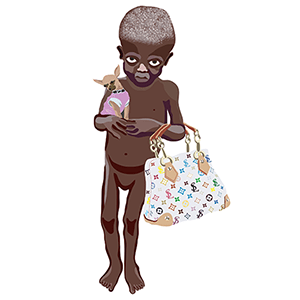
Nadia Plesner is a Danish/Dutch painter who works and lives in the Netherlands. Plesner is working on issues that lie between the editorial and advertising and often with political undertones. She trained at the Graphic Arts Institute, Copenhagen and at the Gerrit Rietveld Academie, Amsterdam. In 2010 Plesner was sued by Louis Vuitton for showing her controversial painting ‘Darfurnica.’ The painting shows a little hungry boy holding a handbag resembling one made by Louis Vuitton. The little boy is standing in the conflict-ridden region of Darfur in Sudan. The fashion giant thought that the legal rules about logo products were broken and the case was taken to court.
A Dutch court imposed daily fines for approximately 6000 US dollars. The trial attracted much international attention and several artists and celebrities supported Plesner as they believed that the case also referred to artistic expression and the right to make the world aware of international issues in an artistic way. Plesner and Louis Vuitton were also involved in a prior dispute about an artistic campaign called Simple Living in 2008. In 2011 the Dutch court reversed its decision and acquitted Nadia Plesner. ‘Darfurnica’ was sold in 2011 for approximately 45.000 US dollars.
Posted in Art, Money, Politics |
Leave a Comment »
March 26, 2011
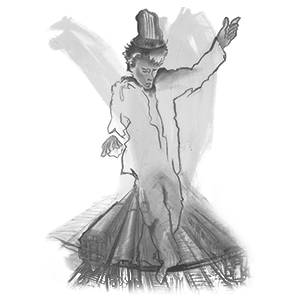
Lee Quiñones [kwi-nohn] (b. 1960) is one of several artists rising from the NYC subway graffiti movement. Born in Puerto Rico and raised in Lower East Side Manhattan, Lee was constantly drawing since the age of five and started with graffiti in 1974. By 1976, Lee was a legend, working in the shadow, leaving huge pieces of art across the subway system. His style is rooted in popular culture, often with political messages. Along with Keith Haring and Jean-Michel Basquiat, Lee Quiñones was one of the innovators of New York’s street-art movement and is considered the single most influential artist to emerge from the graffiti era.
As a subway graffiti artist, Lee almost exclusively painted whole cars (all together about 125), and he was a major contributor to the first-ever whole-train. In November 1976, ten subway cars were painted with a range of colorful murals and set a new benchmark for the scale of graffiti works. Quiñones often added poetic messages in his pieces such as: ‘Graffiti is art and if art is a crime, please God, forgive me.’ He was one of the first street artists to transition fine art. The 1979 exhibition of his canvases at Claudio Bruni’s Galleria Medusa in Rome introduced street art to the rest of the world.
Posted in Art, Money, Politics |
Leave a Comment »
March 26, 2011
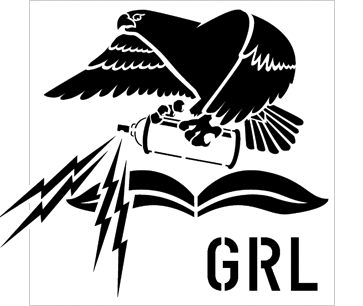
Graffiti Research Lab is a NYC art group dedicated to outfitting graffiti writers, artists and protesters with open source technologies for urban communication. The members of the group experiment in a lab and in the field to develop and test a range of experimental technologies.
The GRL is particularly well-known for inventing ‘LED Throwies.’ Each extension of Graffiti Research Lab is called a cell. Localized cells are found in Vienna, Amsterdam, and Mexico, copying and extending the work of the NY based organization. The cells cooperate and communicate, but are not one formal organization.
Posted in Art, Politics, Technology |
Leave a Comment »
March 26, 2011
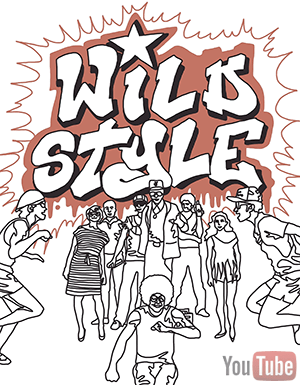
‘Wild Style‘ was the first hip hop motion picture. Released theatrically in 1983, featuring Fab Five Freddy, the Rock Steady Crew, The Cold Crush Brothers, and Grandmaster Flash. The protagonist ‘Zoro’ is played by the legendary NY subway graffiti artist Lee Quinones. An early version of the ‘Wild Style’ logo appeared in the Fall of 1981 when director Charlie Ahearn hired graffiti legend Dondi to paint the ‘window down’ subway car piece that appears in the film. The Dondi piece was the inspiration for the animated title sequence designed by the artist Zephyr in 1982.
The ‘Wild Style’ logo was designed by Zephyr and painted as a huge ‘burner’ mural by Zephyr, Revolt, and Sharp in the Summer of 1983. In addition to covering street artists, the film depicts several prominent figures from the early hip hop culture, engaging in activities such as MCing, turntablism, and breaking. The film has been sampled by many prominent hip hop artists (e.g. ‘Illmatic’ by Nas, ‘Midnight Marauders’ by A Tribe Called Quest, and ‘Check Your Head’ by Beastie Boys).
Posted in Art, Money, Politics |
Leave a Comment »
March 26, 2011


Graffiti refers to images or lettering scratched, scrawled, painted, or marked in any manner on property. Examples date back to Ancient Greece and the Roman Empire. The word ‘graffiti’ and the singular, ‘graffito,’ are from the Italian word ‘graffiato’ (‘scratched’).
The first known example of modern graffiti survives in the ancient Greek city of Ephesus (in modern-day Turkey). It is an advertisement for prostitution. Located near a mosaic and stone walkway, the graffiti shows a handprint that vaguely resembles a heart, along with a footprint and a number. This is believed to indicate that a brothel was nearby, with the handprint symbolizing payment and the number indicating the price.
read more »
Posted in Art, Language, Politics |
Leave a Comment »
March 25, 2011

The Four Pests campaign was one of the first actions taken in the Great Leap Forward, a series of reforms in China from 1958 to 1962. The pests to be eliminated were rats, flies, mosquitoes, and sparrows. The masses of China were mobilized to eradicate the birds, and citizens took to banging pots and pans or beating drums to scare the birds from landing, forcing them to fly until they fell from the sky in exhaustion. Nests were torn down, eggs were broken, and nestlings were killed, resulting in the near-extinction of the birds in China. Non-material rewards and recognition were offered to schools, work units and government agencies in accordance with the volume of pests they had killed.
By April 1960, Chinese leaders realized that sparrows ate more insects than grains. Mao ordered the end of the campaign against sparrows, replacing them with bedbugs in the ongoing campaign against the Four Pests. By this time, however, it was too late. With no sparrows to eat them, locust populations ballooned, swarming the country and compounding the ecological problems already caused by the Great Leap Forward, including widespread deforestation and misuse of poisons and pesticides. Ecological imbalance is credited with exacerbating the Great Chinese Famine in which upwards of 30 million people died of starvation.
Posted in Food, Politics, World |
Leave a Comment »
March 25, 2011

Miscegenation [mi-sej-uh-ney-shuhn] (Latin: miscere ‘to mix,’ genus ‘kind’) is the mixing of different racial groups, a social construct, through marriage, cohabitation, sexual relations, and procreation. The term miscegenation has been used since the 19th century to refer to interracial marriage and interracial sex, and more generally to the process of racial interbreeding, which has taken place since ancient history.
The term entered historical records during European colonialism, but societies such as China and Japan also had restrictions on marrying with peoples they considered different. Historically the term has been used in the context of laws banning interracial marriage and sex, so-called anti-miscegenation laws.
read more »
Posted in Language, Politics, Sex |
Leave a Comment »
March 22, 2011

Kustom Kulture is an an aesthetic and lifestyle born out of the hot rod culture of Southern California of the 1960s, associated with artists such as Kenny Howard (also known as Von Dutch), custom car builders such as ‘Big Daddy’ Ed Roth and Dean Jeffries, hot rod and lowrider customizers such as the Barris Brothers, along with numerous tattoo artists, automobile painters, and movies and television shows such as ‘American Graffiti,’ ‘Happy Days,’ ‘The Munsters’ and ‘The Monkees.’
Kustom Kulture is usually identified with the greasers of the 1950s, the drag racers of the 1960s, and the lowriders of the 1970s. Other subcultures that have had an influence on Kustom Kulture are the Skinheads, mods and rockers of the 1960s, the punks of the 1970s, metal and rockabilly music, the scooterboys of the 1980s, and psychobilly of the 1990s. Each has its own style, but common themes include wild pinstriped paintjobs, choptop Mercurys, custom Harley-Davidson and Triumph Motorcycles, metalflake and black primer paint jobs, and monster movies.
Posted in Art, Politics, Technology |
1 Comment »
March 19, 2011

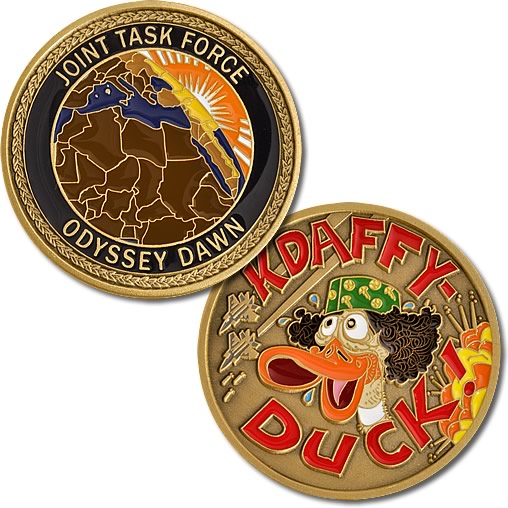
Operation Odyssey Dawn is the codename for the United States participation in a Libyan no-fly zone. The United Kingdom counterpart to this is Operation Ellamy, the French Opération Harmattan. The no-fly zone was proposed during the 2011 Libyan uprising to prevent government forces loyal to Muammar Gaddafi from carrying out air attacks on rebel forces.
Allied operations began with surveillance operations, air attacks and missiles aimed at Libyan military targets. It was reported by the Pentagon that the first strike involved the launch of over 100 Tomahawk cruise missile against shoreline air defenses of the Gaddafi regime.
Posted in Politics, War, World |
Leave a Comment »


 The Daily Omnivore