January 22, 2013

A microexpression is a brief, involuntary facial expression made in reaction to an emotion. They usually occur in high-stakes situations, where people have something to lose or gain. Microexpressions occur when a person is consciously trying to conceal all signs of how he or she is feeling, or when a person does not consciously know how he or she is feeling. Unlike regular facial expressions, it is difficult to hide microexpression reactions. Microexpressions express the seven universal emotions: disgust, anger, fear, sadness, happiness, surprise, and contempt.
Nevertheless, in the 1990s, pyschologist Paul Ekman expanded his list of basic emotions, including a range of positive and negative emotions not all of which are encoded in facial muscles. These emotions are amusement, contempt, embarrassment, excitement, guilt, pride, relief, satisfaction, pleasure, and shame. They are very brief in duration, lasting only 1/25 to 1/15 of a second.
read more »
Posted in Health, Politics, Science |
1 Comment »
January 17, 2013

Quantum mysticism [mis-tuh-siz-uhm] is a term that has been used to refer to a set of metaphysical beliefs and associated practices that seek to relate consciousness, intelligence, or mystical world-views to the ideas of quantum mechanics and its interpretations. The term originally emerged from the founders of quantum theory in the early twentieth century as they debated the interpretations and implications of their nascent theories, which would later evolve into quantum mechanics, and later after WWII, with publications such as Schrödinger’s and Eugene Wigner’s 1961 paper.
The essential qualities of early quantum theory, and the ontological (related to the nature of being) questions that emerged from it, made a distinction between philosophical and scientific discussion difficult as quantum theory developed into a strong scientific theory. Quantum Mysticism is usually considered pseudoscience. Many of the leading Quantum physicists did however give mystical interpretations to their findings.
read more »
Posted in Philosophy, Science |
Leave a Comment »
January 16, 2013
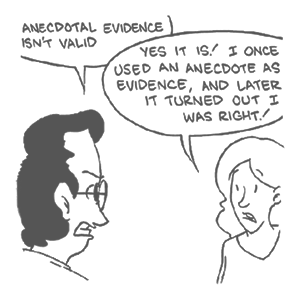
The expression anecdotal [an-ik-doht-l] evidence refers to evidence from anecdotes. Because of the small sample, there is a larger chance that it may be unreliable due to cherry-picked or otherwise non-representative samples of typical cases. Anecdotal evidence is considered dubious support of a claim; it is accepted only in lieu of more solid evidence. This is true regardless of the veracity of individual claims. The term is often used in contrast to scientific evidence, such as evidence-based medicine, which are types of formal accounts.
Some anecdotal evidence does not qualify as scientific evidence because its nature prevents it from being investigated using the scientific method. Misuse of anecdotal evidence is an informal fallacy and is sometimes referred to as the ‘person who’ fallacy (e.g.,’I know a person who…’ or ‘I know of a case where…’). Anecdotal evidence is not necessarily representative of a ‘typical’ experience; in fact, human cognitive biases such as confirmation bias mean that exceptional or confirmatory anecdotes are much more likely to be remembered. Accurate determination of whether an anecdote is ‘typical’ requires statistical evidence.
read more »
Posted in Science |
1 Comment »
January 14, 2013

The role of the unconscious mind on decision making is a topic greatly debated by neuro-scientists and psychologists around the world. Though the actual level of involvement of the unconscious brain during a cognitive process might still be a matter of differential opinion, the fact that the unconscious brain does play a role in cognitive activity is undeniable.
Several experiments and well recorded phenomenon attest to this fact and there have also been several experiments that have been performed that prove that the unconscious brain might actually be better at decision making that the conscious brain when there are multiple variable to be taken into consideration. The attitude of the scientific community towards the unconscious mind has undergone a drastic change from being viewed as a lazy reservoir of memories and non-task oriented behavior to being regarded as an active and essential component in the processes of decision making.
read more »
Posted in Health, Philosophy, Science |
Leave a Comment »
January 11, 2013
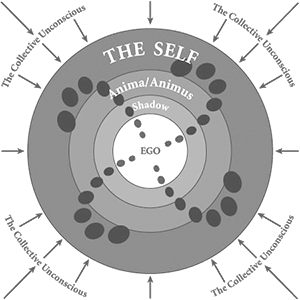
Collective unconscious is a term of analytical psychology, coined by Carl Jung. It is proposed to be a part of the unconscious mind, expressed in humanity and all life forms with nervous systems, and describes how the structure of the psyche autonomously organizes experience.
Jung distinguished the collective unconscious from the personal unconscious, in that the personal unconscious is a personal reservoir of experience unique to each individual, while the collective unconscious collects and organizes those personal experiences in a similar way with each member of a particular species.
read more »
Posted in Health, Philosophy, Science |
1 Comment »
January 11, 2013

Religious behavior is thought to have emerged by the Upper Paleolithic [pey-lee-uh-lith-ik], before 30,000 years ago at the latest, but behavioral patterns such as burial rites that one might characterize as religious – or as ancestral to religious behavior – reach back into the Middle Paleolithic, as early as 300,000 years ago, coinciding with the first appearance of Homo neanderthalensis and Homo sapiens.
Religious behavior may combine (for example) ritual, spirituality, mythology and magical thinking or animism – aspects that may have had separate histories of development during the Middle Paleolithic before combining into ‘religion proper’ of behavioral modernity.
read more »
Posted in Philosophy, Science |
Leave a Comment »
January 10, 2013

The half-life of knowledge is the amount of time that has to elapse before half of the knowledge in a particular area is superseded or shown to be untrue. The concept is attributed to Fritz Machlup (1962). For example, Donald Hebb estimated the half-life of psychology to be five years.
The half-life of knowledge differs from the concept of half-life in physics in that there is no guarantee that the truth of knowledge in a particular area of study is declining exponentially. In addition, knowledge can not be quantified and falsification of a doctrine is hardly comparable to exponential decay process that atomic nuclei go through.
Posted in Education, Science |
Leave a Comment »
January 10, 2013

Rational mysticism [mis-tuh-siz-uhm], which encompasses both rationalism and mysticism, is a term used by scholars, researchers, and other intellectuals, some of whom engage in studies of how altered states of consciousness or transcendence such as trance, visions, and prayer occur. Lines of investigation include historical and philosophical inquiry as well as scientific inquiry within such fields as neurophysiology and psychology.
The term ‘rational mysticism’ was in use at least as early as 1911 when it was the subject of an article by Henry W. Clark in the ‘Harvard Theological Review.’ In a 1924 book, ‘Rational Mysticism,’ theosophist William Kingsland correlated rational mysticism with scientific idealism. South African philosopher J.N. Findlay frequently used the term, developing the theme in ‘Ascent to the Absolute’ and other works in the 1960s and 1970s.
read more »
Posted in Philosophy, Science |
Leave a Comment »
January 10, 2013

The Google effect is the tendency to forget information that can be easily found using internet search engines such as Google, instead of remembering it.
The phenomenon was described and named by researchers Betsy Sparrow, Jenny Liu, and Daniel M. Wegner in 2011. Having easy access to the Internet, their study showed, makes people less likely to remember certain details they believe will be accessible online. People can still remember things they cannot find online, and how to find what they need on the Internet. Sparrow said this made the Internet a type of transactive memory. One result of this phenomenon is dependence on the Internet; if an online connection is lost, the researchers said, it is similar to losing a friend.
read more »
Posted in Health, Science, Technology |
Leave a Comment »
January 8, 2013

The decline effect may occur when scientific claims receive decreasing support over time. The term was first described by parapsychologist Joseph Banks Rhine in the 1930s to describe the disappearing of extrasensory perception (ESP) of psychic experiments conducted by Rhine over the course of study or time. The term was once again used in a 2010 article by Jonah Lehrer published in ‘The New Yorker.’
In his article, Lehrer gives several examples where the decline effect is allegedly showing. In the first example, the development of second generation anti-psychotic drugs, reveals that the first tests had demonstrated a dramatic decrease in the subjects’ psychiatric symptoms. However, after repeating tests this effect declined and in the end it was not possible to document that these drugs had any better effect than the first generation anti-psychotics.
read more »
Posted in Science |
Leave a Comment »
January 8, 2013

Conspicuous consumption refers to monies spent and goods and services acquired to publicly display economic power—either the buyer’s income or the buyer’s accumulated wealth.
Sociologically, to the conspicuous consumer, such a public display of discretionary economic power is a means either of attaining or of maintaining a given social status. Moreover, ‘invidious consumption,’ a more specialized sociological term, denotes the deliberate conspicuous consumption of goods and services intended to provoke the envy of other people, as a means of displaying the buyer’s superior socio-economic status.
read more »
Posted in Money, Politics, Science |
Leave a Comment »
January 7, 2013

Paralanguage refers to non-verbal elements of spoken communication used to modify meaning and convey emotion, such as change in pitch, volume, or intonation. Paralanguage may be expressed consciously or unconsciously. The term ‘paralanguage’ should not be confused with ‘kinesics,’ or the study of body language. While kinesics is non-linguistic (it is not necessarily related to vocal or written language), paralanguage is. Paralinguistic information, because it is phenomenal, belongs to the external speech signal but not to the arbitrary conventional code of language.
The paralinguistic properties of speech play an important role in human speech communication. There are no utterances or speech signals that lack paralinguistic properties, since speech requires the presence of a voice that can be modulated. This voice must have some properties, and all the properties of a voice as such are paralinguistic. However, the distinction linguistic vs. paralinguistic applies not only to speech but to writing and sign language as well, and it is not bound to any sensory modality. Even vocal language has some paralinguistic as well as linguistic properties that can be seen (lip reading, McGurk effect), and even felt, e.g. by the Tadoma method (a touch based language for the deafblind).
read more »
Posted in Health, Language, Science |
Leave a Comment »


 The Daily Omnivore