January 29, 2013
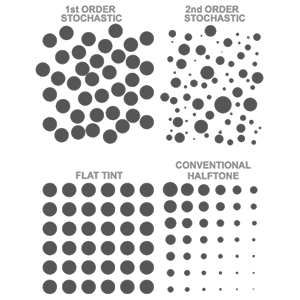
In the mathematics of probability, a stochastic [stuh-kas-tik] process is a random function, such as stock market and exchange rate fluctuations; signals such as speech, audio, and video; medical data such as a patient’s EKG, EEG, blood pressure, or temperature; and random movement such as Brownian motion (random moving of particles suspended in a fluid) or random walks (random, computer generated paths).
Other examples of random fields include static images, random topographies (landscapes), or composition variations of an inhomogeneous material. The stochastic process is the probabilistic counterpart to deterministic systems (in which no randomness is involved in the development of future states of the system). Instead of describing a process which can only evolve in one way, in a stochastic or random process there is some indeterminacy: even if the initial condition (or starting point) is known, there are several (often infinitely many) directions in which the process may evolve.
Posted in Language, Science |
Leave a Comment »
January 28, 2013

Mary Roach is an American author, specializing in popular science. She currently resides in Oakland, California. To date, she has published four books: ‘Stiff: The Curious Lives of Human Cadavers’ (2003), ‘Spook: Science Tackles the Afterlife’ (2005), ‘Bonk: The Curious Coupling of Science and Sex’ (2008) and ‘Packing for Mars: The Curious Science of Life in the Void’ (2010). Roach was raised in Etna, New Hampshire.
She received a bachelor’s degree in psychology from Wesleyan University in 1981. After college, Roach moved to San Francisco and spent a few years working as a freelance copy editor. She worked as a columnist, and also worked in public relations for a brief time. Her writing career began while working part-time at the San Francisco Zoological Society, producing press releases on topics such as elephant wart surgery.
read more »
Posted in Humor, Language, Science |
Leave a Comment »
January 22, 2013

An antioxidant [an-tee-ok-si-duhnt] is a molecule that can slow or stop the oxidation, or loss of electrons, of other molecules. Oxidation reactions are necessary for many bodily functions but can produce free radicals (molecules with an unpaired electron). In turn, these radicals can start chain reactions. When the chain reaction occurs in a cell, it can cause damage or death to the cell. Antioxidants terminate these chain reactions by removing free radical intermediates. They do this by being oxidized themselves (donating an electron to the free radical).
Vitamins and enzymes can have antioxidant properties that neutralize the damaging effects of free radicals. Although oxidation reactions are crucial for life, they can also be damaging; plants and animals maintain complex systems of multiple types of antioxidants. Insufficient levels of antioxidants, or inhibition of the antioxidant enzymes, cause oxidative stress and may damage or kill cells. As oxidative stress appears to be an important part of many human diseases, the use of antioxidants in pharmacology is intensively studied, particularly as treatments for stroke and neurodegenerative diseases. Moreover, oxidative stress is both the cause and the consequence of disease.
read more »
Posted in Food, Health, Science |
Leave a Comment »
January 22, 2013
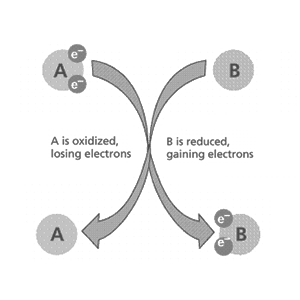
Oxidation [ok-si-dey-shuhn] is any chemical reaction that involves a loss of electrons. For example, when iron reacts with oxygen it forms a chemical called rust: the iron is oxidized (loses electrons) and the oxygen is reduced (gains electrons).
A reduction reaction always comes together with its opposite, the oxidation reaction, and together are called ‘redox’ (reduction and oxidation). Although oxidation reactions are commonly associated with the formation of oxides from oxygen molecules, these are only specific examples of a more general concept of reactions involving electron transfer.
read more »
Posted in Health, Science |
Leave a Comment »
January 22, 2013

A microexpression is a brief, involuntary facial expression made in reaction to an emotion. They usually occur in high-stakes situations, where people have something to lose or gain. Microexpressions occur when a person is consciously trying to conceal all signs of how he or she is feeling, or when a person does not consciously know how he or she is feeling. Unlike regular facial expressions, it is difficult to hide microexpression reactions. Microexpressions express the seven universal emotions: disgust, anger, fear, sadness, happiness, surprise, and contempt.
Nevertheless, in the 1990s, pyschologist Paul Ekman expanded his list of basic emotions, including a range of positive and negative emotions not all of which are encoded in facial muscles. These emotions are amusement, contempt, embarrassment, excitement, guilt, pride, relief, satisfaction, pleasure, and shame. They are very brief in duration, lasting only 1/25 to 1/15 of a second.
read more »
Posted in Health, Politics, Science |
1 Comment »
January 17, 2013
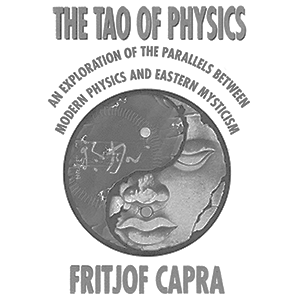
Quantum mysticism [mis-tuh-siz-uhm] is a term that has been used to refer to a set of metaphysical beliefs and associated practices that seek to relate consciousness, intelligence, or mystical world-views to the ideas of quantum mechanics and its interpretations. The term originally emerged from the founders of quantum theory in the early twentieth century as they debated the interpretations and implications of their nascent theories, which would later evolve into quantum mechanics, and later after WWII, with publications such as Schrödinger’s and Eugene Wigner’s 1961 paper.
The essential qualities of early quantum theory, and the ontological (related to the nature of being) questions that emerged from it, made a distinction between philosophical and scientific discussion difficult as quantum theory developed into a strong scientific theory. Quantum Mysticism is usually considered pseudoscience. Many of the leading Quantum physicists did however give mystical interpretations to their findings.
read more »
Posted in Philosophy, Science |
Leave a Comment »
January 16, 2013
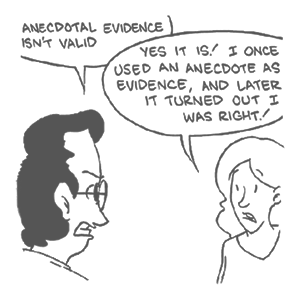
The expression anecdotal [an-ik-doht-l] evidence refers to evidence from anecdotes. Because of the small sample, there is a larger chance that it may be unreliable due to cherry-picked or otherwise non-representative samples of typical cases. Anecdotal evidence is considered dubious support of a claim; it is accepted only in lieu of more solid evidence. This is true regardless of the veracity of individual claims. The term is often used in contrast to scientific evidence, such as evidence-based medicine, which are types of formal accounts.
Some anecdotal evidence does not qualify as scientific evidence because its nature prevents it from being investigated using the scientific method. Misuse of anecdotal evidence is an informal fallacy and is sometimes referred to as the ‘person who’ fallacy (e.g.,’I know a person who…’ or ‘I know of a case where…’). Anecdotal evidence is not necessarily representative of a ‘typical’ experience; in fact, human cognitive biases such as confirmation bias mean that exceptional or confirmatory anecdotes are much more likely to be remembered. Accurate determination of whether an anecdote is ‘typical’ requires statistical evidence.
read more »
Posted in Science |
1 Comment »
January 14, 2013

The role of the unconscious mind on decision making is a topic greatly debated by neuro-scientists and psychologists around the world. Though the actual level of involvement of the unconscious brain during a cognitive process might still be a matter of differential opinion, the fact that the unconscious brain does play a role in cognitive activity is undeniable.
Several experiments and well recorded phenomenon attest to this fact and there have also been several experiments that have been performed that prove that the unconscious brain might actually be better at decision making that the conscious brain when there are multiple variable to be taken into consideration. The attitude of the scientific community towards the unconscious mind has undergone a drastic change from being viewed as a lazy reservoir of memories and non-task oriented behavior to being regarded as an active and essential component in the processes of decision making.
read more »
Posted in Health, Philosophy, Science |
Leave a Comment »
January 11, 2013
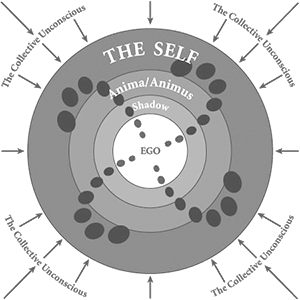
Collective unconscious is a term of analytical psychology, coined by Carl Jung. It is proposed to be a part of the unconscious mind, expressed in humanity and all life forms with nervous systems, and describes how the structure of the psyche autonomously organizes experience.
Jung distinguished the collective unconscious from the personal unconscious, in that the personal unconscious is a personal reservoir of experience unique to each individual, while the collective unconscious collects and organizes those personal experiences in a similar way with each member of a particular species.
read more »
Posted in Health, Philosophy, Science |
1 Comment »
January 11, 2013

Religious behavior is thought to have emerged by the Upper Paleolithic [pey-lee-uh-lith-ik], before 30,000 years ago at the latest, but behavioral patterns such as burial rites that one might characterize as religious – or as ancestral to religious behavior – reach back into the Middle Paleolithic, as early as 300,000 years ago, coinciding with the first appearance of Homo neanderthalensis and Homo sapiens.
Religious behavior may combine (for example) ritual, spirituality, mythology and magical thinking or animism – aspects that may have had separate histories of development during the Middle Paleolithic before combining into ‘religion proper’ of behavioral modernity.
read more »
Posted in Philosophy, Science |
Leave a Comment »
January 10, 2013

The half-life of knowledge is the amount of time that has to elapse before half of the knowledge in a particular area is superseded or shown to be untrue. The concept is attributed to Fritz Machlup (1962). For example, Donald Hebb estimated the half-life of psychology to be five years.
The half-life of knowledge differs from the concept of half-life in physics in that there is no guarantee that the truth of knowledge in a particular area of study is declining exponentially. In addition, knowledge can not be quantified and falsification of a doctrine is hardly comparable to exponential decay process that atomic nuclei go through.
Posted in Education, Science |
Leave a Comment »
January 10, 2013
Rational mysticism [mis-tuh-siz-uhm], which encompasses both rationalism and mysticism, is a term used by scholars, researchers, and other intellectuals, some of whom engage in studies of how altered states of consciousness or transcendence such as trance, visions, and prayer occur. Lines of investigation include historical and philosophical inquiry as well as scientific inquiry within such fields as neurophysiology and psychology.
The term ‘rational mysticism’ was in use at least as early as 1911 when it was the subject of an article by Henry W. Clark in the ‘Harvard Theological Review.’ In a 1924 book, ‘Rational Mysticism,’ theosophist William Kingsland correlated rational mysticism with scientific idealism. South African philosopher J.N. Findlay frequently used the term, developing the theme in ‘Ascent to the Absolute’ and other works in the 1960s and 1970s.
read more »
Posted in Philosophy, Science |
Leave a Comment »



