November 1, 2012

‘Fashionable Nonsense: Postmodern Intellectuals’ Abuse of Science’ (French: ‘Impostures Intellectuelles’) is a 1997 book by NYU physics professor Alan Sokal and Belgian theoretical physicist Jean Bricmont. Sokal is best known for the Sokal Affair, in which he submitted a deliberately absurd article to ‘Social Text,’ a critical theory journal, and was able to get it published. The English editions were revised for greater relevance to debates in the English-speaking world.
As part of the so-called ‘science wars’ (a series of intellectual exchanges, between scientific realists and postmodernist critics), the book criticizes postmodernism in academia for what it claims are misuses of scientific and mathematical concepts in postmodern writing. According to some reports, the response within the humanities was ‘polarized.’ Critics of Sokal and Bricmont charge that they lack understanding of the writing they were criticizing. Responses from the scientific community were more supportive.
read more »
Posted in Language, Philosophy, Science |
Leave a Comment »
October 29, 2012

The Ig Nobel Prizes are a satirical award given each year in early October for ten unusual or trivial achievements in scientific research. The stated aim of the prizes is to ‘first make people laugh, and then make them think.’
Organized by the scientific humor magazine ‘Annals of Improbable Research’ (AIR), they are presented by a group that includes Nobel Laureates at a ceremony at Harvard University’s Sanders Theater, and they are followed by a set of public lectures by the winners at MIT. The name is a play on the words ‘ignoble’ (‘characterized by baseness, lowness, or meanness’) and the Nobel Prize. The pronunciation used during the ceremony is [ig-noh-bel], not like the word ‘ignoble.’
read more »
Posted in Education, Humor, Science |
Leave a Comment »
October 27, 2012

The cocktail party effect is the phenomenon of being able to focus one’s auditory attention on a particular stimulus while filtering out a range of other stimuli, much the same way that a party-goer can focus on a single conversation in a noisy room. This effect is what allows most people to ‘tune in’ to a single voice and ‘tune out’ all others. It may also describe a similar phenomenon that occurs when one may immediately detect words of importance originating from unattended stimuli, for instance hearing one’s name in another conversation.
The cocktail party effect works best as a binaural effect, which requires hearing with both ears. People with only one functional ear seems much more disturbed by interfering noise. However, even without binaural location information, individuals can selectively attend to one particular speaker if the pitch of their voice or the topic of their speech is sufficiently distinctive (albeit with greater difficulty). This phenomenon is still very much a subject of research, in humans as well as in computer implementations (where it is typically referred to as source separation or blind source separation).
read more »
Posted in Health, Science, Technology |
Leave a Comment »
October 26, 2012

Reality tunnel is a term coined by Timothy Leary and popularized by Robert Anton Wilson, akin to the idea of representative realism (equivalent to the accepted view of ‘perception’ in natural science that states that we do not and cannot perceive the external world as it really is but know only our ideas and interpretations of the way the world is). The theory states that, with a subconscious set of mental ‘filters’ formed from their beliefs and experiences, every individual interprets the same world differently, hence ‘Truth is in the eye of the beholder.’ According to Wilson, ‘Every kind of ignorance in the world all results from not realizing that our perceptions are gambles.
We believe what we see and then we believe our interpretation of it, we don’t even know we are making an interpretation most of the time. We think this is reality.’ The idea does not necessarily imply that there is no objective truth; rather that our access to it is mediated through our senses, experience, conditioning, prior beliefs, and other non-objective factors. The implied individual world each person occupies is said to be their reality tunnel. The term can also apply to groups of people united by beliefs: we can speak of the fundamentalist Christian reality tunnel or the ontological naturalism reality tunnel.
read more »
Posted in Philosophy, Science |
Leave a Comment »
October 25, 2012

Consensus reality is that which is generally agreed to be reality, based on a consensus view. However, human beings do not fully understand or agree upon the nature of knowledge or knowing, and therefore (it is often argued) it is not possible to be certain beyond doubt what is real. Accordingly, this line of logic concludes, we cannot in fact be sure beyond doubt about the nature of reality. We can, however, seek to obtain some form of consensus, with others, of what is real.
We can use this consensus as a pragmatic guide, either on the assumption that it seems to approximate some kind of valid reality, or simply because it is more ‘practical’ than perceived alternatives. Consensus reality therefore refers to the agreed-upon concepts of reality which people in the world, or a culture or group, believe are real (or treat as real), usually based upon their common experiences as they believe them to be; anyone who does not agree with these is sometimes stated to be ‘in effect… living in a different world.’
read more »
Posted in Philosophy, Science |
Leave a Comment »
October 24, 2012


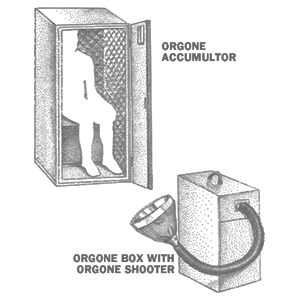
Orgone [awr-gohn] energy was a hypothetical universal life force originally proposed in the 1930s by Austrian psychiatrist Wilhelm Reich. In its final conception, developed by Reich’s student Charles Kelly after Reich’s death, Orgone was conceived as the anti-entropic principle of the universe, a creative substratum in all of nature comparable to Mesmer’s animal magnetism, the Odic force of Carl Reichenbach and Henri Bergson’s élan vital.
Orgone was seen as a massless, omnipresent substance, similar to luminiferous aether, but more closely associated with living energy than inert matter. It could coalesce to create organization on all scales, from the smallest microscopic units—called bions in orgone theory—to macroscopic structures like organisms, clouds, or even galaxies. Reich’s theories held that deficits or constrictions in bodily orgone were at the root of many diseases—including cancer—much as deficits or constrictions in the libido could produce neuroses in Freudian theory.
read more »
Posted in Health, Science, Sex |
Leave a Comment »
October 24, 2012
Within the work of the Austrian psychoanalyst Wilhelm Reich (1897–1957), the term orgastic potency referred to the ability to experience an orgasm with specific psychosomatic characteristics. Reich described it as ‘the real emotional experience of the loss of your ego, of your whole spiritual self,’ and believed it was essential for the capacity to love.
For Reich, ‘orgastic impotence,’ or failure to attain orgastic potency (not to be confused with anorgasmia, the inability to reach orgasm), meant that the undischarged libido, which he saw as a physical energy, might cause illness. This he defined as neurosis, arguing that ‘not a single neurotic individual possesses orgastic potency.’ According to one of his followers, Elsworth Baker, someone who can attain orgastic potency ‘cannot maintain a neurosis.’
read more »
Posted in Health, Science, Sex |
Leave a Comment »
October 24, 2012
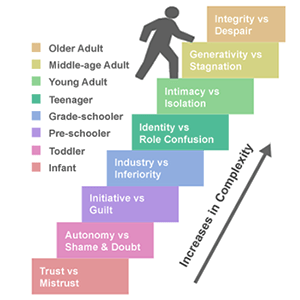
Erikson’s stages of psychosocial development are eight stages through which a healthily developing human should pass from infancy to late adulthood, according to neo-Freudian psychologist Erik Erikson. In each stage the person confronts, and hopefully masters, new challenges. Each stage builds on the successful completion of earlier stages. The challenges of stages not successfully completed may be expected to reappear as problems in the future. However, mastery of a stage is not required to advance to the next stage.
Erikson’s stage theory characterizes an individual advancing through the eight life stages as a function of negotiating his or her biological forces and sociocultural forces. Each stage is characterized by a psycho social crisis of these two conflicting forces. If an individual does indeed successfully reconcile these forces (favoring the first mentioned attribute in the crisis), he or she emerges from the stage with the corresponding virtue. For example, if an infant enters into the toddler stage (autonomy vs. shame & doubt) with more trust than mistrust, he or she carries the virtue of hope into the remaining life stages.
read more »
Posted in Health, Philosophy, Science |
Leave a Comment »
October 23, 2012

Interpersonal reflex is a term created by Timothy Leary and explained in the book, ‘Interpersonal Diagnosis of Personality: A functional theory and methodology for personality evaluation’ (1957). While examining recorded protocols of communications in adults, Leary discovered that typical patterns of interaction existed. Individual units of these behaviors were called interpersonal mechanisms or interpersonal reflexes: ‘They are defined as the observable, expressive units of face-to-face social behavior.’ These reflexes are automatic and involuntary responses to interpersonal situations. They are independent of the content of the communication. They are the individual’s spontaneous methods of reacting to others.
Leary states, ‘The reflex manner in which human beings react to others and train others to respond to them in selective ways is, I believe, the most important single aspect of personality. The systematic estimates of a patient’s repertoire of interpersonal reflexes is a key factor in functional diagnosis.’ Examining interpersonal reflexes helps to explain communication and behavioral patterns in healthy and unhealthy relationships. For example, tender, supportive operations tend to train others to agree, conciliate, and depend. Rigid autocratic individuals seek out docile admiring followers. Competitive, self-enhancing behavior pulls envy, distrust, inferiority feelings, and at times respectful admiration from others.
Posted in Health, Philosophy, Science |
Leave a Comment »
October 23, 2012

The interpersonal circumplex is a model for conceptualizing, organizing, and assessing interpersonal behavior, traits, and motives. It is defined by two orthogonal axes: a vertical axis (of status, dominance, power, or control) and a horizontal axis (of solidarity, friendliness, warmth, or love).
In recent years, it has become conventional to identify the vertical and horizontal axes with the broad constructs of agency and communion. Thus, each point in the interpersonal circumplex space can be specified as a weighted combination of agency and communion.
read more »
Posted in Health, Philosophy, Science |
Leave a Comment »
October 21, 2012

A hiccup is a contraction of the diaphragm that may repeat several times per minute. In medicine it is known as ‘synchronous diaphragmatic flutter’ (SDF), or ‘singultus,’ from the Latin ‘singult,’ ‘the act of catching one’s breath while sobbing.’ The hiccup is an involuntary action involving a reflex arc.
Once triggered, the reflex causes a strong contraction of the diaphragm followed about 0.25 seconds later by closure of the vocal cords, which results in the classic hic sound. At the same time, the normal peristalis of the esophagus is suppressed. A bout of hiccups, in general, resolves itself without intervention, although many home remedies are often used to attempt to shorten the duration. Medical treatment is occasionally necessary in cases of chronic hiccups.
read more »
Posted in Health, Science |
1 Comment »
October 21, 2012

Sociocybernetics is an independent chapter of science in sociology based upon Systems Theory (a framework to analyze a group of objects that work in concert to produce some result) and cybernetics (the study of control and communication systems in animals and machines). It also has a basis in Organizational Development (OD) consultancy practice and in Theories of Communication, theories of psychotherapies, and computer sciences. The ‘International Sociological Association’ has a specialist research committee in the area, which publishes the (electronic) ‘Journal of Sociocybernetics.’
The study of society as a system can be traced back to the origin of sociology when the emergent idea of functional differentiation was applied for the first time to society by Auguste Comte. From his viewpoint, the principal feature of modern society was the increased process of system differentiation as a way of dealing with the complexity of the environment. This is accomplished through the creation of subsystems in an effort to copy within a system the difference between it and the environment.
read more »
Posted in Politics, Science, Technology |
Leave a Comment »


 The Daily Omnivore