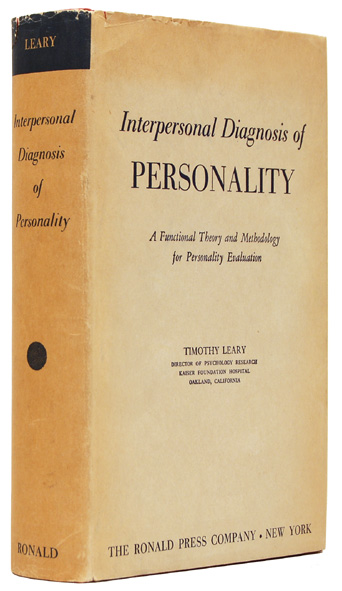
Interpersonal reflex is a term created by Timothy Leary and explained in the book, ‘Interpersonal Diagnosis of Personality: A functional theory and methodology for personality evaluation’ (1957). While examining recorded protocols of communications in adults, Leary discovered that typical patterns of interaction existed. Individual units of these behaviors were called interpersonal mechanisms or interpersonal reflexes: ‘They are defined as the observable, expressive units of face-to-face social behavior.’ These reflexes are automatic and involuntary responses to interpersonal situations. They are independent of the content of the communication. They are the individual’s spontaneous methods of reacting to others.
Leary states, ‘The reflex manner in which human beings react to others and train others to respond to them in selective ways is, I believe, the most important single aspect of personality. The systematic estimates of a patient’s repertoire of interpersonal reflexes is a key factor in functional diagnosis.’ Examining interpersonal reflexes helps to explain communication and behavioral patterns in healthy and unhealthy relationships. For example, tender, supportive operations tend to train others to agree, conciliate, and depend. Rigid autocratic individuals seek out docile admiring followers. Competitive, self-enhancing behavior pulls envy, distrust, inferiority feelings, and at times respectful admiration from others.
Interpersonal Reflex
Interpersonal Circumplex

The interpersonal circumplex is a model for conceptualizing, organizing, and assessing interpersonal behavior, traits, and motives. It is defined by two orthogonal axes: a vertical axis (of status, dominance, power, or control) and a horizontal axis (of solidarity, friendliness, warmth, or love).
In recent years, it has become conventional to identify the vertical and horizontal axes with the broad constructs of agency and communion. Thus, each point in the interpersonal circumplex space can be specified as a weighted combination of agency and communion.
read more »
Hiccup

A hiccup is a contraction of the diaphragm that may repeat several times per minute. In medicine it is known as ‘synchronous diaphragmatic flutter’ (SDF), or ‘singultus,’ from the Latin ‘singult,’ ‘the act of catching one’s breath while sobbing.’ The hiccup is an involuntary action involving a reflex arc.
Once triggered, the reflex causes a strong contraction of the diaphragm followed about 0.25 seconds later by closure of the vocal cords, which results in the classic hic sound. At the same time, the normal peristalis of the esophagus is suppressed. A bout of hiccups, in general, resolves itself without intervention, although many home remedies are often used to attempt to shorten the duration. Medical treatment is occasionally necessary in cases of chronic hiccups.
read more »
Sociocybernetics

Sociocybernetics is an independent chapter of science in sociology based upon Systems Theory (a framework to analyze a group of objects that work in concert to produce some result) and cybernetics (the study of control and communication systems in animals and machines). It also has a basis in Organizational Development (OD) consultancy practice and in Theories of Communication, theories of psychotherapies, and computer sciences. The ‘International Sociological Association’ has a specialist research committee in the area, which publishes the (electronic) ‘Journal of Sociocybernetics.’
The study of society as a system can be traced back to the origin of sociology when the emergent idea of functional differentiation was applied for the first time to society by Auguste Comte. From his viewpoint, the principal feature of modern society was the increased process of system differentiation as a way of dealing with the complexity of the environment. This is accomplished through the creation of subsystems in an effort to copy within a system the difference between it and the environment.
read more »
Food Microbiology
Food microbiology is the study of the microorganisms that inhabit, create, or contaminate food. Including the study of microorganisms causing food spoilage. ‘Good’ bacteria, however, such as probiotics, are becoming increasingly important in food science. In addition, microorganisms are essential for the production of foods such as cheese, yogurt, other fermented foods, bread, beer and wine. Food safety is a major focus of food microbiology. Pathogenic bacteria, viruses, and toxins produced by microorganisms are all possible contaminants of food.
However, microorganisms and their products can also be used to combat these pathogenic microbes. Probiotic bacteria, including those that produce bacteriocins (toxins created by bacteria to kill rival bacteria), can inhibit pathogens. Alternatively, purified bacteriocins such as nisin can be added directly to food products. Finally, bacteriophages, viruses that only infect bacteria, can be used to kill bacterial pathogens. Thorough preparation of food, including proper cooking, eliminates most bacteria and viruses. However, toxins produced by contaminants may not be heat-labile, and some are not eliminated by cooking
read more »
Century Egg
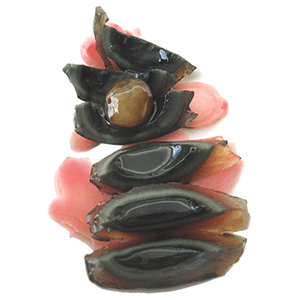
Century egg (‘pidan,’ also known as preserved egg and millennium egg) is a Chinese cuisine ingredient made by preserving fowl eggs in a mixture of clay, ash, salt, quicklime (calcium oxide), and rice hulls for several weeks to several months, depending on the method of processing. Through the process, the yolk becomes a dark green to gray color with a creamy consistency and an odor of sulfur and ammonia, while the white becomes a dark brown, translucent jelly with little flavor.
The transforming agent in the century egg is its alkaline material, which gradually raises the pH of the egg to around 9, 12, or more during the curing process. This chemical process breaks down some of the complex, flavorless proteins and fats, which produces a variety of smaller flavorful compounds. Some eggs have fungal patterns near the surface of the egg white that are likened to pine branches, and that gives rise to one of its Chinese names, the ‘pine-patterned egg.’
read more »
Pickling

Pickling, also known as ‘brining’ or ‘corning,’ is the process of preserving food with acid. Pickling began 4000 years ago using cucumbers native to India. It is called ‘achar’ in northern India. This was used as a way to preserve food for out-of-season use and for long journeys, especially by sea. Salt pork and salt beef were common staples for sailors before the days of steam engines. Although the process was invented to preserve foods, pickles are also made and eaten because people enjoy the resulting flavors.
Pickling may also improve the nutritional value of food by introducing B vitamins produced by bacteria (when pickled in a process utilizing fermentation). The term ‘pickle’ is derived from the Dutch word ‘pekel,’ meaning ‘brine’ (salt water). In the U.S. Canada, and Australia the word ‘pickle’ alone almost always refers to a pickled cucumber (other types of pickles will be described as ‘pickled onion,’ ‘pickled cauliflower,’ etc.), except when it is used figuratively. In the UK, ‘pickle’ refers to Ploughman’s pickle, a kind of chutney; a pickled cucumber is referred to as a ‘gherkin.’
read more »
Fermentation

Fermentation [fur-men-tey-shuhn] is when a living cell uses sugar for energy without requiring oxygen. Yeast is an organism that ferments. When yeast ferments sugar, the yeast eats sugar and makes alcohol. Other organisms (such as bacteria) make vinegar (acetic acid) or lactic acid when they ferment sugar. Fermentation is used to make beer, some types of fuel, and to make bread rise. When yeast ferments, it breaks down the glucose into ethanol and carbon dioxide.
Ethanol fermentation always produces ethanol and carbon dioxide. It is important in bread-making, brewing, and winemaking. Lactic acid fermentation produces lactic acid. It happens in muscles of animals when they need lots of energy fast, and is also used to preserve foods in pickling. The word ‘fermentation’ is derived from the Latin verb ‘fervere,’ which means ‘to boil’ (same root as ‘effervescence’). It is thought to have been first used in the late fourteenth century in alchemy, but only in a broad sense. It was not used in the modern scientific sense until around 1600.
read more »
Recapitulation Theory

The theory of recapitulation [ree-kuh-pich-uh-ley-shuhn] is often known as ‘ontogeny recapitulates phylogeny.’ It was an idea of French physician Étienne Serres in 1824. In 1886 German biologist Ernst Haekel proposed that the embryonic development of an individual organism (its ontogeny) followed the same path as the evolutionary history of its species (its phylogeny). It is also called the ‘biogenetic law’ or ’embryological parallelism.’
It was a theory that tied evolution (change in organisms over time) with embryology (the way organisms develop before they are born). The theory basically stated that before they are born, organisms pass through developmental stages that look like adult animals of other species, in roughly the same order that these other species split off during evolution. Although there is something to this idea, it is no longer thought to be such a useful way to look at development.
read more »
Phylogeny
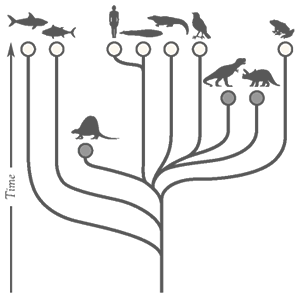
In biology, phylogeny [fahy-loj-uh-nee] refers to the evolutionary relationships among groups of organisms (e.g. species, populations). The term ‘phylogenetics’ derives from the Greek terms ‘phyle’ and ‘phylon,’ denoting ‘tribe’ and ‘race’; and the term ‘genetikos,’ denoting ‘relative to birth,’ from ‘genesis’ (‘origin’). The result of phylogenetic studies is a hypothesis about the evolutionary history of taxonomic groups. Phylogenetic analyses have become essential in researching the evolutionary tree of life. The overall goal of National Science Foundation’s Assembling the Tree of Life activity (AToL) is to resolve evolutionary relationships for large groups of organisms throughout the history of life, with the research often involving large teams working across institutions and disciplines.
Taxonomy, the classification, identification, and naming of organisms, is usually richly informed by phylogenetics, but remains methodologically and logically distinct. The degree to which taxonomy depends on phylogenies differs between schools of taxonomy: ‘numerical taxonomy’ ignored phylogeny altogether, trying to represent the similarity between organisms instead; ‘phylogenetic systematics’ tries to reproduce phylogeny in its classification without loss of information; ‘evolutionary taxonomy’ tries to find a compromise between them in order to represent stages of evolution.
read more »
Virus as Life
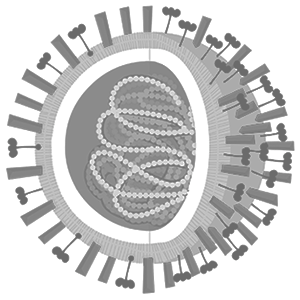
Opinions differ on whether viruses are a form of life, or organic structures that interact with living organisms. They have been described as ‘organisms at the edge of life,’ since they resemble organisms in that they possess genes and evolve by natural selection, and reproduce by creating multiple copies of themselves through self-assembly. Although they have genes, they do not have a cellular structure, which is often seen as the basic unit of life.
Viruses do not have their own metabolism, and require a host cell to make new products. They therefore cannot naturally reproduce outside a host cell (although bacterial species such as chlamydia are considered living organisms despite the same limitation). Accepted forms of life use cell division to reproduce, whereas viruses spontaneously assemble within cells. They differ from autonomous growth of crystals as they inherit genetic mutations while being subject to natural selection. Virus self-assembly within host cells has implications for the study of the origin of life, as it lends further credence to the hypothesis that life could have started as self-assembling organic molecules.
Deutsche Physik
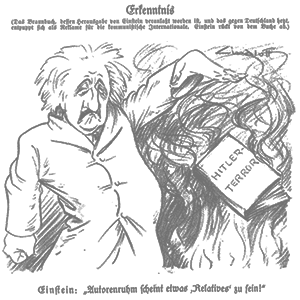
Deutsche Physik (literally: ‘German Physics’) or ‘Aryan Physics’ was a nationalist movement in the German physics community in the early 1930s against the work of Albert Einstein and other modern theoretically based physics, labeled ‘Jewish Physics’ (German: ‘Jüdische Physik’). The term was taken from the title of a 4-volume physics textbook by Philipp Lenard in the 1930s.
This movement began as an extension of a German nationalistic movement in the physics community which went back as far as World War I. In 1915, during fighting between the German army and Belgian resistance fighters after the German invasion in Belgium, the library of the Katholieke Universiteit in Leuven caught fire when German troops looted and set fire to the town. The loss of the library led to a protest note by British scientists, which was signed also by eight distinguished British scientists, namely William Bragg, William Crookes, Alexander Fleming, Horace Lamb, Oliver Lodge, William Ramsay, Baron Rayleigh, and J.J. Thomson, and in which it was assumed that the war propaganda mentioned corresponded to real behavior of German soldiers.
read more »