October 7, 2012
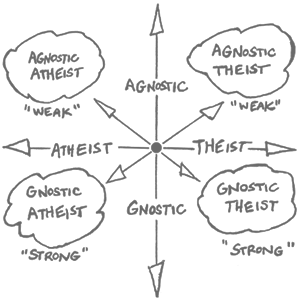
Weak agnosticism is the assertion that, at present, there is not enough information to know whether any deities exist, but that such might become knowable, or that someone may come forward with a conclusive and irrefutable proof for the existence of such deities. It is in contrast to strong agnosticism, which is the belief that the existence of any gods is completely unknowable to humanity. Neither type of agnosticism is fully irreconcilable with theism (belief in a deity or deities) nor atheism (rejecting belief in all deities).
Weak agnostics who also consider themselves theists are likely to acknowledge they have some doubt, though they are not necessarily having a crisis of faith. Weak agnosticism is compatible with weak atheism (wherein a person does not believe in the existence of any deities, but does not explicitly assert there to be none). Weak agnosticism is also referred to as ’empirical agnosticism’ and as ‘negative agnosticism.’ According to Australian philosopher Graham Oppy, weak agnosticism is ‘the view which is sustained by the thesis that it is permissible for reasonable persons to suspend judgement on the question of God’s existence.’
read more »
Posted in Philosophy, Science |
Leave a Comment »
October 1, 2012

Nensha (Chinese: ‘spirit photography’ literally ‘sense inception’), better known to English speakers as ‘thoughtography’ or ‘projected thermography’ or ‘nengraphy,’ is the ability to psychically ‘burn’ images from one’s mind onto surfaces, or even into the minds of others.
It is common in fiction, and made noteworthy by ‘The Ring’ media franchise. While the term ‘thoughtography’ has been in the English lexicon since 1913, the more recent term ‘projected thermography’ is a neologism originating from the 2002 U.S. remake of ‘The Ring.’
read more »
Posted in Death, Philosophy, Science |
Leave a Comment »
October 1, 2012

Ectoplasm [ek-tuh-plaz-uhm] (Greek: ‘ektos,’ meaning ‘outside,’ and ‘plasma,’ meaning ‘something formed or molded’) is a term coined by French physiologist Charles Richet to denote a substance or spiritual energy ‘exteriorized’ by physical mediums (individuals who claim a spiritual connection to the dead).
Ectoplasm is said to be associated with the formation of spirits; however since World War II reports of ectoplasmic phenomena have declined and many psychical researchers doubt whether genuine cases ever existed. Ectoplasm is said to be formed by physical mediums when in a trance state. This material is excreted as a gauze-like substance from orifices on the medium’s body and spiritual entities are said to drape this substance over their nonphysical body, enabling them to interact in the physical and real universe. According to mediums, the ectoplasm can not occur in light conditions as the ectoplasmic substance would disintegrate.
read more »
Posted in Death, Philosophy, Science |
Leave a Comment »
September 30, 2012
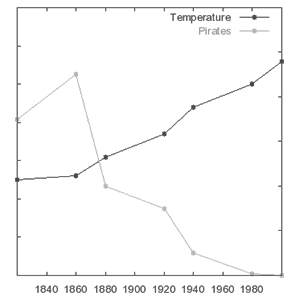
‘Correlation does not imply causation‘ is a phrase used in science and statistics to emphasize that a relationship between two variables does not automatically imply that one causes the other. The opposite belief, ‘correlation proves causation,’ is one of several questionable cause logical fallacies by which two events that occur together are claimed to have a cause-and-effect relationship.
The fallacy is also known as ‘cum hoc ergo propter hoc’ (Latin for ‘with this, therefore because of this’) and ‘false cause.’ It is a common fallacy in which it is assumed that, because two things or events occur together, one must be the cause of the other. By contrast, the fallacy, ‘post hoc ergo propter hoc,’ requires that one event occur after the other, and so may be considered a related fallacy.
read more »
Posted in Health, Language, Science |
Leave a Comment »
September 30, 2012
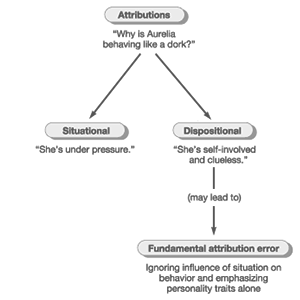
Actor-observer asymmetry (also actor-observer bias) explains the errors that one makes when forming attributions about behavior. When a person judges their own behavior, and they are the actor, they are more likely to attribute their actions to the particular situation than to a generalization about their personality. Yet when a person is attributing the behavior of another person, thus acting as the observer; they are more likely to attribute this behavior to the person’s overall disposition than as a result of situational factors.
People are more likely to see their own behavior as affected by the situation they are in, or the sequence of occurrences that have happened to them throughout their day. But, they see other people’s actions as solely a product of their overall personality, and they do not afford them the chance to explain their behavior as exclusively a result of a situational effect.
read more »
Posted in Health, Science |
Leave a Comment »
September 29, 2012
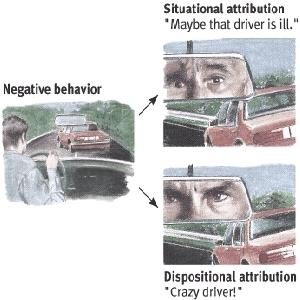
In social psychology, the fundamental attribution error describes the tendency to over-value dispositional or personality-based explanations for the observed behaviors of others while under-valuing situational explanations for those behaviors.
The fundamental attribution error is most visible when people explain the behavior of others. It does not explain interpretations of one’s own behavior—where situational factors are often taken into consideration. This discrepancy is called the actor–observer bias. As a simple example, if Alice saw Bob trip over a rock and fall, Alice might consider Bob to be clumsy or careless (dispositional). If Alice tripped over the same rock herself, she would be more likely to blame the placement of the rock (situational).
read more »
Posted in Health, Science |
Leave a Comment »
September 29, 2012

Backmasking is a recording technique in which a sound or message is recorded backward on to a track that is meant to be played forward. Backmasking is a deliberate process, whereas a message found through ‘phonetic reversal’ may be unintentional. Backmasking was popularized by The Beatles who used backward instrumentation on their 1966 album ‘Revolver.’ Artists have since used backmasking for artistic, comedic and satiric effect, on both analogue and digital recordings.
The technique has also been used to censor words or phrases for ‘clean’ releases of rap songs. Backmasking has been a controversial topic in the United States since the 1980s, when allegations from Christian groups of its use for Satanic purposes were made against prominent rock musicians, leading to record-burning protests and proposed anti-backmasking legislation by state and federal governments.
read more »
Posted in Humor, Philosophy, Science |
Leave a Comment »
September 29, 2012

Subliminal stimuli (literally ‘below threshold’), contrary to ‘supraliminal stimuli’ or ‘above threshold,’ are any sensory stimuli below an individual’s threshold for conscious perception. Some research has found that subliminal messages do not produce strong or lasting changes in behavior. However, a recent review of functional magnetic resonance imaging (fMRI) studies shows that subliminal stimuli activate specific regions of the brain despite participants being unaware.
Visual stimuli may be quickly flashed before an individual can process them, or flashed and then masked, thereby interrupting the processing. Audio stimuli may be played below audible volumes, masked by other stimuli, or recorded backwards in a process called ‘backmasking.’
read more »
Posted in Money, Science |
1 Comment »
September 29, 2012

The mere-exposure effect is a psychological phenomenon by which people tend to develop a preference for things merely because they are familiar with them. In social psychology, this effect is sometimes called the familiarity principle. The effect has been demonstrated with many kinds of things, including words, Chinese characters, paintings, pictures of faces, geometric figures, and sounds. In studies of interpersonal attraction, the more often a person is seen by someone, the more pleasing and likeable that person appears to be.
The earliest known research on the effect was conducted by Gustav Fechner in 1876. Edward B. Titchener also documented the effect and described the ‘glow of warmth’ felt in the presence of something that is familiar. However, Titchener’s hypothesis was thrown out once tested and results showed that the enhancement of preferences for objects did not depend on the individual’s subjective impressions of how familiar the objects were. The rejection of Titchener’s hypothesis spurred further research and the development of current theory.
read more »
Posted in Health, Money, Science |
Leave a Comment »
September 29, 2012

In social psychology, propinquity [proh-ping-kwi-tee] (from Latin: ‘nearness’) is one of the main factors leading to interpersonal attraction. It refers to the physical or psychological proximity between people. Propinquity can mean physical proximity, a kinship between people, or a similarity in nature between things (‘like-attracts-like’).
Two people living on the same floor of a building, for example, have a higher propinquity than those living on different floors, just as two people with similar political beliefs possess a higher propinquity than those whose beliefs strongly differ. Propinquity is also one of the factors, set out by Jeremy Bentham, used to measure the amount of (utilitarian) pleasure in a method known as felicific calculus (which is used to calculate the degree or amount of pleasure that a specific action is likely to cause).
read more »
Posted in Love, Science, Sex |
Leave a Comment »
September 24, 2012

Freethought is a philosophical viewpoint that holds opinions should be formed on the basis of logic, reason, and empiricism and not authority, tradition, or other dogmas.
The pansy is the long-established and enduring symbol of freethought, its usage inaugurated in the literature of the American Secular Union in the late 1800s. The reasoning lies in both the flower’s name and appearance. The pansy derives its name from the French word ‘pensée,’ which means ‘thought;’ it was so named because the flower resembles a human face, and in mid to late summer it nods forward as if deep in thought.
read more »
Posted in Philosophy, Science, World |
Leave a Comment »
September 24, 2012


Secular morality is the aspect of philosophy that deals with morality outside of religious traditions. Modern examples include humanism, freethinking, and most versions of consequentialism. Additional philosophies with ancient roots include those such as Skepticism, which professes that ‘man is the measure of all things.’
Harvard Humanist Chaplain Greg M. Epstein also states that, ‘much of ancient Far Eastern thought is deeply concerned with human goodness without placing much if any stock in the importance of gods or spirits.’ Other philosophers have proposed various ideas about how to determine right and wrong actions. An example is Immanuel Kant’s categorical imperative: ‘The idea that actions can only be considered moral if they could be imitated by anyone else and produce good results.’
read more »
Posted in Philosophy, Science, World |
Leave a Comment »


 The Daily Omnivore