September 11, 2012

The question of whether or not crustaceans can experience pain is unresolved. Because of the ambiguous nature of pain, most people who contend that crustaceans do have this capacity approach the issue using ‘argument by analogy’ – that is, they hold that certain similarities between crustacean and human biology or behaviour warrant an assumption that crustaceans can feel pain.
In vertebrates, endogenous opioids are neurochemicals that moderate pain by interacting with opioid receptors. Opioid peptides (chains of amino acids) and opioid receptors occur naturally in crustaceans, and although ‘at present no certain conclusion can be drawn,’ some have interpreted their presence as an indication that crustaceans may be able to experience pain. Lobsters’ opioids may ‘mediate pain in the same way’ as in vertebrates.
read more »
Posted in Food, Politics, Science |
Leave a Comment »
September 10, 2012
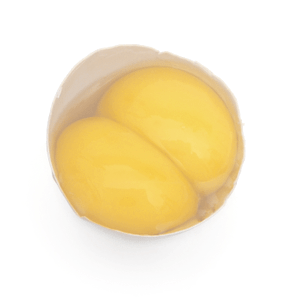
Double-yolk eggs occur when ovulation occurs too rapidly, or when one yolk becomes joined with another yolk. These eggs may be the result of a young hen’s reproductive cycle not yet being synchronized. Some hybrid breeds of hens also produce double-yolk eggs by default. Such eggs are produced in India. Heavier poultry breeds such as the buff Orpington have been known to lay triple yolk eggs in their lifetime. Although heredity causes some hens to have a higher propensity to lay double-yolked eggs, they occur more frequently as occasional abnormalities in young hens beginning to lay. Double-yolked eggs usually only lead to observed successful hatchlings under human intervention, as the chickens interfere with each other’s hatching process and die.
Eggs without yolk are called ‘dwarf’ or ‘wind’ eggs. Such an egg is most often a pullet’s first effort, produced before her laying mechanism is fully ready. In a mature hen, a wind egg is unlikely, but can occur if a bit of reproductive tissue breaks away, stimulating the egg producing glands to treat it like a yolk and wrap it in albumen, membranes and a shell as it travels through the egg tube. An archaic term for a no yolk egg is a ‘cock’ egg. Since they contained no yolk and therefore can’t hatch, it was traditionally believed that these eggs were laid by roosters.
Posted in Food, Science |
Leave a Comment »
September 8, 2012

George Dantzig (1914 – 2005) was an American mathematical scientist who solved two unsolved problems in statistical theory, which he had mistaken for homework after arriving late to a lecture of UC Berkeley statistician Jerzy Neyman. Dantzig was the Professor Emeritus of Transportation Sciences and Professor of Operations Research and of Computer Science at Stanford.
Born in Portland, Oregon, George Bernard Dantzig was named after George Bernard Shaw, the Irish writer. His father, Tobias Dantzig, was a Baltic German mathematician and linguist, and his mother, Anja Dantzig (née Ourisson), was a French linguist. Dantzig’s parents met during their study at the Sorbonne, where Tobias studied mathematics under Henri Poincaré.
read more »
Posted in Education, Money, Science |
Leave a Comment »
September 5, 2012

Limbic regulation is the effect of contact with other people upon the development and stability of personality and mood. The concept was advanced in the book ‘A General Theory of Love’ (2000), and is one of three interrelated concepts central to the book’s premise: that our brain chemistry and nervous systems are measurably affected by those closest to us (limbic resonance); that our systems synchronize with one another in a way that has profound implications for personality and lifelong emotional health (limbic regulation); and that these set patterns can be modified through therapeutic practice (limbic revision).
As the authors poetically frame it: ‘Human physiology finds a hub … in the harmonizing activity of nearby limbic brains. Our neural architecture places relationships at the crux of our lives, where, blazing and warm, they have the power to stabilize. When people are hurting and out of balance, they turn to regulating affiliations: groups, clubs, pets, marriages, friendships, masseuses, chiropractors, the Internet. All carry at least the potential for emotional connection.’
read more »
Posted in Health, Science |
Leave a Comment »
September 5, 2012

Limbic resonance is the capacity for sharing deep emotional states arising from the limbic system of the brain. These states include the dopamine circuit promoted feelings of empathic harmony, and the norepinephrine circuit originated emotional states of fear, anxiety, and anger. The concept was first advanced in the book ‘A General Theory of Love’ (2000). It refers to the capacity for empathy and non-verbal connection that is present in animals, and that forms the basis of our social connections as well as the foundation for various modes of therapy and healing.
According to the authors (Thomas Lewis, M.D, Fari Amini, M.D., and Richard Lannon, M.D.), professors of psychiatry at UCSF, our nervous systems are not self-contained, but rather demonstrably attuned to those around us with whom we share a close connection. ‘Within the effulgence of their new brain, mammals developed a capacity we call ‘limbic resonance’ — a symphony of mutual exchange and internal adaptation whereby two mammals become attuned to each other’s inner states.’
read more »
Posted in Health, Science |
Leave a Comment »
September 5, 2012

Emotional contagion is the tendency to catch and feel emotions that are similar to and associated with those of others. One view developed by Elaine Hatfield, John Cacioppo, and Richard Rapson of the underlying mechanism is that it represents a tendency to mimic and synchronize facial expressions, vocalizations, postures, and movements with those of another person automatically and, consequently, to converge emotionally.
A broader definition of the phenomenon was suggested by Schoenewolf—’a process in which a person or group influences the emotions or behavior of another person or group through the conscious or unconscious induction of emotion states and behavioral attitudes.’
read more »
Posted in Health, Money, Science |
Leave a Comment »
September 4, 2012

Ideasthesia is a neurological or cognitive phenomenon in which activation of a particular concept triggers a sensory-like experience. Specifically it is when activations of concepts (inducers) evoke perception-like experiences (concurrents). The name comes from Greek, meaning sensing concepts or sensing ideas.
The main reason for introducing the notion of ideaesthesia was the empirical evidence indicating that the related term synesthesia (i.e. union of senses) suggests incorrect explanation of a set of phenomena traditionally covered by this heading.
read more »
Posted in Health, Language, Science |
Leave a Comment »
September 4, 2012

Grapheme-color [graf-eem] synesthesia [sin-uhs-thee-zhuh] is a form of synesthesia (mixing of sensations) in which an individual’s perception of numbers and letters is associated with the experience of colors. Like all forms of synesthesia, grapheme-color synesthesia is involuntary, consistent, and memorable. It is one of the most common forms of synesthesia, and because of the extensive knowledge of the visual system, one of the most studied. While it is extremely unlikely that any two synesthetes will report the same colors for all letters and numbers, studies of large numbers of synesthetes find that there are some commonalities across letters (e.g., ‘A’ is likely to be red).
Early studies argued that the condition was not due to associative learning, such as from playing with colored refrigerator magnets. However, one recent study has documented a case of synesthesia in which synesthetic associations could be traced back to colored refrigerator magnets. Despite the existence of this individual case, the majority of synesthetic associations do not seem to be driven by learning of this sort. Rather, it seems that more frequent letters are paired with more frequent colors, and some meaning-based rules, such as ‘b’ being blue, drive most synesthetic associations.
read more »
Posted in Health, Language, Science |
Leave a Comment »
September 4, 2012

Neural oscillation is rhythmic or repetitive neural activity in the central nervous system. In individual neurons, oscillations can appear either as oscillations in membrane potential or as rhythmic patterns of action potentials, which then produce oscillatory activation of post-synaptic neurons. At the level of neural ensembles, synchronized activity of large numbers of neurons can give rise to macroscopic oscillations, which can be observed in the electroencephalogram (EEG).
Oscillatory activity in groups of neurons generally arise from feedback connections between the neurons that result in the synchronization of their firing patterns. The interaction between neurons can give rise to oscillations at a different frequency than the firing frequency of individual neurons. A well-known example of macroscopic neural oscillations is alpha activity, neural oscillations in the frequency range of 8–12 Hz arising from electrical activity of thalamic pacemaker. In lay terms, they are brain waves associated with feelings of relaxation.
read more »
Posted in Health, Science |
Leave a Comment »
September 4, 2012

Sensory deprivation or perceptual isolation is the deliberate reduction or removal of stimuli from one or more of the senses. Simple devices such as blindfolds or hoods and earmuffs can cut off sight and hearing respectively, while more complex devices can also cut off the sense of smell, touch, taste, thermoception (heat-sense), and ‘gravity.’
Sensory deprivation has been used in various alternative medicines and in psychological experiments (e.g., see isolation tank). Short-term sessions of sensory deprivation are described as relaxing and conducive to meditation; however, extended or forced sensory deprivation can result in extreme anxiety, hallucinations, bizarre thoughts, and depression.
read more »
Posted in Health, Science, War |
1 Comment »
September 3, 2012

An isolation tank is a lightless, soundproof tank inside which subjects float in salt water at skin temperature. They were first used by John C. Lilly in 1954 to test the effects of sensory deprivation. Such tanks are now also used for meditation and relaxation and in alternative medicine.
The isolation tank was originally called the sensory deprivation tank. Other names for the isolation tank include flotation tank, John C. Lilly tank, REST tank, sensory attenuation tank, and think tank.
read more »
Posted in Drugs, Health, Science |
Leave a Comment »
September 3, 2012
The International Linear Collider (ILC) is a proposed linear particle accelerator to succeed the Large Hadron Collider (LHC), the world’s largest and highest-energy particle accelerator. The ILC is planned to have a collision energy of 500 GeV initially, with the possibility for a later upgrade to 1,000 GeV (1 TeV).
The host country for the accelerator has not yet been chosen and proposed locations are Japan, Europe (CERN), and the USA (Fermilab). Japan is considered the most likely candidate, as the Japanese government is willing to contribute half of the costs, according to a representative for the European Commission on Future Accelerators.
read more »
Posted in Science, Technology, World |
1 Comment »