February 25, 2012
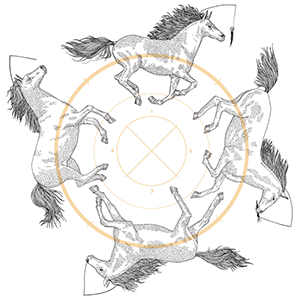
The hedonic treadmill is the supposed tendency of humans to quickly return to a relatively stable level of happiness despite major positive or negative events or life changes. According to this theory, as a person makes more money, expectations and desires rise in tandem, which results in no permanent gain in happiness. Brickman and Campbell coined the term in their essay ‘Hedonic Relativism and Planning the Good Society’ (1971). During the late ’90s, the concept was modified by Michael Eysenck, a British psychology researcher, to become the current ‘hedonic treadmill theory’ which compares the pursuit of happiness to a person on a treadmill, who has to keep working just to stay in the same place. The general idea of the ‘Hedonic (or Happiness) Set Point’ has gained interest throughout the field of positive psychology.
Research supports a three-factor model, where our level of happiness is 50% determined by genetics, 10% determined by outside circumstances, and 40% determined by intentional activities. That last factor, of intentional activities, is the focus of positive psychology, especially because not all activities are equally effective at helping one to reach the higher end of their happiness range. One study concluded that life goals along with personality characteristics are important determinants of one’s subjective well-being. Life goals that enrich one’s relationships and social resources, such as altruistic and family oriented goals, increase their level of subjective well-being. On the other hand, materialistic life goals, such as monetary achievement, have a negative effect on people’s overall subjective well-being.
Posted in Health, Science |
1 Comment »
February 23, 2012

Gravitropism [gra-vitre-pizm] is a turning or growth movement by a plant or fungus in response to gravity.
Charles Darwin was one of the first to scientifically document that roots show positive gravitropism and stems show negative gravitropism. That is, roots grow in the direction of gravitational pull (i.e., downward) and stems grow in the opposite direction (i.e., upwards).
Posted in Language, Science |
Leave a Comment »
February 21, 2012

The Beginning of Infinity is a popular science book by physicist David Deutsch that was published in 2011. Deutsch views the enlightenment of the 18th century as near the beginning of an infinite sequence of purposeful knowledge creation. Knowledge here consists of information with good explanatory function that is resistant to falsifiability. Any real process physically possible is able to be performed provided the knowledge to do so has been acquired.
The enlightenment set up the conditions for knowledge creation which disrupted the static societies that previously existed. These conditions are the valuing of creativity and the free and open debate that exposed ideas to criticism to reveal those good explanatory ideas that naturally resist being falsified due to their having basis in reality. Deutsch points to previous moments in history, such as Renaissance Florence and Plato’s Academy in Golden age Athens, where this process almost got underway before succumbing to their static societies’ resistance to change.
read more »
Posted in Language, Science, Technology |
1 Comment »
February 21, 2012
A Guide for the Perplexed is a short book by E. F. Schumacher, published in 1977. The title is a reference to Maimonides’s ‘The Guide for the Perplexed.’ Schumacher himself considered ‘A Guide for the Perplexed’ to be his most important achievement, although he was better known for his 1974 environmental economics bestseller ‘Small Is Beautiful,’ which made him a leading figure within the ecology movement.
His daughter wrote that her father handed her the book on his deathbed, five days before he died and he told her ‘this is what my life has been leading to.’ The book is a statement of the philosophical underpinnings that inform ‘Small is Beautiful.’
read more »
Posted in Language, Philosophy, Science |
1 Comment »
February 18, 2012

Feral pigeons are derived from domestic pigeons that have returned to the wild. The domestic pigeon was originally bred from the wild Rock dove, which naturally inhabits sea-cliffs and mountains. Feral pigeons find the ledges of buildings to be a substitute for sea cliffs, and have become adapted to urban life and are abundant in towns and cities throughout much of the world.
All pigeons are one species (columba livia). Pigeons breed when the food supply is good, which in cities can be any time of the year. Laying of eggs can take place up to six times per year. Pigeons mate for life, and are often found in pairs during the breeding season, but usually the pigeons are gregarious preferring to exist in flocks of from 50 to 500 birds.
read more »
Posted in Politics, Science, World |
Leave a Comment »
February 17, 2012

The Ganzfeld effect (German: ‘complete field’) is a phenomenon of visual perception caused by staring at an undifferentiated and uniform field of color. The effect is described as the loss of vision as the brain cuts off the unchanging signal from the eyes. The result is ‘seeing black’ – apparent blindness. In the 1930s, research by psychologist Wolfgang Metzger established that when subjects gazed into a featureless field of vision they consistently hallucinated and their electroencephalograms changed. The Ganzfeld effect is the result of the brain amplifying neural noise in order to look for the missing visual signals. The noise is interpreted in the higher visual cortex, and gives rise to hallucinations. This is similar to dream production because of the brain’s state of sensory deprivation during sleep.
The Ganzfeld effect has been reported since ancient times. The adepts of Pythagoras retreated to pitch black caves to receive wisdom through their visions, known as the prisoner’s cinema. Miners trapped by accidents in mines frequently reported hallucinations, visions and seeing ghosts when they were in the pitch dark for days. Arctic explorers seeing nothing but featureless landscape of white snow for a long time also reported hallucinations and an altered state of mind.
Posted in Health, Philosophy, Science |
Leave a Comment »
February 16, 2012

Self-domestication refers to the process of adaptation of wild animals to humans, without direct human selective breeding of the animals. The term is also used to refer to biological processes in the evolution of humans and human culture. Wild animals may self-domesticate when tame behavior enhances their survival near humans.
Tolerating or even enjoying the close approach of humans in order to feed near them, and a lessening of natural adult aggression, are two aspects of tameness. An environment that supports the survival of tame animals can lead to other changes in behavior and appearance as well. Smaller skulls on tame animals have been noticed in other species.
read more »
Posted in Science |
Leave a Comment »
February 15, 2012
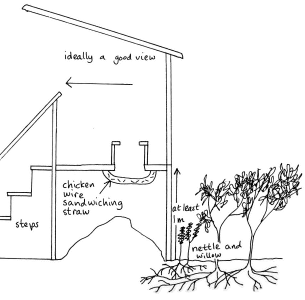
A tree bog is a form of outside toilet which has willows, nettles and other nutrient-hungry flora planted around it. ‘Bog’ is a British English slang word for ‘toilet,’ not to be confused with its other meaning of ‘swampland.’ The feces are held in a chamber open to the air which allows it to decompose rapidly, feeding the trees around it. Unlike a conventional compost toilet, a tree bog should never need emptying. Effectively, it is a system for converting human waste to biomass.
The tree bog was invented in 1995 by Jay Abrahams of Biologic Design in the UK after he observed that the trees around the place where feces were deposited were particularly vigorous. Tree bogs can be considered examples of permaculture design (which seeks to develop sustainable human settlements). The tree bog is a simple method of composting wastes, and since its introduction over 500 have been built in Britain. They have been on sites ranging from fruit farms and pick-your-own enterprises, campsites, and an angling lake, to annual festival sites, remote/low impact dwellings, holiday cottages, and churches.
read more »
Posted in Science |
Leave a Comment »
February 12, 2012
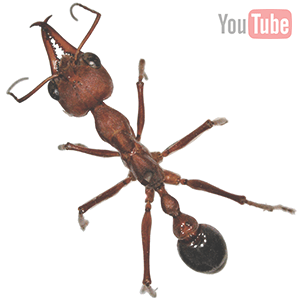
Myrmecia, often called bull ants, is a genus of ants found almost exclusively in Australia. These ants are well-known for their aggressive behavior and powerful stings. The venom of these ants has the potential to induce anaphylactic shock in allergic sting victims. As with most severe allergic reactions, if left untreated the reaction may be lethal. Bull ants eat small insects, honeydew (a sweet, sticky liquid found on leaves, deposited from various insects), seeds, fruit, fungi, gums, and nectar. They have larger eyes, and hence better vision, than most ants.
The bull ant famously appears in the philosopher Arthur Schopenhauer’s major work, ‘The World as Will and Representation,’ as a paradigmatic example of strife and constant destruction endemic to the ‘will to live.’ ‘But the bulldog-ant of Australia affords us the most extraordinary example of this kind; for if it is cut in two, a battle begins between the head and the tail. The head seizes the tail in its teeth, and the tail defends itself bravely by stinging the head: the battle may last for half an hour, until they die or are dragged away by other ants. This contest takes place every time the experiment is tried.’
Posted in Death, Philosophy, Science |
Leave a Comment »
February 9, 2012

A squircle [skwer-kul] is a mathematical shape with properties between those of a square and those of a circle. It is a special case of superellipse. The word ‘squircle’ is a portmanteau of the words ‘square’ and ‘circle.’ A shape similar to a squircle, called a rounded square, may be generated by arranging four quarters of a circle and connecting their loose ends with straight lines. Although constructing a rounded square may be conceptually and physically simpler, the squircle has the simpler equation and can be generalized much more easily. One consequence of this is that the squircle and other superellipses can be scaled up or down quite easily. This is useful where, for example, one wishes to create nested squircles.
Squircles are useful in optics. If light is passed through a two-dimensional square aperture, the central spot in the diffraction pattern can be closely modeled by a squircle (also called a supercircle). If a rectangular aperture is used, the spot can be approximated by a superellipse. Squircles have also been used to construct dinner plates. A squircular plate has a larger area (and can thus hold more food) than a circular one with the same radius, but still occupies the same amount of space in a rectangular or square cupboard. The same is true of a square plate, but there are various problems (such as wiping up sauce) associated with the corners of square plates.
Posted in Science, Technology |
1 Comment »
February 9, 2012

In geometry, a superegg is a solid of revolution obtained by rotating an elongated super-ellipse with exponent greater than 2 around its longest axis. It is a special case of super-ellipsoid. Unlike an elongated ellipsoid, an elongated superegg can stand upright on a flat surface, or on top of another superegg.
This is due to its curvature being zero at the tips. The shape was popularized by Danish poet and scientist Piet Hein (1905–1996). Supereggs of various materials were sold as novelties or ‘executive toys’ in the 1960s. A 1-ton superegg made of steel and aluminum was placed outside Kelvin Hall in Glasgow in 1971, on occasion of a lecture by Piet Hein.
Posted in Art, Science |
Leave a Comment »
February 8, 2012
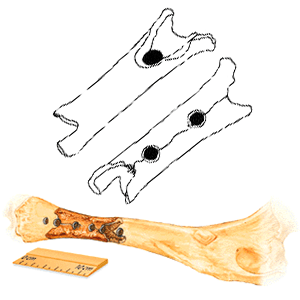
Prehistoric music (previously called primitive music) is a term in the history of music for all music produced in preliterate cultures (prehistory), beginning somewhere in very late geological history. Prehistoric music is followed by ancient music in different parts of the world, but still exists in isolated areas.
Prehistoric music thus technically includes all of the world’s music that has existed before the advent of any currently-extant historical sources concerning that music, for example, traditional Native American music of preliterate tribes and Australian Aboriginal music. However, it is more common to refer to the ‘prehistoric’ music which still survives as folk, indigenous or traditional music. Prehistoric music is studied alongside other periods within Music Archaeology.
read more »
Posted in Art, Science, Technology |
Leave a Comment »



 The Daily Omnivore