September 27, 2011

Stigler’s law of eponymy [uh-pon-uh-mee] is a process proposed by University of Chicago statistics professor Stephen Stigler in his 1980 publication of the same name. In its simplest and strongest form it says: ‘No scientific discovery is named after its original discoverer.’ Stigler named the sociologist Robert K. Merton as the discoverer of ‘Stigler’s law,’ consciously making ‘Stigler’s law’ exemplify Stigler’s law.
For example: Alzheimer’s disease, though named after Alois Alzheimer, had been previously described by at least half a dozen others before Alzheimer’s 1906 report which is often (wrongly) regarded as the first description of the disorder. Historical acclaim for discoveries is often allotted to persons of notoriety who bring attention to an idea that is not yet widely known, whether or not that person was its original inventor – theories may be named long after their discovery.
read more »
Posted in Humor, Language, Science |
1 Comment »
September 25, 2011
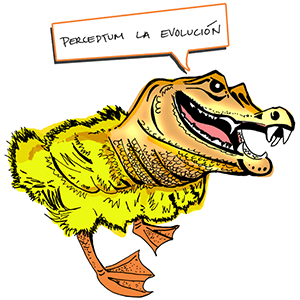
The term ‘crocoduck‘ was originally presented in a 2004 children’s story, ‘Guji Guji.’ The author and illustrator Chih-Yuan Chen produced the bestselling children’s story in 2004 as a modern day twist on The Ugly Duckling story in which a crocodile egg rolls into a duck’s nest and is raised in a brood of ducklings, growing up as a ‘crocoduck’ who thinks he is ‘not a bad crocodile,’ but ‘Of course, I’m not exactly a duck either.’ It was later used by creationists to claim that the absence of any half-crocodile, half-duck creature disproves evolution, an argument that quickly became a popular theme used to ridicule a common misrepresentation of the theory of evolution.
In 2007 creationists Kirk Cameron and Ray Comfort participated in a televised debate, parts of which were aired on ABC Nightline, on the existence of God. Comfort says they produced composite pictures of what ‘we imagined would be genuine species-to-species transitional forms. We called one a ‘crocoduck’ and another was called a ‘birddog.’ These pictures were used to show exactly what they thought evolutionists believe, but can’t back up through the fossil record.’ Their composite picture of the imaginary ‘crocoduck’ showed the head of a crocodile on a duck’s body. However, modern species share a common ancestor, but are neither descended from each other nor from some crude composite chimera, and ducks are not descended from crocodiles.
Posted in Humor, Philosophy, Science |
1 Comment »
September 25, 2011

Menstrual [men-stroo-uhl] synchrony [sing-kruh-nee], also known as the McClintock Effect, or the Wellesley Effect is a phenomenon reported in 1971 wherein the menstrual cycles of women who lived together (such as in homes, prisons, convents, bordellos, dormitories, or barracks) reportedly became synchronized over time. The existence of menstrual synchrony has not been definitively established, and studies investigating it have been controversial.
The phenomenon of menstrual synchrony also addresses the larger question of whether or not humans have and can perceive pheromones, or utilize chemosignaling. Psychologist Martha McClintock was the first scientist to do a study on menstrual synchrony, reporting her findings in ‘Nature’ in 1971.
read more »
Posted in Health, Science, Sex |
2 Comments »
September 20, 2011

Superstition is a belief in a non-physical (i.e. supernatural) causality: that one event causes another without any physical process linking the two events. The word is often used pejoratively to refer to practices (e.g. Voodoo) other than the one prevailing in a given society (e.g. Christianity in western culture), although the prevailing religion may contain just as many supernatural beliefs.
It is also commonly applied to beliefs and practices surrounding luck, prophecy and spiritual beings, particularly the belief that future events can be foretold by specific unrelated prior events.
read more »
Posted in Language, Philosophy, Science |
Leave a Comment »
September 19, 2011

Trichomes [trik-ohm] (from the Greek word ‘trikhoma’ meaning ‘growth of hair’) are structures on plants that look like hairs. Glandular trichomes have chemicals in them. They break when the plant is touched. For example, trichomes on poison ivy leaves have a chemical that causes a rash. Cannabis trichomes produce a psychoactive resin. It is likely that in many cases, plant hairs interfere with the feeding of herbivores. Hairs on plants growing in areas subject to frost keep the frost away from the living surface cells. In windy locations, hairs break-up the flow of air across the plant surface, reducing evaporation. Dense coatings of hairs reflect solar radiation, protecting the more delicate tissues underneath in hot, dry, open habitats. And in locations where much of the available moisture comes from cloud drip, hairs appear to enhance this process.
They occur only on plants and certain protists (a type of single-celled organism). Certain algae, have their terminal cell shaped into an elongate ‘hair-like’ structure called a trichome. The same term is applied to such structures in some cyanobacteria (bacterium which rely on photosynthesis). Trichomes on plants are epidermal outgrowths of various kinds. The terms ’emergences,’ ‘thorns,’ ‘spines,’ and ‘prickles’ refer to outgrowths that involve more than the epidermis (the outermost layer of the plant). See for example, the ‘wait-a-minute tree,’ which has numerous hooked thorns with the shape and size of a cat’s claw, that tend to hook onto passers-by; the hooked person must stop (‘wait a minute’) to remove the thorns carefully to avoid injury.
Posted in Drugs, Language, Science |
Leave a Comment »
September 15, 2011

Lewis Hine (1874 – 1940) was an American sociologist and photographer. Hine used his camera as a tool for social reform. His photographs were instrumental in changing the child labor laws in the United States. Born in Oshkosh, Wisconsin in 1874. After his father died in an accident, he began working and saved his money for a college education.
Hine studied sociology at the University of Chicago, Columbia University and New York University. He became a teacher in New York City at the Ethical Culture School, where he encouraged his students to use photography as an educational medium. The classes traveled to Ellis Island in New York Harbor, photographing the thousands of immigrants who arrived each day. Between 1904 and 1909, Hine took over 200 plates (photographs), and eventually came to the realization that his vocation was photojournalism.
read more »
Posted in Money, Politics, Science |
Leave a Comment »
September 11, 2011

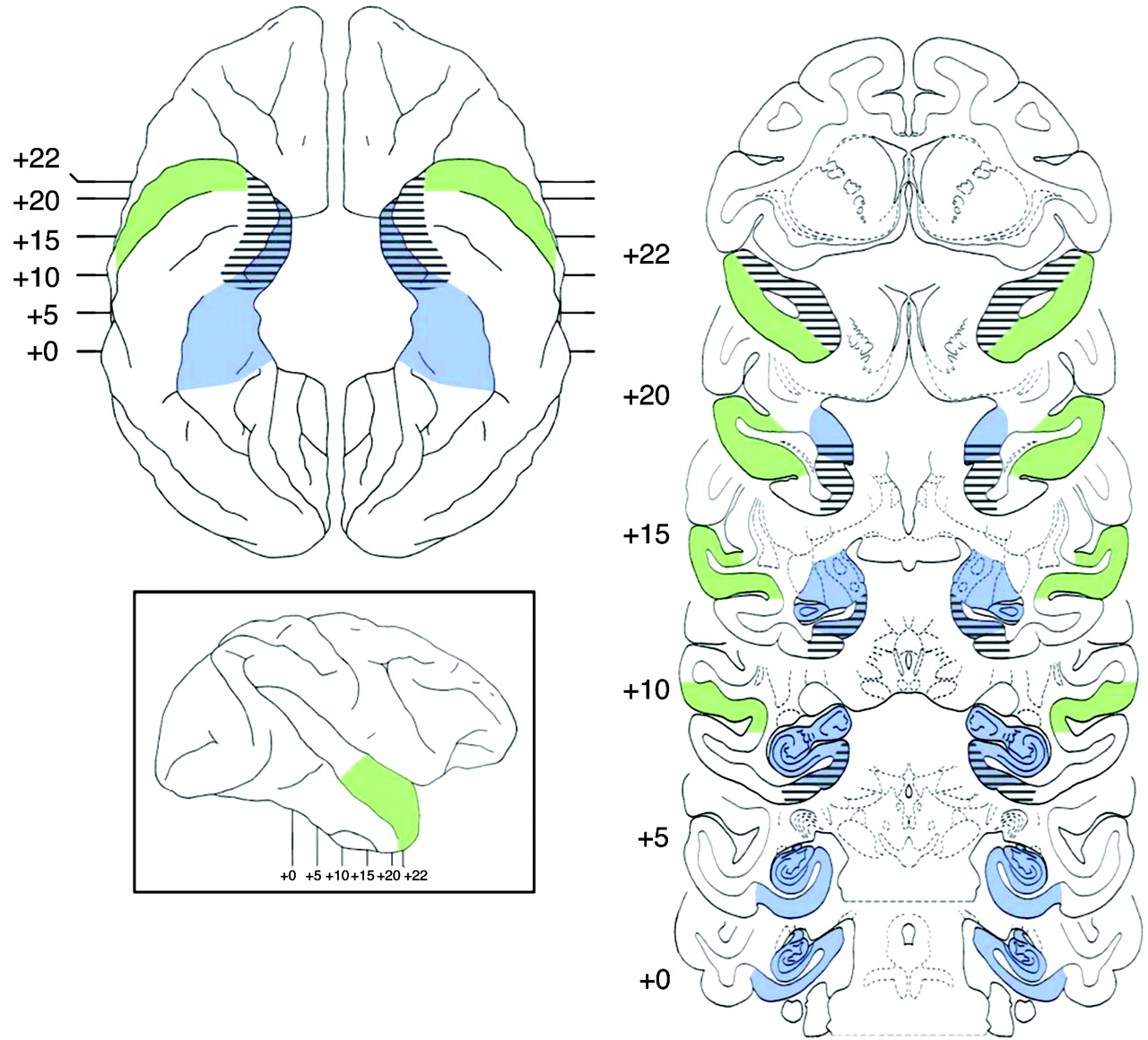
Engrams [en-gram] are a hypothetical means by which memory traces are stored as biophysical or biochemical changes in the brain (and other neural tissue) in response to external stimuli. They are also sometimes thought of as a neural network or fragment of memory, sometimes using a hologram analogy to describe its action in light of results showing that memory appears not to be localized in the brain. The existence of engrams is posited by some scientific theories to explain the persistence of memory and how memories are stored in the brain. The existence of neurologically defined engrams is not significantly disputed, though their exact mechanism and location has been a focus of persistent research for many decades.
The term was coined by the little-known but influential German evolutionary biologist Richard Semon. Overall, the mechanisms of memory are poorly understood. Such brain parts as the cerebellum, striatum, cerebral cortex, hippocampus, and amygdala are thought to play an important role in memory. For example, the hippocampus is believed to be involved in spatial and declarative learning, as well as consolidating short-term into long-term memory.
read more »
Posted in Health, Language, Science |
Leave a Comment »
September 9, 2011

Experiential avoidance (EA) has been broadly defined as attempts to avoid thoughts, feelings, memories, physical sensations, and other internal experiences—even when doing so creates harm in the long-run. The process of EA is thought to be maintained through negative reinforcement—that is, short-term relief of discomfort is achieved through avoidance, thereby increasing the likelihood that the behavior will persist.
Importantly, the current conceptualization of EA suggests that it is not negative thoughts, emotions, and sensations that are problematic, but how one responds to them that can cause difficulties. In particular, a habitual and persistent unwillingness to experience uncomfortable thoughts and feelings (and the associated avoidance and inhibition of these experiences) is thought to be linked to a wide range of problems.
read more »
Posted in Health, Language, Science |
Leave a Comment »
September 9, 2011
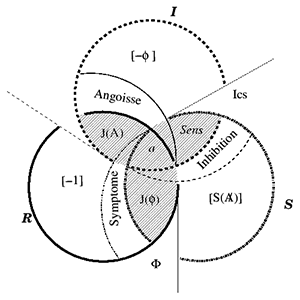
In Freudian psychology, the pleasure principle is the psychoanalytic concept describing people seeking pleasure and avoiding suffering (pain) in order to satisfy their biological and psychological needs. Furthermore, the counterpart concept, the ‘reality principle,’ describes people choosing to defer gratification of a desire when circumstantial reality disallows its immediate gratification. In infancy and early childhood, the Id (one of the three components of Freud’s model of the psyche) rules behavior by obeying only the pleasure principle. Maturity is learning to endure the pain of deferred gratification, when reality requires it; thus, the psychoanalitic Sigmund Freud proposes that ‘an ego thus educated has become ‘reasonable’; it no longer lets itself be governed by the pleasure principle, but obeys the reality principle, which also, at bottom, seeks to obtain pleasure, but pleasure which is assured through taking account of reality, even though it is pleasure postponed and diminished.’
Sigmund Freud discusses this idea, pleasure principle, and its limits in more details in his book, ‘Beyond the Pleasure Principle,’ published in 1921. In his discussion of the opposition between Eros, the life instinct, and the Thanatos, the death instinct, he examines the role of the repetition compulsion caused by the pleasure principle and of the sexual instincts.
Posted in Health, Language, Science |
Leave a Comment »
September 7, 2011

Stereotype threat is the experience of anxiety or concern in a situation where a person has the potential to confirm a negative stereotype about their social group. First described by social psychologist Claude Steele and his colleagues, stereotype threat has been shown to reduce the performance of individuals who belong to negatively stereotyped groups.
For example, stereotype threat can lower the intellectual performance of African-Americans taking the SAT reasoning test used for college entrance in the United States, due to the stereotype that African-Americans are less intelligent than other groups. Since its introduction into the scientific literature in 1995, stereotype threat has become one of the most widely studied topics in the field of social psychology.
read more »
Posted in Language, Science |
Leave a Comment »
August 26, 2011

The matching hypothesis is a popular psychology and social psychology theory, proposed by Elaine Hatfield and her colleagues in 1966, which suggests why people become attracted to their partner. It claims that people are more likely to form long standing relationships with someone who is as equally physically attractive as they are. This is influenced by realistic choices, desire of the match and good probability of obtaining the date.
In successful couples in which the partners differ greatly in physical attractiveness, it is likely that the less attractive partner has compensating qualities to offer. For instance, some men with wealth and status desire younger, more attractive women, and some women are more likely to overlook physical attractiveness for men who possess wealth and status.
read more »
Posted in Science, Sex |
1 Comment »
August 26, 2011
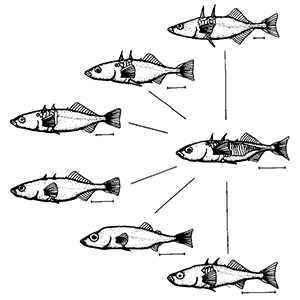
Assortative mating is the phenomenon where a sexually reproducing organism chooses to mate with individuals that are similar (positive assortative mating) or dissimilar (negative assortative mating) to itself in some specific manner. In evolution, these two types of assortative mating have the effect, respectively, of increasing or reducing the range of variation (trait variance), when the assorting is cued on heritable traits. Positive assortative mating, therefore, results in disruptive natural selection, and negative assortative mating results in stabilized natural selection.
Assortative mating has been invoked to explain sympatric speciation (the process through which new species evolve from a single ancestral species while inhabiting the same geographic region). For some populations there are two different resources for which different phenotypes (genetic traits) are optimum. Intermediates between these two phenotypes are less favorable. It is then favorable if the organisms can recognize mates that are optimized for the same resources as they are themselves. If mutations that make such recognition possible appear, these will be selected for.
read more »
Posted in Health, Science, Sex |
Leave a Comment »




 The Daily Omnivore