August 25, 2011

In decision making and psychology, decision fatigue refers to the deteriorating quality of decisions made by an individual, after a long session of decision making. It is now understood as one of the causes of irrational trade-offs in decision making. For instance, judges have been shown to make poorer decisions later in the day. Decision fatigue can not only results in fast and careless decisions, but even in decision paralysis where no decision is made at all. In the formal approach to decision quality management, specific techniques have been devised to help managers cope with decision fatigue.
Trade-offs, where either of two choices have positive and negative elements, are an advanced and energy consuming form of decision making. A person who is mentally depleted becomes reluctant to make trade-offs, or makes very poor choices. Jonathan Levav at Stanford University designed experiments showing how decision fatigue can leave a person vulnerable to sales and marketing strategies designed to time the sale.
read more »
Posted in Health, Money, Science |
Leave a Comment »
August 25, 2011
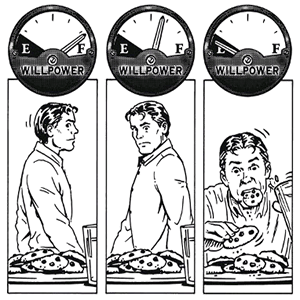
Ego depletion refers to the idea that self-control or willpower is an exhaustible resource that can be used up. When that energy is low, mental activity that requires self-control is impaired. In other words, using one’s self-control impairs the ability to control one’s self later on. In an illustrative experiment on ego depletion, participants who controlled themselves by trying not to laugh while watching a comedian did worse on a later task that required self-control compared to participants who watching the video and were free to laugh.
Much of the early research on ego depletion was performed by social psychologists Roy Baumeister, Mark Muraven, and their colleagues. In a recent series of studies, they suggest that a positive mood stimulus could help restore the depleted energy. For example, watching short clips of stand-up comedy by Robin Williams and Eddie Murphy can restores the capacity to self-regulate. The work is experimental and does not consider in depth the mechanisms by which performance is restored. Whether it is because of an actual restoration of self-regulatory resources or provides an additional motivation to press on with a depleted self remains an open question., and a study from Carol Dweck and other researchers from Stanford University, questions the ego depletion theory, and presents evidence that ‘a person’s mindset and personal beliefs about willpower determine how long and how well they’ll be able to work on a tough mental exercise.’
Posted in Health, Language, Science |
Leave a Comment »
August 25, 2011

Persistence hunting is a hunting technique in which hunters use a combination of running and tracking to pursue prey to the point of exhaustion. While humans can sweat to reduce body heat their quadruped prey would need to slow from a gallop to pant. Today, it is very rare and seen only in a few groups such as Kalahari bushmen and the Tarahumara or Raramuri people of Northern Mexico. Persistence hunting requires endurance running – running many miles for extended periods of time. Among primates, endurance running is only seen in humans, and persistence hunting is thought to have been one of the earliest forms of human hunting, having evolved 2 million years ago.
The persistence hunt may well have been the first form of hunting practiced by hominids. It is likely that this method of hunting evolved before humans invented projectile weapons, such as darts, spears, or slings. Since they could not kill their prey from a distance and were not fast enough to catch the animal, one reliable way to kill it would have been to run it down over a long distance.
read more »
Posted in Food, Games, Science |
1 Comment »
August 17, 2011
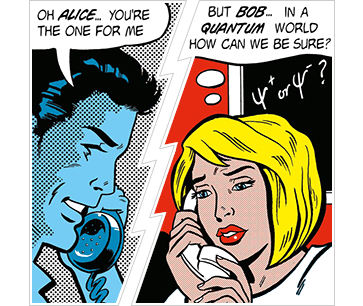
The names Alice and Bob are commonly used placeholder names for archetypal characters in fields such as cryptography and physics. The names are used for convenience; for example, ‘Alice sends a message to Bob encrypted with his public key’ is easier to follow than ‘Party A sends a message to Party B encrypted by Party B’s public key.’ Following the alphabet, the specific names have evolved into common parlance within these fields—helping technical topics to be explained in a more understandable fashion.
In cryptography and computer security, there are a number of widely used names for the participants in discussions and presentations about various protocols. The names are conventional, somewhat self-suggestive, sometimes humorous, and effectively act as metasyntactic variables. In typical implementations of these protocols, it is understood that the actions attributed to characters such as Alice or Bob need not always be carried out by human parties directly, but also by a trusted automated agent (such as a computer program) on their behalf. Despite the advantage of Alice and Bob’s distinct genders in reducing ambiguity, there has been little tendency to introduce inanimate parties so they could be referred by neuter pronouns.
read more »
Posted in Language, Science, Technology |
1 Comment »
August 17, 2011
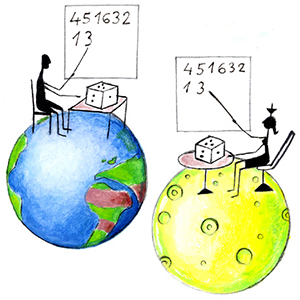
An ansible [an-si-bull] is a hypothetical machine capable of instantaneous or superluminal (faster-than-light) communication. They are used as science fiction plot devices and in thought experiments of theoretical physics. The word was coined by American author Ursula K. Le Guin in her 1966 novel, ‘Rocannon’s World.’
She derived the name from ‘answerable,’ as the device would allow its users to receive answers to their messages in a reasonable amount of time, even over interstellar distances. The name of the device has since been borrowed by authors such as Orson Scott Card and Vernor Vinge; similar devices are present in the works of numerous others, such as Frank Herbert. One ansible-like device which predates Le Guin’s is the ‘Dirac communicator’ in James Blish’s 1954 short story ‘Beep.’ The device received the sum of all transmitted messages in universal space-time, in a single pulse, so that demultiplexing yielded information about the past, present, and future.
read more »
Posted in Language, Science, Technology |
Leave a Comment »
August 15, 2011

In mathematics education, number sense can refer to ‘an intuitive understanding of numbers, their magnitude, relationships, and how they are affected by operations.’ Some definitions emphasize an ability to work outside of the traditionally taught algorithms, e.g., ‘a well organized conceptual framework of number information that enables a person to understand numbers and number relationships and to solve mathematical problems that are not bound by traditional algorithms.’
There are also some differences in how number sense is defined in the field of mathematical cognition. For example, Gersten and Chard say number sense ‘refers to a child’s fluidity and flexibility with numbers, the sense of what numbers mean and an ability to perform mental mathematics and to look at the world and make comparisons.’ Researchers consider number sense to be of prime importance for children in early elementary education, and the National Council of Teachers of Mathematics has made number sense a focus area of pre-K through 2nd grade mathematics education. An active area of research is to create and test teaching strategies to develop children’s number sense.
Posted in Education, Science |
1 Comment »
August 14, 2011

Greenwashing (a compound word modelled on ‘whitewash’), or ‘green sheen,’ is a form of spin in which ‘green’ PR or ‘green’ marketing is deceptively used to promote the perception that a company’s policies or products are environmentally friendly. The term was coined by New York environmentalist Jay Westerveld in a 1986 essay regarding the hotel industry’s practice of placing placards in each room promoting reuse of towels ostensibly to ‘save the environment.’
Westerveld noted that, in most cases, little or no effort toward reducing energy waste was being made by these institutions — as evidenced by the lack of cost reduction this practice effected. Westerveld opined that the actual objective of this ‘green campaign’ on the part of many hoteliers was, in fact, increased profit. Westerveld thus labeled this and other outwardly environmentally conscientious acts with a greater, underlying purpose of profit increase as greenwashing.
read more »
Posted in Money, Politics, Science |
1 Comment »
August 8, 2011

In psychogeography, a dérive is an unplanned journey through a landscape, usually urban, in which an individual travels where the subtle aesthetic contours of the surrounding architecture and geography subconsciously direct them with the ultimate goal of encountering an entirely new and authentic experience. Situationist theorist Guy Debord defines the dérive as ‘a mode of experimental behavior linked to the conditions of urban society: a technique of rapid passage through varied ambiances.’ He also notes that ‘the term also designates a specific uninterrupted period of dériving.’ The term is literally translated into English as ‘drift.’
The concept of the dérive has its origins in the Letterist International of the 1940s, an artistic and political collective based in Paris, where it was a critical tool for understanding and developing the theory of psychogeography, defined as the ‘specific effects of the geographical environment (whether consciously organized or not) on the emotions and behavior of individuals.’ The dérive, an unplanned tour through an urban landscape directed entirely by the feelings evoked in the individual by their surroundings, served as the primary means for mapping and investigating the psychogeography of these different areas.
read more »
Posted in Games, Science |
Leave a Comment »
August 7, 2011

A false awakening is a vivid dream about awakening from sleep. After a false awakening, subjects often dream they are performing daily morning rituals such as cooking, cleaning and eating. The experience is sometimes called a double dream, or a dream within a dream. A false awakening may occur following an ordinary dream or following a lucid dream (one in which the dreamer has been aware of dreaming). Particularly if the false awakening follows a lucid dream, the false awakening may turn into a ‘pre-lucid dream,’ that is, one in which the dreamer may start to wonder if they are really awake and may or may not come to the correct conclusion.
In a study by Harvard psychologist Deirdre Barrett, 2,000 dreams from 200 subjects were examined and it was found that false awakenings and lucidity were significantly more likely to occur within the same dream or within different dreams of the same night. False awakenings often preceded lucidity as a cue, but they could also follow the realization of lucidity, often losing it in the process.
read more »
Posted in Health, Philosophy, Science |
Leave a Comment »
August 7, 2011
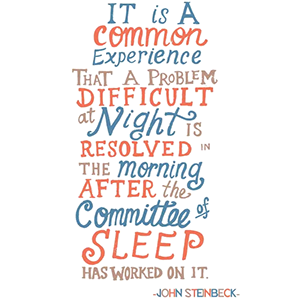
Dream incubation is a practiced technique of learning to ‘plant a seed’ in the mind, in order for a specific dream topic to occur, either for recreation or to attempt to solve a problem. For example, a person might go to bed repeating to themselves that they will dream about a presentation they have coming up, or a vacation they recently took, or a person they are interested in. While somewhat similar to lucid dreaming, dream incubation is simply focusing attention on a specific issue when going to sleep. Several studies have shown this method to be successful over a period of time.
For example, in a study at Harvard Medical School, Dr. Deirdre Barrett had her students focus on a problem, such as an unsolved homework assignment or other objective problem, before going to sleep each night for a week. She found that it was possible to develop novel solutions in dreams that were both satisfactory to the dreamer and rated as objectively solving the problem by an outside observer. In her study, two-thirds of participants had dreams that addressed their chosen problem, and one-third reached some form of solution within their dreams.
read more »
Posted in Science |
Leave a Comment »
August 6, 2011

Aposematism [app-uh-sem-uh-tizm], perhaps most commonly known in the context of warning coloration, describes a family of antipredator adaptations where a warning signal is associated with the unprofitability of a prey item to potential predators. It is one form of ‘advertising’ signal, with many others existing such as the bright colors of flowers which lure pollinators. The warning signal may take the form of conspicuous colors, sounds, odors, or other perceivable characteristics. Aposematic signals are beneficial for both the predator and prey, who both avoid potential harm.
This tendency to become highly noticeable and distinct from harmless organisms is the antithesis of crypsis, or avoidance of detection. Aposematism has been such a successful adaptation that harmless organisms have repeatedly evolved to mimic aposematic species, a pattern known as Batesian mimicry. Another related pattern is Müllerian mimicry, where aposematic species come to resemble one another.
read more »
Posted in Science |
Leave a Comment »
August 5, 2011
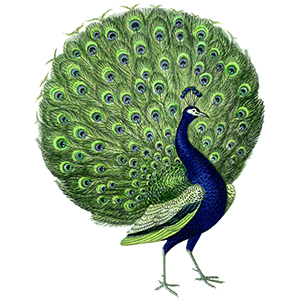
The handicap principle is a hypothesis originally proposed in 1975 by biologist Amotz Zahavi to explain how evolution may lead to ‘honest’ or reliable signaling between animals who have an obvious motivation to bluff or deceive each other. The handicap principle suggests that reliable signals must be costly to the signaler, costing the signaler something that could not be afforded by an individual with less of a particular trait.
For example, in the case of sexual selection, the theory suggests that animals of greater biological fitness signal this status through handicapping behavior or morphology that effectively lowers this quality. The central idea is that sexually selected traits function like conspicuous consumption, signalling the ability to afford to squander a resource simply by squandering it. Receivers know that the signal indicates quality because inferior quality signalers cannot afford to produce such wastefully extravagant signals.
read more »
Posted in Money, Science, Sex |
Leave a Comment »



 The Daily Omnivore