April 21, 2011

Transitional fossils are the fossilized remains of intermediary forms of life that illustrate an evolutionary transition. They can be identified by their retention of certain primitive traits in comparison with their more derived relatives. Numerous examples exist, including those of primates and early humans.
read more »
Posted in Language, Science |
Leave a Comment »
April 20, 2011

Hash oil is an evaporated solution of THC (tetrahydrocannabinol, the principal psychoactive constituent of the cannabis plant) and various other compounds. It is traditionally a dark, viscous liquid made by solvent (e.g. butane, alcohol, acetone) extraction of cannabis resin. Despite the similarity in names, it does not resemble hashish. It can be a very potent medication due to its high THC concentration, which generally varies between 60% and 90%.
Related honey oil is a specific type of hash oil. It can be vaporized off improvised devices; such as a an electric stove element, car cigarette lighter, or pressed between two heated knives (known as blades, spotting or hot knifing). The vapor can then be inhaled through a hollow tube, often an empty pen tube called a hooter.
Posted in Drugs, Science |
Leave a Comment »
April 20, 2011

Morning Star is a highly potent strain of cannabis that is distributed in California as part of its medical marijuana program. It is known to have as much as 24% THC content. The amount of THC present in a cannabis sample is generally used as a measure of cannabis potency.
The three main forms of cannabis products are the herb (marijuana), resin (hashish), and oil (hash oil). Marijuana often contains 5% THC content, resin 20%, and cannabis oil may contain more than 60%. The Morning Star strain is available at Leaf Lab located in San Jose, CA.
Posted in Drugs, Health, Science |
Leave a Comment »
April 14, 2011

The weasel war dance is a colloquial term for a behavior of excited ferrets and weasels. In wild animals, it is speculated that this dance is used to confuse or disorient prey. In domestic animals, the war dance usually follows play or the successful capture of a toy or a stolen object.
It consists of a frenzied series of sideways and backwards hops, often accompanied by an arched back, hissing noises, and a frizzy tail. Ferrets are notoriously clumsy in their surroundings during their dance and will often bump into or fall over objects and furniture. Although the weasel war dance may make a ferret appear frightened or angry, they are often just excited and are usually harmless to humans.
Posted in Humor, Science |
Leave a Comment »
April 13, 2011

Dichroic [dahy-kroh-ik] glass is glass containing multiple micro-layers of metal oxides which alter its optical properties. The invention of dichroic glass is often erroneously attributed to NASA and its contractors, who developed it for use in dichroic filters.
Dichroic glass dates back to at least the 4th century CE as seen in the Lycurgus cup, a Roman relic.
read more »
Posted in Art, Science, Technology |
2 Comments »
April 12, 2011
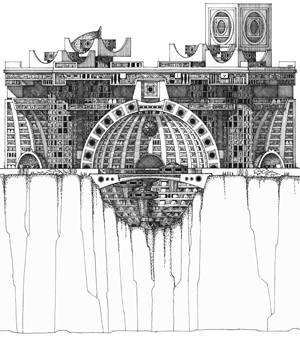
Arcosanti is an experimental town that began construction in 1970 in central Arizona, 70 mi (110 km) north of Phoenix, at an elevation of 3,732 feet (1,130 meters).
Architect Paolo Soleri, using a concept he calls arcology (a portmanteau of architecture and ecology), started the town to demonstrate how urban conditions could be improved while minimizing the destructive impact on the earth.
read more »
Posted in Money, Science, Technology |
Leave a Comment »
April 12, 2011

The Anthropocene [an-thruh-poh-seen] is a proposed geological epoch that marks the impact of human activities on the Earth’s ecosystems. The term was coined in 2000 by the Nobel Prize-winning atmospheric chemist Paul Crutzen, who regards the influence of human behavior on the Earth’s atmosphere in recent centuries as so significant as to constitute a new geological era for its lithosphere (the rigid outermost shell of a rocky planet). As early as 1873, the Italian geologist Antonio Stoppani acknowledged the increasing power and impact of humanity on the Earth’s systems and referred to the ‘anthropozoic era’
The Anthropocene has no precise start date, but based on atmospheric evidence may be considered to start with the Industrial Revolution (late 18th century). Other scientists link it to earlier events, such as the rise of agriculture. Human influence on land use, ecosystems, biodiversity and species extinctions, may have begun as early as 10,000 years before present. This period (10,000 years to present) is usually referred to as the Holocene by geologists. For the majority of the Holocene, human populations were relatively low and their activities considerably muted relative to that of the last few centuries. Nonetheless, many of the processes currently altering the Earth’s environment were already occurring.
Posted in Language, Science, Technology |
Leave a Comment »
April 12, 2011

Highway hypnosis, also popularly known as ‘driving without attention mode’ or ‘white line fever,’ is a mental state in which a person can drive a motor vehicle great distances, responding to external events in the expected manner with no recollection of having consciously done so. In this state the driver’s conscious mind is apparently fully focused elsewhere, with seemingly direct processing of the masses of information needed to drive safely. Highway hypnosis is just one manifestation of a relatively commonplace experience, where the conscious and unconscious minds appear to concentrate on different things.
Building on the theories of American psychologist, Ernest Hilgard (1904 – 2001), that hypnosis is an altered state of awareness, some theorists hold that the consciousness can develop hypnotic dissociation. In the example of highway hypnosis, one stream of consciousness is driving the car while the other stream of consciousness is dealing with other matters. Amnesia can even develop for the dissociated consciousness that drove the automobile. The phenomenon is an example of automaticity in cognitive psychology.
Posted in Health, Language, Science |
Leave a Comment »
April 12, 2011

Automaticity [aw-tuh-mah-tis-i-tee] is the ability to do things without occupying the mind with the low-level details required, allowing it to become an automatic response pattern or habit. It is usually the result of learning, repetition, and practice. Examples of automaticity are common activities such as speaking, bicycle-riding, assembly-line work, and driving a car.
After an activity is sufficiently practiced, it is possible to focus the mind on other activities or thoughts while undertaking an automaticized activity (for example, holding a conversation or planning a speech while driving a car). Walking is not an example of automaticity as it is not a cortical function. It is a medullary function, with specific medullary circuits, which can be learnt to be inhibited or altered by higher-order ones.
Posted in Health, Language, Science |
Leave a Comment »
April 12, 2011

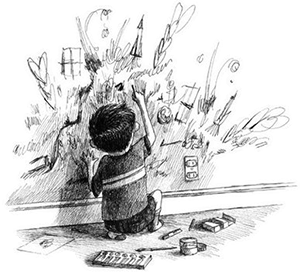
The hunter vs. farmer hypothesis is a hypothesis proposed by American author and former psychotherapist, Thom Hartmann, about the origins of attention-deficit hyperactivity disorder (ADHD), suggesting that the condition may be an adaptive behavior. Hartmann proposes that the high frequency of ADHD in contemporary settings represents otherwise normal behavioral strategies that become maladaptive in such evolutionarily novel environments as the formal school classroom. Genetic variants conferring susceptibility to ADHD are very frequent—implying that the trait had provided selective advantage in the past.
Hartmann notes that most or all humans were nomadic hunter gatherers for hundreds of thousands of years, but that this standard gradually changed as agriculture developed in most societies, and more people worldwide became farmers. Over many years, most humans adapted to farming cultures, but Hartmann speculates that people with ADHD retained some of the older hunter characteristics. The theory also explains the distractibility factor in ADHD individuals and their short attention span, along with various other characteristics, such as apathy towards social norms, poor planning and organizing ability, distorted sense of time, impatience, and impulsiveness.
Posted in Health, Science |
Leave a Comment »
April 11, 2011

The Candle Problem is a cognitive performance test, measuring the influence of functional fixedness on a participant’s problem solving capabilities. The test was created by Gestalt psychologist Karl Duncker and published posthumously in 1945. The test presents the participant with the following task: how to fix a lit candle on a wall (a cork board) in a way so the candle wax won’t drip onto the table below. To do so, one may only use the following along with the candle: a book of matches and a box of thumbtacks.
The solution is to empty the box of thumbtacks, put the candle into the box, use the thumbtacks to nail the box (with the candle in it) to the wall, and light the candle with the match. The concept of functional fixedness predicts that the participant will only see the box as a device to hold the thumbtacks and not immediately perceive it as a separate and functional component available to be used in solving the task. However, if the task is presented with the tacks piled next to the box (rather than inside it), virtually all of the participants were shown to achieve the optimal solution.
Posted in Games, Science |
Leave a Comment »
April 11, 2011

Mike Alder is an Australian mathematician and philosopher known for his popular writing, such as sardonic articles about the lack of basic arithmetic skills in young adults. ‘Newton’s flaming laser sword’ is a philosophical razor devised by Alder in 2004 on the conflicting positions of scientists and philosophers on epistemology (the study of knowledge).
The razor is humorously named after Isaac Newton, as it is inspired by Newtonian thought, and is ‘much sharper and more dangerous than Occam’s Razor.’
read more »
Posted in Language, Philosophy, Science |
Leave a Comment »





 The Daily Omnivore