March 10, 2011

Beer head is the frothy foam on top of beer after it is poured in a glass. It is produced by bubbles of carbon dioxide rising to the surface. The density and longevity of the head will be determined by the type of malt and adjunct from which the beer was fermented. In general, wheat tends to produce larger and longer lasting heads than barley.
The carbon dioxide may be produced naturally through the activity of brewer’s yeast, or artificially by dissolving carbon dioxide under pressure into the liquid. The beer head is created by the carbon dioxide produced as a byproduct of the metabolism of brewer’s yeast acting upon starches and sugars found in the wort.
read more »
Posted in Drugs, Food, Science |
Leave a Comment »
March 10, 2011
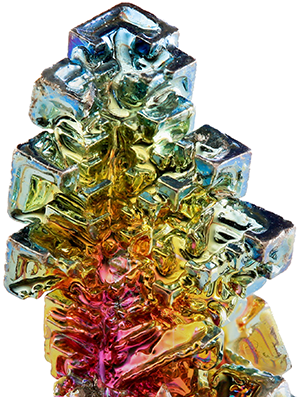
A hopper crystal is a form of crystal, defined by its ‘hoppered’ shape: the edges are fully developed, but the interior spaces are not filled in due to rapid growth. This results in what appears to be a hollowed out step lattice formation; the interior edges still show the crystal form characteristic to the specific mineral, and so appear to be a series of smaller and smaller stepped down miniature versions of the original crystal.
Hoppering occurs when electrical attraction is higher along the edges of the crystal, causing faster growth at edges than near face centers. This attraction draws the mineral molecules more strongly than the interior sections of the crystal, thus the edges develop more quickly. Hoppering is common in many minerals, including lab-grown bismuth, galena, quartz (called skeletal or fenster crystals), gold, calcite, halite (salt), and water (ice).
Posted in Science |
Leave a Comment »
March 10, 2011

The Strauss-Howe generational theory, created by historians William Strauss and Neil Howe, identifies a recurring generational cycle in American history. Strauss and Howe lay the groundwork for the theory in their 1991 book Generations, which retells the history of America as a series of generational biographies going back to 1584.
Former U.S Vice President Al Gore called Generations the most stimulating book on American history he’d ever read, and sent a copy to each member of Congress. Some reviewers of the duo’s books, such as the New York Times’ Michael Lind have criticized their theories for being too vague, and for verging into the realm of pseudoscience.
read more »
Posted in Politics, Science |
Leave a Comment »
March 10, 2011
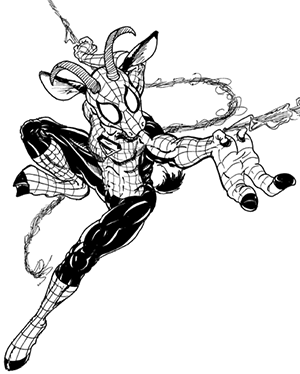
Spider silk is a protein fiber spun by spiders. Spiders use their silk to make webs or other structures, which function as nets to catch other animals, or as nests or cocoons for protection for their offspring. They can also suspend themselves using their silk.
Spider silk is a remarkably strong material. Its tensile strength is comparable to that of high-grade steel, and about half as strong as Kevlar, but Spider silk is about a fifth of the density of steel; a strand long enough to circle the Earth would weigh less than 500 grams (18 oz).
read more »
Posted in Money, Science, Technology |
Leave a Comment »
March 9, 2011
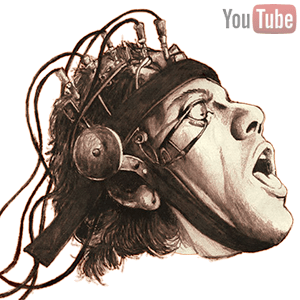
The Ludovico technique is a fictional drug-assisted aversion therapy from the novel and film ‘A Clockwork Orange.’ It involves the patient being forced to watch violent images for long periods of time, while under the effect of drugs that cause a near death experience. The idea is that if the patient is forced to watch the horribly graphic rapes, assaults and other acts of violence while suffering from the drug effects, the patient will assimilate the sensations and then become incapacitated or very ill either attempting to perform or even just witnessing said acts of violence.
The concept is an artistic semblance of the psychological phenomenon known as classical conditioning which is a form of associative learning that was first demonstrated by Ivan Pavlov. The typical procedure for inducing classical conditioning involves presentation of a neutral stimulus along with either the presentation of a positive stimulus or the removal of an aversive stimulus. The neutral stimulus could be any event that does not result in an overt behavioral response from the organism under investigation.
Posted in Art, Politics, Science |
Leave a Comment »
March 8, 2011


The glycemic index or GI is a measure of the effects of carbohydrates on blood sugar levels. Carbohydrates that break down quickly during digestion and release glucose rapidly into the bloodstream have a high GI; carbohydrates that break down more slowly, releasing glucose more gradually into the bloodstream, have a low GI.
The concept was developed by Dr. David J. Jenkins and colleagues in 1980 at the University of Toronto in their research to find out which foods were best for people with diabetes.
read more »
Posted in Food, Health, Science |
Leave a Comment »
March 7, 2011

Brain lateralization [lat-er-uh-luh-zey-shuhn] is the distribution of function into right and left hemispheres. In most brains the left hemisphere is the center of language, logic, and rationality and controls the right side of the body, and the right hemisphere is the focus of creativity, intuition, holistic thought, and controls the left side of the body. In common speech lateralization is referred to as handedness, the preference for using either the left or the right side of the body for certain things.
Lateralization occurs in animals when one side of the brain is stronger (more dominant) than the other. Until fairly recently it was thought humans preferred the left or right sides of their body was because they could speak. However, it was later discovered that many nonverbal species display lateralization. For example, elephants often have preferences for whether they swing their trunks to the left or the right. Honeybees have right antennas that are more sensitive to smells. Parrots can be left- or right-footed, and some are ambidextrous. Chickens and minnows like to look for food with one eye and look out for predators with the other.
Posted in Health, Language, Science |
Leave a Comment »
March 3, 2011
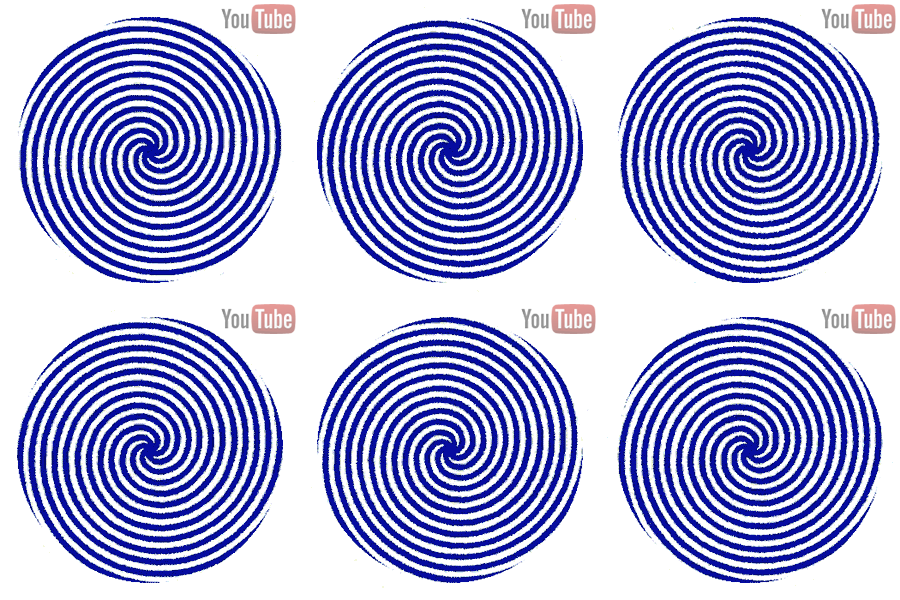
The motion after-effect is a visual illusion experienced after viewing a moving visual stimulus for a time (seconds to minutes) with stationary eyes, and then fixating a stationary stimulus. The stationary stimulus appears to move in the opposite direction to the original (physically moving) stimulus. The illusion is believed to be the result of motion adaptation.
For example, if one looks at a waterfall for about a minute and then looks at the stationary rocks at the side of the waterfall, these rocks appear to be moving upwards slightly. The illusory upwards movement is the motion aftereffect. This particular motion aftereffect is also known as the waterfall illusion. Another example can be seen when one looks at the center of a rotating spiral for several seconds. The spiral can exhibit outward or inward motion. When one then looks at any stationary pattern, it appears to be moving in the opposite direction. This form of the motion aftereffect is known as the spiral aftereffect.
Posted in Science |
Leave a Comment »
March 3, 2011

An afterimage or ghost image is an optical illusion that refers to an image continuing to appear in one’s vision after the exposure to the original image has ceased. One of the most common afterimages is the bright glow that seems to float before one’s eyes after looking into a light source for a few seconds. The phenomenon of afterimages may be closely related to persistence of vision, which allows a rapid series of pictures to portray motion, which is the basis of animation and cinema.
Closing the eye can help achieve a better sense of the color in its own aspect. Afterimages come in two forms, negative (inverted) and positive (retaining original color). The process behind positive afterimages is unknown, though thought to be related to neural adaptation. On the other hand, negative afterimages are a retinal phenomenon and are well understood.
Posted in Science |
Leave a Comment »
March 3, 2011
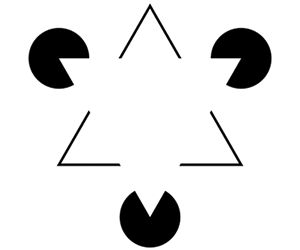
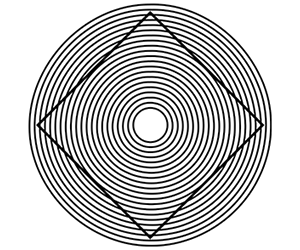
Illusory contours or subjective contours are a form of visual illusion where contours are perceived without a luminance or color change across the contour. A classic example of illusory contours is the Kanizsa triangle. This figure comprises three black circles with equal wedges cut out of them facing the center point and three black angles on a white background.
But many observers see a white triangle on top of three black disks and an outline triangle. The white triangle appears brighter than the white background and shows a contour even in regions where there is no luminance change in the image. The Ehrenstein illusion is another common form of illusory contours. It is thought that early visual cortical regions such as V2 are responsible for forming illusory contours.
Posted in Science |
Leave a Comment »
March 3, 2011
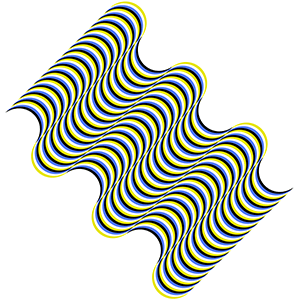
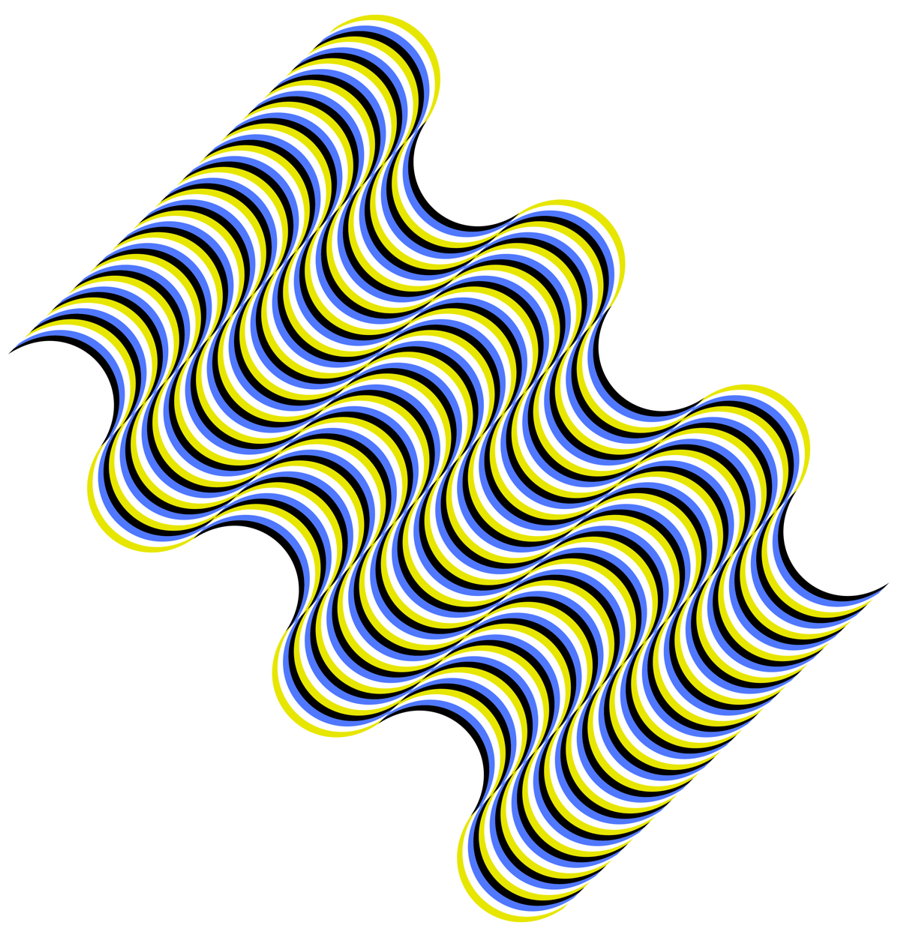
The term illusory motion is used to define the appearance of movement in a static image. This is an optical illusion in which a static image appears to be moving due to the cognitive effects of interacting color contrasts and shape position.
Another type of motion illusion that causes an optical illusion is when a moving object appears to be moving in a path other than what is perceived by the brain. An example of this can be demonstrated by placing a colored filter over ones eye of the observer, and swinging a ball back and forth in front of them. To the observer the ball appears to be swinging in a circular motion.
Posted in Art, Science |
Leave a Comment »
March 3, 2011
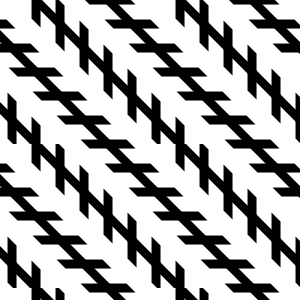
The Zöllner illusion is a classic optical illusion named after its discoverer, German astrophysicist Johann Karl Friedrich Zöllner. In 1860, Zöllner sent his discovery in a letter to physicist and scholar Johann Christian Poggendorff, who subsequently discovered the related Poggendorff illusion, in the original drawing by Zöllner. In the illusion the black lines seem to be unparallel, but in reality they are parallel. The shorter lines are on an angle to the longer lines. This angle helps to create the impression that one end of the longer lines is nearer to us than the other end.
This is very similar to the way the Wundt illusion appears. It is also is similar to the Hering illusion and the Müller-Lyer illusion. All these illusions demonstrate how lines can seem to be distorted by their background.
Posted in Science |
Leave a Comment »



 The Daily Omnivore