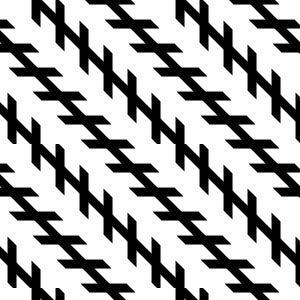
The Zöllner illusion is a classic optical illusion named after its discoverer, German astrophysicist Johann Karl Friedrich Zöllner. In 1860, Zöllner sent his discovery in a letter to physicist and scholar Johann Christian Poggendorff, who subsequently discovered the related Poggendorff illusion, in the original drawing by Zöllner. In the illusion the black lines seem to be unparallel, but in reality they are parallel. The shorter lines are on an angle to the longer lines. This angle helps to create the impression that one end of the longer lines is nearer to us than the other end.
This is very similar to the way the Wundt illusion appears. It is also is similar to the Hering illusion and the Müller-Lyer illusion. All these illusions demonstrate how lines can seem to be distorted by their background.



Leave a comment