February 27, 2011

SweeTango, a registered trademark for a cultivar of apples produced in Minneiska, Minnesota. It is a newly released hybrid brand apple that debuted in 2009. It is a pinkish apple consisting of a yellow background that is intermittent with red coloration. The surface of the apple has several distinguishing visual characteristics. The prominent white lenticels appear freckle-like on the fruit. The name comes from those that have tasted this new brand of apple. They say they taste sweet as well as tart at the same time, sweet and tangy.
University of Minnesota produced this variety of apple from their breeding program. Their 80 acre Horticultural Research Center near Victoria, Minnesota, produced the Minneiska variety apple from Honeycrisp and Zestar apple varieties, which they also specially breed. Others apple varieties they have developed in their facility are Fireside, Haralson, and Honeygold.
Posted in Food, Money, Science |
Leave a Comment »
February 24, 2011

Vertebral [vur-tuh-bruhl] subluxation [suhb-luhk-sey-shuhn] is a controversial term that is commonly used by chiropractors to describe signs and symptoms of the spinal column. The chiropractic vertebral subluxation complex has been a source of controversy since its inception in 1895 due to its metaphysical origins and claims of far reaching effects on health and disease. Although some in the chiropractic profession reject the concept of subluxation and shun the use of this term as a diagnosis, its current and officially accepted status by the profession has been repeatedly confirmed.
In 2010 the General Chiropractic Council, the statutory regulatory body for chiropractors in the United Kingdom, issued guidance for chiropractors stating that the chiropractic vertebral subluxation complex ‘is not supported by any clinical research evidence that would allow claims to be made that it is the cause of disease or health concerns.’ A similar stance is taken by the National Health Service: ‘There is also no scientific evidence to support the idea that most illness is caused by misalignment of the spine.’
Posted in Health, Language, Science |
Leave a Comment »
February 24, 2011

The Waimea River is a river on the island of Kauai in the U.S. state of Hawaii. At approximate 12 miles in length, it is one of the longest rivers in the Hawaiian Islands. It rises in a wet plateau of the island’s central highlands, in the Alaka’i Swamp, the largest high-elevation swamp in the world. It flows south, passing through the 3,000-foot-deep (910 m) Waimea Canyon, known as the ‘Grand Canyon of the Pacific.’
Due to wave action, sand gets pushed up into a large hill in front of the river each winter. This creates a natural dam that water collects behind for months, and which is about 20 feet above the level of the ocean on the other side of the sand berm. Every year some one digs a trench through the sand releasing millions of gallons of fresh water into the ocean. This produces a standing wave which is perfect for body boarding and surfing on.
Posted in Games, Science |
Leave a Comment »
February 24, 2011

The Marula is a medium-sized dioecious tree, indigenous to Africa. The fruits are used in the liqueur Amarula. The distribution of this species throughout Africa has followed the Bantu people in their migrations, as it has been an important item in their diet since time immemorial. When ripe, the fruits have a light yellow skin, with white flesh, rich in vitamin C, are succulent, tart with a strong and distinctive flavor.
The marula fruit is also eaten by various animals in Southern Africa. In the movie ‘Animals Are Beautiful People’ by Jamie Uys, released in 1974, some scenes portray elephants, warthogs and monkeys becoming intoxicated from eating fermented marula fruit. Later research showed that these scenes were improbable and, in all probability, staged. Elephants would need a huge amount of fermented marulas to have any effect on them, and the amount of water drunk by elephants each day would also dilute the effect.
Posted in Drugs, Food, Science |
Leave a Comment »
February 23, 2011

Here Comes Science is a 2009 children’s album from Brooklyn-based band They Might Be Giants, packaged as a CD/DVD set. The album is the third in their line of educational albums, following 2005’s Here Come the ABCs and 2008’s Here Come the 123s. It is the band’s 14th studio album and fourth children’s album.
Posted in Art, Education, Science |
Leave a Comment »
February 23, 2011

‘Gödel, Escher, Bach: An Eternal Golden Braid’ (GEB) is a book by cognitive scientist Douglas Hofstadter, described by the author as ‘a metaphorical fugue on minds and machines in the spirit of Lewis Carroll.’ On its surface, GEB examines logician Kurt Gödel, artist M. C. Escher and composer Johann Sebastian Bach, discussing common themes in their work and lives. At a deeper level, the book is a detailed and subtle exposition of concepts fundamental to mathematics, symmetry, and intelligence. Through illustration and analysis, the book discusses how self-reference and formal rules allow systems to acquire meaning despite being made of ‘meaningless’ elements.
It also discusses what it means to communicate, how knowledge can be represented and stored, the methods and limitations of symbolic representation, and even the fundamental notion of ‘meaning’ itself. In response to confusion over the book’s theme, Hofstadter has emphasized that GEB is not about mathematics, art, and music but rather about how cognition and thinking emerge from well-hidden neurological mechanisms. In the book, he presents an analogy about how the individual neurons of the brain coordinate to create a unified sense of a coherent mind by comparing it to the social organization displayed in a colony of ants.
Posted in Art, Philosophy, Science |
Leave a Comment »
February 22, 2011
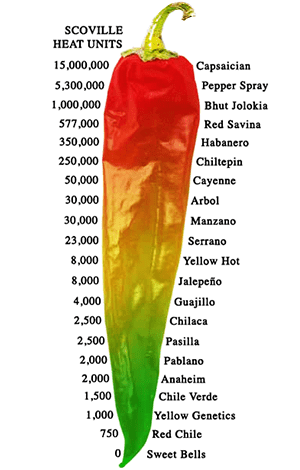
The Scoville scale is a measurement of the spicy heat (or piquance) of foods. The number of Scoville heat units (SHU) indicates the amount of capsaicin (a chemical compound that stimulates chemoreceptor nerve endings in the skin, especially the mucous membranes) present. The scale is named after its creator, American pharmacist Wilbur Scoville who developed it in 1912. The chilis with the highest rating on the Scoville scale exceed one million Scoville units, and include specimens of naga jolokia.
Posted in Food, Science |
Leave a Comment »
February 22, 2011

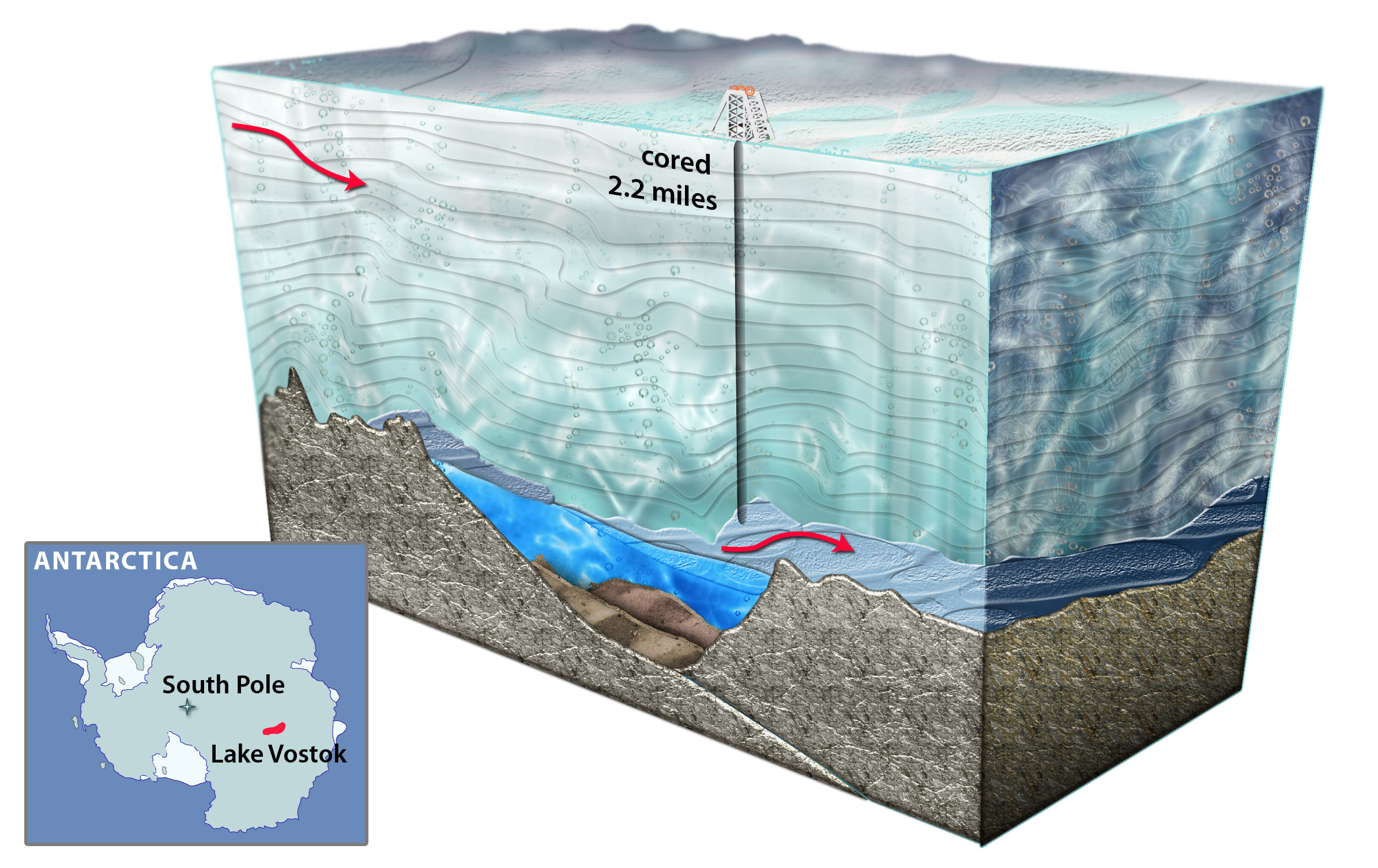
Lake Vostok is the largest of more than 140 subglacial lakes found under the surface of Antarctica. The overlying ice provides a continuous paleo-climatic record of 400,000 years, and the lake water itself has been isolated for 15 million years. The lake is named after the ship of Fabian von Bellingshausen, an Antarctic pioneer. There is presently underway a scientific effort to reach the lake by drill. The lake is under complete darkness and expected to be rich in oxygen, so there is speculation that any organisms inhabiting the lake could have evolved in a manner unique to this environment. These adaptations to an oxygen-rich environment might include high concentrations of protective oxidative enzymes.
Living Hydrogenophilus thermoluteolus microorganisms have been found in Lake Vostok’s deep ice core drillings, an extant surface dwelling species. This suggests the presence of a deep biosphere utilizing a geothermal system of the bedrock encircling the subglacial lake. There is optimism that microbial life in the lake may be possible despite high pressure, constant cold, low nutrient input, potentially high oxygen concentration and an absence of sunlight. Due to the lake’s similarity to the Jupiter moon Europa and Saturn’s moon Enceladus, any confirmation of life living in Lake Vostok would strengthen the prospect for the possible presence of life on Europa or Enceladus.
Posted in Science, World |
Leave a Comment »
February 21, 2011


A platonic [pluh-ton-ik] solid is a three dimensional shape where each face is built from the same type of polygons, and there are the same number of polygons meeting at every corner of the shape. There are only five Platonic Solids: Tetrahedron, Cube, Hexahedron, Octahedron, Dodecahedron, and Isosahedron. The shapes are often used to make dice, because dice of these shapes can be made fair. 6-sided dice are very common, but the other numbers are commonly used in role-playing games. Such dice are commonly referred to as D followed by the number of faces (d8, d20 etc.).
The tetrahedron (4 sided), cube (6 sided), and octahedron (8 sided), are found naturally in crystal structures. In meteorology and climatology, global numerical models of atmospheric flow are of increasing interest which use grids that are based on an icosahedron (20 sides,refined by triangulation) instead of the more commonly used longitude/latitude grid. This has the advantage of better spatial resolution without singularities (i.e. the poles) at the expense of somewhat greater numerical difficulty.
Posted in Art, Language, Science |
Leave a Comment »
February 21, 2011

Lucy Temerlin (1964–1987) was a chimpanzee owned by the Institute for Primate Studies in Oklahoma, and raised by Maurice K. Temerlin, Ph.D., a psychotherapist and professor at the University of Oklahoma and his wife, Jane W. Temerlin.
read more »
Posted in Language, Science, Sex |
1 Comment »
February 21, 2011


Mars-500 is a multi-part ground-based experiment simulating a manned flight to Mars. The experiment’s facility is located at the Russian Academy of Sciences’ Institute of Biomedical Problems (IBMP) in Moscow, Russia. A total of 640 experiment days have been scheduled, divided into three stages. During each stage, a crew of six volunteers live and work in a mockup spacecraft. Communication with the outside world is limited, and has a simulated 20 minute delay. The supply of on-board consumables is limited.
The longest stage of the experiment is intended to simulate a complete 520-day mission to Mars, and began on June 3, 2010.
Posted in Health, Science |
Leave a Comment »
February 17, 2011

The Droste [dro-st] effect is a specific kind of recursive picture, one that in heraldry is termed ‘mise en abyme’ (French for ‘placing into infinity’). An image exhibiting the Droste effect depicts a smaller version of itself in a place where a similar picture would realistically be expected to appear. This smaller version then depicts an even smaller version of itself in the same place, and so on. Only in theory could this go on forever; practically, it continues only as long as the resolution of the picture allows, which is relatively short, since each iteration geometrically reduces the picture’s size.
The effect is named after the image on the tins and boxes of Droste cocoa powder, one of the main Dutch brands, which displayed a nurse carrying a serving tray with a cup of hot chocolate and a box with the same image. This image, introduced in 1904 and maintained for decades with slight variations, became a household notion.
Posted in Art, Language, Science |
Leave a Comment »




 The Daily Omnivore