December 14, 2010
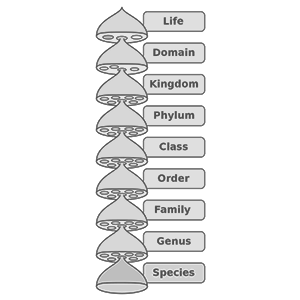
Taxonomy [tak-son-uh-mee] is the practice and science of classification. The word finds its roots in the Greek ‘taxis’ (meaning ‘order’ or ‘arrangement’) and ‘nomos’ (meaning ‘law’ or ‘science’).
Taxonomies are typically organized by generalization-specialization relationships, or less formally, parent-child relationships: the subtype has the same properties, behaviors, and constraints as the supertype plus one or more. For example: car is a subtype of vehicle, so any car is also a vehicle, but not every vehicle is a car.
Posted in Education, Language, Science |
Leave a Comment »
December 14, 2010

Getting Things Done (GTD) is an organizational method created by David Allen, described in a book of the same name. The Getting Things Done method rests on the principle that a person needs to move tasks out of the mind by recording them externally. That way, the mind is freed from the job of remembering everything that needs to be done, and can concentrate on actually performing those tasks.
read more »
Posted in Money, Science |
Leave a Comment »
December 14, 2010

Emerging adulthood is a phase of the life span between adolescence and full-fledged adulthood, proposed by Clark University professor, Jeffrey Arnett in a 2000 article in the American Psychologist. It primarily applies to young adults in developed countries who do not have children or begin a lifelong career in their early 20s. That emerging adulthood is a new demographic is contentious, as some believe that twenty-somethings have always struggled with ‘identity exploration, instability, self-focus, and feeling in-between.
read more »
Posted in Health, Science |
Leave a Comment »
December 14, 2010
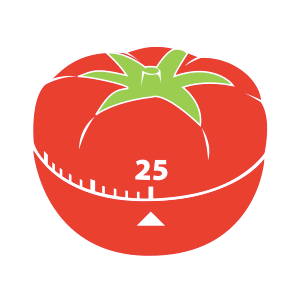
The Pomodoro Technique is a time management method developed in the late 1980s. The technique uses a timer to break down periods of work into 25-minute intervals called ‘pomodoros’ separated by breaks. The method is based on the idea that frequent breaks can improve mental agility, and seeks to provide an effective response to time as an anxiety-provoking state.
There are five basic steps to implementing the technique: 1) Decide on the task to be done; 2) Set the (timer) to 25 minutes; 3) Work on the task until the timer rings; record with an x; 4) Take a short break (5 minutes); and 5) Every four “pomodoros” take a longer break (15–20 minutes). The Pomodoro Technique is named after the tomato-shaped kitchen timer that was first used by technique creator Francesco Cirillo when he was a university student (Pomodoro is Italian for tomato).
Posted in Money, Science |
Leave a Comment »
December 14, 2010

The executive system is a theorized cognitive system in psychology that controls and manages other cognitive processes. It is also referred to as the executive function, supervisory attentional system, or cognitive control. The concept is used by psychologists and neuroscientists to describe a loosely defined collection of brain processes that are responsible for planning, cognitive flexibility, abstract thinking, rule acquisition, initiating appropriate actions and inhibiting inappropriate actions, and selecting relevant sensory information.
The executive functions are often invoked when it is necessary to override responses that might otherwise be automatically elicited by stimuli in the external environment. For example, on being presented with a potentially rewarding stimulus, such as a tasty piece of chocolate cake, a person might have the automatic response to take a bite. However, where such behavior conflicts with internal plans (such as having decided not to eat chocolate cake while on a diet), the executive functions might be engaged to inhibit that response.
Posted in Health, Science |
Leave a Comment »
December 13, 2010

Paris syndrome is a transient psychological disorder encountered by some people visiting or vacationing in Paris. It is characterized by acute delusional states, hallucinations, feelings of persecution (delusions of being a victim of prejudice, aggression, or hostility from others), derealization, depersonalization, anxiety, and also psychosomatic manifestations such as dizziness, tachycardia, sweating, etc. Japanese visitors are observed to be especially susceptible, and around twenty Japanese tourists a year are affected. It was first noted in Nervure, the French journal of psychiatry in 2004.
Posted in Health, Science, World |
Leave a Comment »
December 13, 2010

The Jerusalem syndrome is a group of mental phenomena involving the presence of either religiously themed obsessive ideas, delusions or other psychosis-like experiences that are triggered by a visit to the city of Jerusalem. It is not endemic to one single religion or denomination and has affected Jews, Christians and Muslims of many different backgrounds.
The best known, although not the most prevalent, manifestation of the Jerusalem syndrome is the phenomenon whereby a person who seems previously balanced and devoid of any signs of psychopathology becomes psychotic after arriving in Jerusalem. The psychosis is characterised by an intense religious theme and typically resolves to full recovery after a few weeks or after being removed from the area.
read more »
Posted in Health, Philosophy, Science |
Leave a Comment »
December 13, 2010

Stendhal [sten-dahl] syndrome (also known as hyperkulturemia and Florence syndrome) is a psychosomatic illness that causes rapid heartbeat, dizziness, fainting, confusion and even hallucinations when an individual is exposed to art, usually when the art is particularly beautiful or a large amount of art is in a single place. The term can also be used to describe a similar reaction to a surfeit of choice in other circumstances, e.g. when confronted with immense beauty in the natural world.
The condition is named after the famous 19th century French author Stendhal (Henri-Marie Beyle), who described his experience with the phenomenon during his 1817 visit to Florence, Italy. Although there are many descriptions of people becoming dizzy and fainting while taking in Florentine art, especially at the Uffizi, dating from the early 19th century on, the syndrome was only named in 1979, when it was described by Italian psychiatrist Graziella Magherini, who observed and described more than 100 similar cases among tourists and visitors in Florence.
Posted in Art, Health, Science |
Leave a Comment »
December 13, 2010

Spirulina [spahy-ruh-lahy-nuh] is a microscopic blue-green algae in the shape of a spiral coil, living both in sea and freshwater. It is the common name for human and animal food produced primarily from two species: Arthrospira platensis, and Arthrospira maxima. Though referred to as ‘algae’ because they are aquatic organisms capable of photosynthesis, cyanobacteria are not related to any of the various eukaryotic algae. Spirulina is rich in complete proteins, essential fatty acids, b vitamins, minerals, and phytochemicals like beta-carotene. Spirulina contains an unusually high amount of protein, between 55% and 77% by dry weight. It is a complete protein, containing all essential amino acids, though with reduced amounts of methionine, cysteine, and lysine when compared to the proteins of meat, eggs, and milk.
It is, however, superior to typical plant protein, such as that from legumes. Spirulina also contains the amino acid phenylalanine, which should be avoided by people who have the metabolic disorder phenylketonuria. Arthrospira is cultivated around the world, and is used as a human dietary supplement, as well as a whole food, and is available in tablet, flake, and powder form. It is also used as a feed supplement in the aquaculture, aquarium, and poultry industries. Spirulina was a food source for Mesoamericans; the Aztecs called it ‘stone’s excrement.’ Its cultivation dates back to the 9th century in Chad, where dried cakes of spirulina, called dihéare, are used as bullion cubes.
Posted in Food, Health, Science |
Leave a Comment »
December 10, 2010


Cordyceps [kord-uh-seps] is a genus of mushrooms that grows on caterpillars and other insects; it has a number of Eastern and Western medical applications. It is used for a wide range of conditions including fatigue, sexual dysfunction, coughing, and as an adaptogen or immune stimulant.
An interesting feature of the Cordyceps species is the ability to affect the behavior of their insect host. Cordyceps unilateralis causes ants to climb a plant and attach there before they die. This ensures the parasite’s environment is of the optimal temperature and humidity, and maximal distribution of the spores from the fruiting body that sprouts out of the dead insect is achieved.
read more »
Posted in Drugs, Money, Science |
Leave a Comment »
December 9, 2010
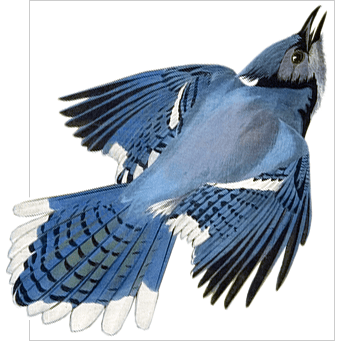

‘The Birds of America‘ is the title of a book by naturalist and painter John James Audubon, containing paintings and scientific description of a wide variety of birds of the United States. It was first published as a series of sections between 1827 and 1838 in Edinburgh and London. The work consists of hand-colored, life-size prints made from engraved plates measuring around 39 by 26 inches. In December of 2010 a copy sold at auction for £7.3 million. The original edition is often regarded as the greatest picture book ever produced. 161 subscribers paid $1,000 each for what ended up to be four volumes.
There are only 11 copies held in private collections out of 119 thought to still exist and it is estimated that out of the top ten most expensive books, five of them would be copies of ‘Birds of America.’ In 2007 the book was the subject of an exhibition by the Teylers Museum (the oldest museum in the Netherlands), which owns a copy it ordered from the original subscription, along with the table sold to house and display it. The book’s subsections fit into special drawers around a fly-leaf table; the table formed the centerpiece for gatherings of the Teyler’s gentleman’s society of science. A low-resolution version of ‘Birds of America’ can be viewed on the Audubon website.
Posted in Art, Money, Science |
Leave a Comment »
December 6, 2010

Brown adipose tissue (BAT) or brown fat is one of two types of fat or adipose tissue (the other being white adipose tissue) found in mammals. It is especially abundant in newborns and in hibernating mammals. Its primary function is to generate body heat without requiring the body to shiver. In contrast to white adipocytes (fat cells), which contain a single lipid droplet, brown adipocytes contain numerous smaller droplets and a much higher number of mitochondria, which contain iron and make it brown. Brown fat also contains more capillaries than white fat, since it has a greater need for oxygen than most tissues.
Typically, mammals generate heat by shivering. Low temperatures signal muscle groups around vital organs begin to shake in small movements in an attempt to create warmth by expending energy. It produces heat because the conversion of the chemical energy (food) into kinetic energy (motion) is not 100% efficient, causing some of the energy to show up as heat. Brown fat cells use their mitochondria to convert chemical energy directly into heat by altering the movement of protons that pass through them. It was discovered recently that some adults retain a portion of their juvenile brown fat deposits.
Posted in Health, Science |
Leave a Comment »