August 1, 2010
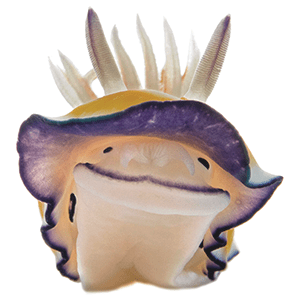
A nudibranch [noo-duh-brangk] is a marine mollusk which sheds its shell after the larval stage. They are noted for their often extraordinary colors and striking forms. More than 3,000 different species have been identified. The word ‘nudibranch’ comes from the Latin ‘nudus’ (‘naked’) and the Greek ‘brankhia’ (‘gills’).
Nudibranchs are often casually called sea slugs, but many sea slugs belong to several taxonomic groups which are not closely related to nudibranchs. A number of these other sea slugs (such as the colorful Aglajidae) are often confused with nudibranchs. Nudibranchs are found worldwide, at virtually all depths of salt water, but reach their greatest size and variation in warm, shallow waters.
read more »
Posted in Science |
Leave a Comment »
August 1, 2010
A Shepard tone, named after Roger Shepard, is a sound consisting of a superposition of sine waves separated by octaves. This creates the auditory illusion of a tone that continually ascends or descends in pitch, yet which ultimately seems to get no higher or lower.
Posted in Science |
Leave a Comment »
August 1, 2010

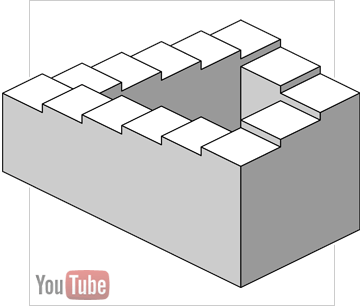
The Penrose stairs is an impossible object created by Lionel Penrose and his son Roger Penrose. It can be seen as a variation on the Penrose triangle. It is a two-dimensional depiction of a staircase in which the stairs make four 90-degree turns as they ascend or descend yet form a continuous loop, so that a person could climb them forever and never get any higher. This is clearly impossible in three dimensions; the two-dimensional figure achieves this paradox by distorting perspective.
The best known example of Penrose stairs appears in the lithograph Ascending and Descending by M. C. Escher, where it is incorporated into a monastery where several monks ascend and descend the endless staircase. The staircase had also been discovered previously by the Swedish artist Oscar Reutersvärd, but neither Penrose nor Escher were aware of his designs.
Posted in Art, Science |
Leave a Comment »
July 22, 2010

Roundup is the brand name of a herbicide produced by Monsanto that contains the active ingredient glyphosate. Glyphosate is the most used herbicide in the USA, and Roundup has been the number one selling herbicide worldwide since at least 1980. Several weed species, known as superweeds, have developed Roundup resistance largely because of repeated exposure.
Monsanto also produces seeds which grow into plants genetically engineered to be tolerant to glyphosate, which are known as Roundup Ready crops. The genes contained in these seeds are patented. Soy was the first Roundup Ready crop, and was produced at Monsanto’s Agracetus Campus located in Middleton, Wisconsin in 1996. As of 2005, 87% of U.S. soybean fields were planted with glyphosate resistant varieties. The Roundup Ready line of seeds has grown to include corn, canola, cotton, and other crops. The latest iteration is Roundup Ready Corn 2.
Posted in Food, Money, Science |
Leave a Comment »
July 22, 2010
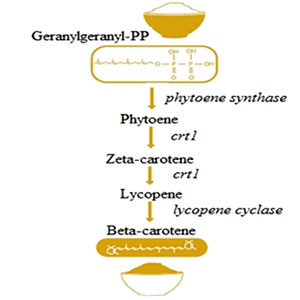
Golden rice is a variety of rice produced through genetic engineering to biosynthesize beta-carotene, a precursor of pro-vitamin A in the edible parts of rice. The scientific details of the rice were first published in Science in 2000. Golden rice was developed as a fortified food to be used in areas where there is a shortage of dietary vitamin A. In 2005 Syngenta, a biotechnology company announced a new variety called Golden Rice 2 which produces up to 23 times more beta-carotene than the original variety.
Neither variety is currently available for human consumption. Although golden rice was developed as a humanitarian tool, it has met with significant opposition from environmental and anti-globalization activists.
Posted in Food, Health, Science |
Leave a Comment »
July 21, 2010
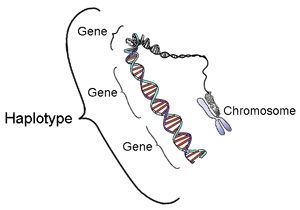

The International HapMap Project an organization that aims to develop a haplotype map (HapMap) of the human genome, which will describe the common patterns of human genetic variation. Haplotypes are contiguous strings of DNA. HapMap is a key resource for researchers to find genetic variants affecting health, disease, and responses to drugs and environmental factors. The information produced by the project is made freely available to researchers around the world.
Unlike with the rarer Mendelian diseases, combinations of different genes and the environment play a role in the development and progression of common diseases (such as diabetes, cancer, heart disease, stroke, depression, and asthma), or in the individual response to pharmacological agents. To find the genetic factors involved in these diseases, one could in principle obtain the complete genetic sequence of several individuals, some with the disease and some without, and then search for differences between the two sets of genomes. This approach is currently infeasible because of the cost of full genome sequencing. The HapMap project proposes a shortcut.
Posted in Health, Science |
Leave a Comment »
July 17, 2010
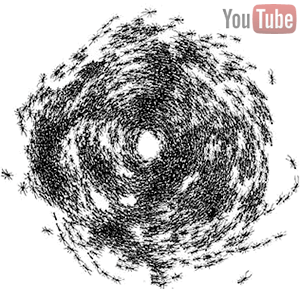
An ant mill is a phenomenon where a small group of army ants separated from the main foraging party lose the pheromone track and begin to follow one another, forming a continuously rotating circle. The ants will eventually die of exhaustion. This phenomenon is a side effect of the self-organizing structure of ant colonies.
Each ant follows the ant in front of it, and this will work until something goes wrong and an ant mill forms. An ant mill was first described by William Beebe who observed a mill 1,200 feet in circumference. It took each ant 2.5 hours to make one revolution. Similar phenomena have been noted in processionary caterpillars and fish.
Posted in Science |
Leave a Comment »
July 17, 2010

Ylem is a term coined in the late 1940s by cosmologist Ralph Alpher for a hypothetical original substance or condensed state of matter, which became subatomic particles and elements as we understand them today.
Posted in Language, Science |
Leave a Comment »
July 15, 2010

Basket stars are a group of brittle stars, which are related to sea stars (also known as starfish). They generally live in deep sea habitats. Their life span in the wild is up to 35 years. They weigh around 11 lbs, or 5 kg. Like other echinoderms, basket stars lack blood and achieve gas exchange via their water vascular system.
Posted in Science |
Leave a Comment »
July 15, 2010
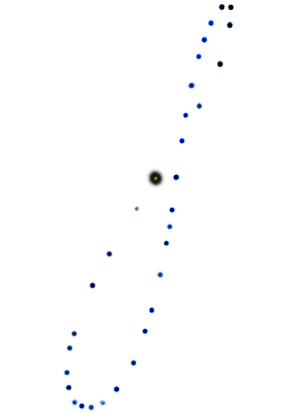

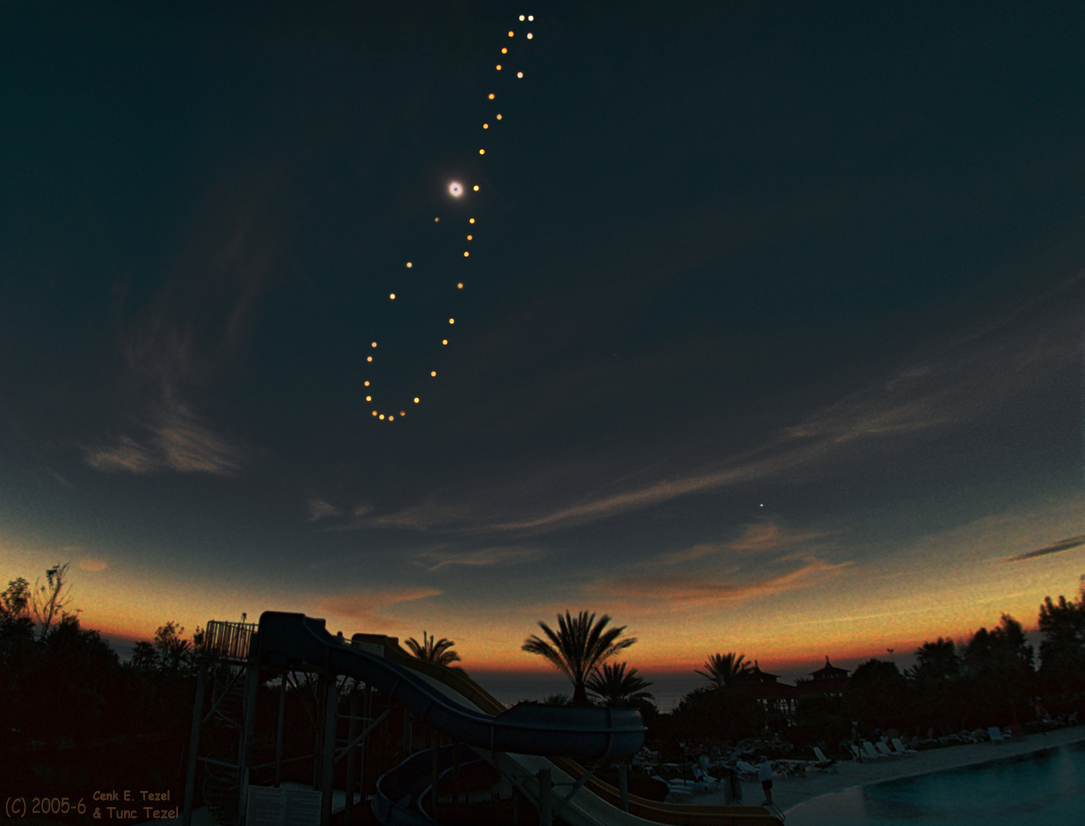
An analemma [an-l-em-uh] is a plot or photograph of the position of a star in the sky at a certain time of day (such as noon) at one locale measured throughout the year that has the shape of a figure 8. With great planning and effort, the series can include a total eclipse of the Sun as one of the images, which has been dubbed a tutulemma.
Posted in Science |
Leave a Comment »
July 12, 2010

In gemology, chatoyancy [shuh-toi-an-see], or chatoyance, is an optical reflectance effect seen in certain gemstones. Coined from the French ‘œil de chat,’ meaning ‘cat’s eye,’ chatoyancy arises either from the fibrous structure of a material, as in tiger eye quartz, or from fibrous inclusions or cavities within the stone, as in cat’s eye chrysoberyl.
Posted in Science |
1 Comment »
July 12, 2010

Prosopagnosia [prahs-oh-pag-noh-shuh] (sometimes known as face blindness) is a disorder of face perception where the ability to recognize faces is impaired, while the ability to recognize other objects may be relatively intact. Few successful therapies have so far been developed for affected people, although individuals often learn to use ‘piecemeal’ or ‘feature by feature’ recognition strategies. This may involve secondary clues such as clothing, hair color, body shape, and voice.
Posted in Health, Science |
Leave a Comment »




 The Daily Omnivore