September 13, 2011
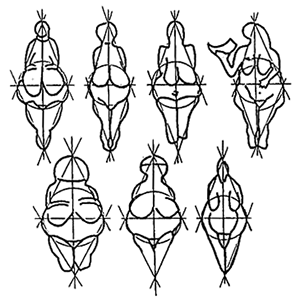
Venus figurines is an umbrella term for a number of prehistoric statuettes of women portrayed with similar physical attributes from the Upper Palaeolithic (between 40,000 and 10,000 years ago), mostly found in Europe, but with finds as far east as Siberia, extending their distribution to much of Eurasia.
These figurines were carved from soft stone (such as steatite, calcite or limestone), bone or ivory, or formed of clay and fired. The latter are among the oldest ceramics known. In total, over a hundred such figurines are known; virtually all of modest size, between 4 cm and 25 cm in height. They are some of the earliest works of prehistoric art.
read more »
Posted in Art, Sex, World |
Leave a Comment »
September 13, 2011
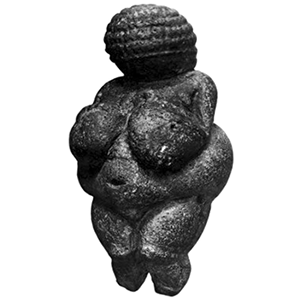
The Venus of Willendorf, also known as the ‘Woman of Willendorf,’ is an 11 cm (4.3 in) high statuette of a female figure estimated to have been made between 24,000 and 22,000 BCE. It was discovered in 1908 by archaeologist Josef Szombathy at a paleolithic site near Willendorf, a village in Lower Austria. It is carved from an oolitic limestone that is not local to the area, and tinted with red ochre. Several similar statuettes and other forms of art have been discovered, and they are collectively referred to as ‘Venus figurines,’ although they pre-date the mythological figure of Venus by millennia. The Willendorf figure was named following a model already over fifty years old, and shares many characteristics with other figures.
After a wide variety of proposed dates, following a revised analysis of the stratigraphy of its site in 1990, the figure has been estimated to have been carved 24,000–22,000 BCE. Very little is known about its origin, method of creation, or cultural significance. The Venus of Willendorf was recovered in a site that also contained a few amulets of Moldavite. The purpose of the carving is the subject of much speculation. It never had feet and does not stand on its own. The apparent large size of the breasts and abdomen, and the detail put into the vulva, have led scholars to interpret the figure as a fertility symbol. The figure has no visible face, her head being covered with circular horizontal bands of what might be rows of plaited hair, or a type of headdress. She was thought to be very healthy given her weight and size.
Posted in Art, Sex |
Leave a Comment »
September 11, 2011

Jeju Loveland is an outdoor sculpture park which opened in 2004 on Jeju Island in South Korea. The park is focused on a theme of sex, running sex education films, and featuring 140 sculptures representing humans in various sexual positions. It also has other elements such as large phallus statues, stone labia, and hands-on exhibits such as a ‘masturbation-cycle.’ The park’s website describes the location as ‘a place where love oriented art and eroticism meet.’ In 2002, graduates of Seoul’s Hongik University began creating sculptures for the park. Encompassing an area the size of two soccer fields, all of the sculptures can be viewed in approximately one hour, and there is an additional monthly rotating exhibit featuring works by different Korean artists. Visitors are required to be at least 18 years old, and a separate play area is available for minors while adults visit.
After the Korean War, the island became a popular honeymoon destination for Korean couples, due to the island’s warm climate. Many of the couples had wed because of arranged marriages, and the island also became known for being a center of sex education. According to an article in Germany’s ‘Der Spiegel’ magazine, in the late 1980s journalist and travel writer Simon Winchester reported that some hotel employees on the island performed as ‘professional icebreakers.’ In the evenings, the hotel would offer an entertainment program featuring erotic elements, to help newlyweds relax.
Posted in Art, Sex, World |
Leave a Comment »
September 10, 2011

Tsundere [tsoon-dey-ray] is a Japanese character development process that describes a person who is cold and even hostile before gradually showing their warm side. The word is derived from the terms ‘Tsun Tsun,’ meaning to turn away in disgust, and ‘Dere Dere’ meaning to become ‘lovey dovey.’
Originally found in Japanese bishōjo games (or ‘gal games,’ a type of Japanese video game centered on interactions with attractive anime-style girls; a subset of dating simulators), the word is now part of the otaku moe phenomenon (a rarefied pseudo-love for fictional characters).
read more »
Posted in Games, Love, Sex |
Leave a Comment »
August 26, 2011

The matching hypothesis is a popular psychology and social psychology theory, proposed by Elaine Hatfield and her colleagues in 1966, which suggests why people become attracted to their partner. It claims that people are more likely to form long standing relationships with someone who is as equally physically attractive as they are. This is influenced by realistic choices, desire of the match and good probability of obtaining the date.
In successful couples in which the partners differ greatly in physical attractiveness, it is likely that the less attractive partner has compensating qualities to offer. For instance, some men with wealth and status desire younger, more attractive women, and some women are more likely to overlook physical attractiveness for men who possess wealth and status.
read more »
Posted in Science, Sex |
1 Comment »
August 26, 2011
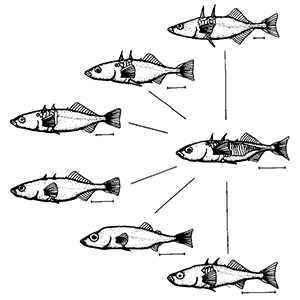
Assortative mating is the phenomenon where a sexually reproducing organism chooses to mate with individuals that are similar (positive assortative mating) or dissimilar (negative assortative mating) to itself in some specific manner. In evolution, these two types of assortative mating have the effect, respectively, of increasing or reducing the range of variation (trait variance), when the assorting is cued on heritable traits. Positive assortative mating, therefore, results in disruptive natural selection, and negative assortative mating results in stabilized natural selection.
Assortative mating has been invoked to explain sympatric speciation (the process through which new species evolve from a single ancestral species while inhabiting the same geographic region). For some populations there are two different resources for which different phenotypes (genetic traits) are optimum. Intermediates between these two phenotypes are less favorable. It is then favorable if the organisms can recognize mates that are optimized for the same resources as they are themselves. If mutations that make such recognition possible appear, these will be selected for.
read more »
Posted in Health, Science, Sex |
Leave a Comment »
August 15, 2011

Global Orgasm, also known as GORG, was an action originally scheduled for December 22, 2006 to coincide with the end of solstice. The idea was for participants throughout the world to have an orgasm during this one day while thinking about peace in order to emit positive energy to Earth. The Second Annual Synchronized Global Orgasm for Peace occurred at 6:08 (GMT) on December 22, 2007, the actual moment of the Solstice.
In 2009 Ani Sinclair took over the cause (and website) of Global Orgasm. She encourages everyone to practice conscious dedication of orgasmic energy to world peace. The Solstice on December 21st is the day to culminate the practice for the year and then to begin again, practicing for the next year. She would like to help change the perception about sexuality from ‘original sin’ to ‘original blessing,’ honoring and empowering women.Studies have found increases in the hormone oxytocin at orgasm in both men and women. Oxytocin’s role in increasing trust, pair bonding and reducing anxiety has meant it is sometimes referred to as the ‘love and trust’ hormone.
Posted in Philosophy, Sex, War |
Leave a Comment »
August 15, 2011

Fuck for forest, or FFF, is a non-profit environmental organization founded in Norway by Leona Johansson and Tommy Hol Ellingsen, which raises money for rescuing the world’s rainforests by producing pornographic material or having sex in public. They are the world’s first eco-porn organization. However, their unorthodox methods have made it difficult to distribute monies. The Norwegian chapter of the Rainforest Foundation Fund as well as the WWF both in the Netherlands and in Norway have refused to accept donations from FFF. As a result, Fuck for Forest is working on a project to work directly with indigenous communities in Costa Rica and the Brazilian Amazon rainforest.
The group gained notoriety when its two members had sexual intercourse on stage during a 2004 Quart Festival concert featuring Norwegian singer Kristopher Schau and his band The Cumshots, after delivering a brief talk on the impact humans have on forests. The group then faced legal action as a result (including a fine imposed on the group after its male member dropped his pants in a courtroom), and consequently moved its headquarters to Berlin, Germany.
Posted in Humor, Politics, Sex |
Leave a Comment »
August 5, 2011
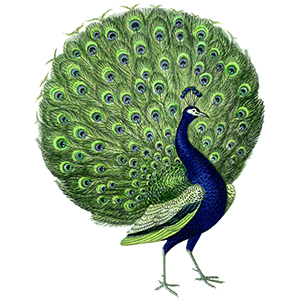
The handicap principle is a hypothesis originally proposed in 1975 by biologist Amotz Zahavi to explain how evolution may lead to ‘honest’ or reliable signaling between animals who have an obvious motivation to bluff or deceive each other. The handicap principle suggests that reliable signals must be costly to the signaler, costing the signaler something that could not be afforded by an individual with less of a particular trait.
For example, in the case of sexual selection, the theory suggests that animals of greater biological fitness signal this status through handicapping behavior or morphology that effectively lowers this quality. The central idea is that sexually selected traits function like conspicuous consumption, signalling the ability to afford to squander a resource simply by squandering it. Receivers know that the signal indicates quality because inferior quality signalers cannot afford to produce such wastefully extravagant signals.
read more »
Posted in Money, Science, Sex |
Leave a Comment »
July 24, 2011

The Selfish Gene is a book on evolution by Richard Dawkins, published in 1976. It builds upon the principal theory of George C. Williams’s first book ‘Adaptation and Natural Selection.’ Dawkins coined the term ‘selfish gene’ as a way of expressing the gene-centred view of evolution as opposed to the views focused on the organism and the group. From the gene-centred view follows that the more two individuals are genetically related, the more sense (at the level of the genes) it makes for them to behave selflessly with each other. Therefore the concept is especially good at explaining many forms of altruism, regardless of a common misuse of the term along the lines of a selfishness gene.
An organism is expected to evolve to maximize its inclusive fitness — the number of copies of its genes passed on globally (rather than by a particular individual). As a result, populations will tend towards an evolutionarily stable strategy. The book also coins the term ‘meme’ for a unit of human cultural evolution analogous to the gene, suggesting that such ‘selfish’ replication may also model human culture, in a different sense. Memetics has become the subject of many studies since the publication of the book.
read more »
Posted in Language, Science, Sex |
Leave a Comment »
July 24, 2011

Orgasm control, also known as ‘edging,’ ‘peaking,’ ‘surfing,’ and by other terms, is a sexual technique which involves the maintenance of a high level of sexual arousal for an extended period of time before reaching orgasm. If orgasm is not reached after the extended period of arousal, it is referred to as ‘erotic sexual denial.’
If the partner whose orgasm is being controlled, sometimes referred to as the submissive partner, is put into physical restraints, the better to control the orgasm, the activity is sometimes called ‘tie and tease,’ and if orgasm is denied it is ‘tease and denial.’ Additional possibilities include the dominant partner subjecting the submissive partner to a forced orgasm(s). Orgasm control can involve either one sex partner being in control of the other partner’s orgasm, or a person delaying their own orgasm during sexual intercourse or masturbation.
read more »
Posted in Sex |
1 Comment »
July 22, 2011

Sexploitation describes a class of independently produced, low budget feature films generally associated with the 1960s, and serving largely as a vehicle for the exhibition of non-explicit sexual situations and gratuitous nudity. Sexploitation films were generally exhibited in urban grindhouse theatres, the precursor to the adult movie theaters of the 1970s and ’80s that featured hardcore content. The term soft-core is often used to designate non-explicit sexploitation films after the general legalization of hardcore content.
A series of United States Supreme Court rulings in the late 50s and 60s had enabled increasingly explicit sex films to be distributed.There were initially three broad types; ‘nudie cuties’ such as ‘The Immoral Mr. Teas’ (1959), films set in nudist camps like ‘Daughter of the Sun’ (1962), and somewhat more ‘artistic’ foreign pictures such as ‘The Twilight Girls’ (1961). Nudie cuties were popular in the early 60s, and were a development from the nudist camp films of the 50s.
read more »
Posted in Art, Politics, Sex |
Leave a Comment »


 The Daily Omnivore