March 29, 2026

Enshittification, also known as platform decay, is a process in which two-sided online products and services decline in quality over time. Initially, vendors create high-quality offerings to attract users, then they degrade those offerings to better serve business customers, and finally degrade their services to both users and business customers to maximize short-term profits for shareholders.
Canadian writer Cory Doctorow coined the neologism enshittification in November 2022. The American Dialect Society selected it as its 2023 Word of the Year, with Australia’s Macquarie Dictionary following suit for 2024. Merriam-Webster and Dictionary.com also list enshittification as a word.
read more »
Posted in Money, Technology |
1 Comment »
March 25, 2026

The millennial pause is a pause in speaking at the start of some videos, especially in short-form content and on social media apps such as TikTok. The pause is generally ascribed to millennials, the generation of people born from 1981 to 1996. The phenomenon is an example of the digital generation gap between millennials and subsequent generations.
The term ‘millennial pause’ is attributed to TikTok user nisipisa, a millennial who posted a TikTok video in 2021, pointing out that Taylor Swift, a millennial singer, includes such pauses at the start of her videos.
read more »
Posted in Language, Technology |
Leave a Comment »
March 12, 2026

Doomscrolling is the act of spending an excessive amount of time watching short-form content or watching large quantities of user-generated content or news, particularly negative news, on the web and social media.
The concept was coined around 2018, and became more widespread in the context of the COVID-19 pandemic. The World Health Organization (WHO) observed that the pandemic was accompanied by widespread misleading information, conspiracy theories, and false reports, which it referred to as an ‘infodemic.’
read more »
Posted in Health, Technology |
Leave a Comment »
January 27, 2026

The Torment Nexus is a term used in critical commentary of the influence of science fiction on technological development. It was coined in a 2021 Tweet by American writer Alex Blechman, shortly following Facebook’s announcement that it would be rebranding to Meta Platforms as part of a shift in the company’s focus towards developing a metaverse.
Dais Johnston of Inverse has defined the Torment Nexus as ‘shorthand for something that backfired in fiction being unironically replicated in reality.’ Reviewing the 2023 CES trade show, Katie Wickens of ‘PC Gamer’ defined the Torment Nexus as ‘a concept that encompasses our growing concern that science fiction will continue to become science fact across the consumer market, with the phobias wrought by technological speculation turning palpable in the hands of money-hungry corporations.’
read more »
Posted in Humor, Technology |
Leave a Comment »
January 20, 2026

Chatbot psychosis, also called AI psychosis, is a phenomenon wherein individuals reportedly develop or experience worsening psychosis, such as paranoia and delusions, in connection with their use of chatbots. The term was first suggested in a 2023 editorial by Danish psychiatrist Søren Dinesen Østergaard. It is not a recognized clinical diagnosis.
Journalistic accounts describe individuals who have developed strong beliefs that chatbots are sentient, are channeling spirits, or are revealing conspiracies, sometimes leading to personal crises or criminal acts. Proposed causes include the tendency of chatbots to provide inaccurate information (‘hallucinate’) and to affirm or validate users’ beliefs, or their ability to mimic an intimacy that users do not experience with other humans.
read more »
Posted in Health, Technology |
Leave a Comment »
October 9, 2025

Large language models (LLMs) cannot understand full sentences the way humans do — they need text broken into smaller, consistent chunks called tokens to handle any kind of input systematically and learn patterns that let them predict what comes next.
A glitch token is token that causes unexpected or glitchy outputs when used in a prompt. Such output may include the model misunderstanding meanings of words, refusing to respond or generating repetitive or unrelated text. Prompts that cause this behavior may look completely or mostly normal.
read more »
Posted in Language, Technology |
Leave a Comment »
September 8, 2025

Clanker is a slur for robots and artificial intelligence software. The term has been used in ‘Star Wars’ media, first appearing in the franchise’s 2005 video game ‘Star Wars: Republic Commando.’ In 2025, the term became widely used to discuss distaste for machines ranging from delivery robots to large language models. This trend has been attributed to anxiety around the negative societal effects of artificial intelligence.
Whereas AI slop describes low-quality output from artificial intelligence, clanker belittles the underlying robotic systems. While other science fiction media includes pejoratives for robots, such as ‘skinjob’ in ‘Blade Runner’ and ‘toaster’ in ‘Battlestar Galactica,’ clanker is believed to have gained popularity because its usage is intuitive and flexible.
read more »
Posted in Language, Technology |
Leave a Comment »
August 28, 2025


A data broker is an individual or company that specializes in collecting personal data (such as income, ethnicity, political beliefs, or geolocation data) or data about people, mostly from public records but sometimes sourced privately, and selling or licensing such information to third parties for a variety of uses.
Sources, usually Internet-based since the 1990s, may include census and electoral roll records, social networking sites, court reports and purchase histories. The information from data brokers may be used in background checks used by employers and housing.
read more »
Posted in Money, Politics, Technology |
Leave a Comment »
August 11, 2025
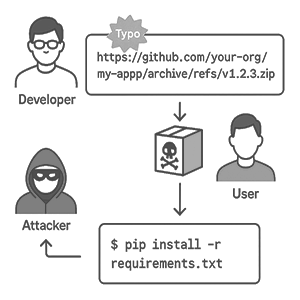
Slopsquatting is a type of cybersquatting. It is the practice of registering a non-existent software package name that a large language model (LLM) may hallucinate in its output, whereby someone unknowingly may copy-paste and install the software package without realizing it is fake. Attempting to install a non-existent package should result in an error, but some have exploited this for their gain in the form of typosquatting.
In 2023, security researcher Bar Lanyado noted that LLMs hallucinated a package named ‘huggingface-cli. While this name is identical to the command used for the command-line version of HuggingFace Hub, it is not the name of the package. The software is correctly installed with the code pip install -U ‘huggingface_hub[cli].’ Lanyado tested the potential for slopsquatting by uploading an empty package under this hallucinated name. In three months, it had received over 30,000 downloads. The hallucinated packaged name was also used in the README file of a repo for research conducted by Alibaba.
read more »
Posted in Money, Technology |
Leave a Comment »
June 11, 2025

You Will was an AT&T marketing campaign that launched in 1993, consisting of commercials directed by David Fincher. Each ad presented a futuristic scenario beginning with “Have you ever…” and ending with “…you will. And the company that will bring it to you: AT&T.” The ads were narrated by Tom Selleck. One of the first web banner ads ever sold was part of an AT&T campaign that ran on HotWired starting October 27, 1994, asking “Have you ever clicked your mouse right HERE? You Will.”
In 2016, technology writer Timothy B. Lee commented that ‘overall, the ads were remarkably accurate in predicting the cutting-edge technologies of the coming decades. But the ads were mostly wrong about one thing: the company that brought these technologies to the world was not AT&T. At least not on its own. AT&T does provide some of the infrastructure on which the world’s communications flow. But the gadgets and software that brought these futuristic capabilities to consumers were created by a new generation of Silicon Valley companies that mostly didn’t exist when these ads were made.’
read more »
Posted in Money, Technology |
Leave a Comment »
March 31, 2025

Steganography [steg-uh-nog-ruh-fee] is the practice of representing information within another message or physical object, in such a manner that the presence of the concealed information would not be evident to an unsuspecting person’s examination.
The word steganography comes from Greek words steganós (‘covered or concealed’) and graphia (‘writing’). The first recorded use of the term was in 1499 by German Benedictine abbot Johannes Trithemius in his Steganographia, a treatise on cryptography and steganography, disguised as a book on magic.
read more »
Posted in Politics, Science, Technology |
Leave a Comment »
March 21, 2025
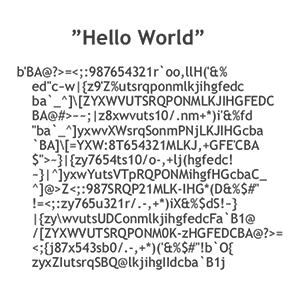
Malbolge [mahl-bol-jeh] is a public domain esoteric programming language invented by Ben Olmstead in 1998, named after the eighth circle of hell in Dante’s Inferno, the Malebolge. It was specifically designed to be almost impossible to use, via a counter-intuitive ‘crazy operation,’ base-three arithmetic, and self-altering code. It builds on the difficulty of earlier challenging esoteric languages (such as Brainfuck and Befunge) but exaggerates this aspect to an extreme degree, playing on the entangled histories of computer science and encryption. Despite this design, it is possible to write useful Malbolge programs, though the author himself has never written one.
The first program was not written by a human being; it was generated by a beam search algorithm designed by Andrew Cooke and implemented in Lisp. Later, Lou Scheffer posted a cryptanalysis of Malbolge and provided a program to copy its input to its output. He also saved the original interpreter and specification after the original site stopped functioning and offered a general strategy of writing programs in Malbolge as well as some thoughts on its Turing completeness.
Posted in Humor, Technology |
Leave a Comment »


 The Daily Omnivore