February 23, 2016

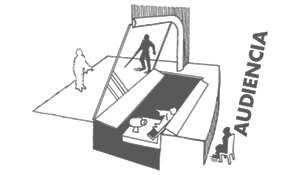
Pepper’s ghost is an illusion technique used in theater, amusement parks, museums, television, and concerts. It is named after John Henry Pepper, a scientist who popularized the effect in a famed demonstration in 1862. It has a long history, dating into the 16th century, and remains widely performed today.
Notable examples of the illusion are the ‘Girl-to-Gorilla’ trick found in old carnival sideshows and the appearance of ‘ghosts’ at the ‘Haunted Mansion’ at Disneyland. Teleprompters are a modern implementation of Pepper’s ghost. They reflect a speech or script and are commonly used for live broadcasts such as news programs. Examples of concert illusions based on Pepper’s ghost are the appearance of Tupac Shakur onstage with Dr. Dre and Snoop Dogg at the 2012 Coachella Music and Arts Festival and Michael Jackson at the 2014 Billboard Music Awards.
read more »
Posted in Art, Technology |
Leave a Comment »
February 15, 2016
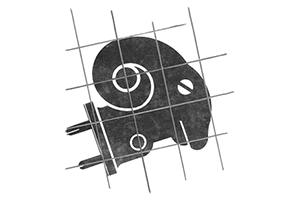

Do Androids Dream of Electric Sheep? is a science fiction novel by American writer Philip K. Dick. First published in 1968, the novel is set in a post-apocalyptic San Francisco, where Earth’s life has been greatly damaged by nuclear global war. Most animal species are endangered or extinct due to extreme radiation poisoning, so that owning an animal is now a sign of status and empathy, an attitude encouraged towards animals. The book served as the primary basis for the 1982 film ‘Blade Runner.’
The main plot follows a single day in the life of Rick Deckard, a bounty hunter hired by the San Francisco Police Department to ‘retire’ (kill) six escaped androids. A secondary plot follows John Isidore, a driver for an electric-animal repair company, who is a ‘special’ (a radioactively-damaged, intellectually slow human whose status prohibits him from emigrating). In connection with Deckard’s mission, the novel explores the issue of what it is to be human. Unlike humans, the androids are claimed to possess no sense of empathy.
read more »
Posted in Art, Language, Technology |
1 Comment »
February 11, 2016

A Shabbat elevator is an elevator which works in a special mode, operating automatically, a way to circumvent the Jewish law requiring observers to abstain from operating electric switches during the Sabbath. In this mode, an elevator will stop automatically at every floor, allowing people to step in and out without having to press any buttons. They are found in Israeli hospitals, hotels, and apartment buildings, and in some synagogues.
The Israeli Knesset passed a special Shabbat elevator law in 2001 ordering the planning and building of all residential buildings, and public buildings which have more than one elevator, to install a control mechanism for Shabbat (Shabbat module) in one of the elevators. In 2009 senior haredi rabbis, led by Rabbi Yosef Shalom Elyashiv, published a religious injunction forbidding the use of Shabbat elevators on the grounds that even in Shabbat mode the user is indirectly violating Shabbat.
Posted in Philosophy, Technology, World |
Leave a Comment »
January 27, 2016

The term infomania is used to describe a sometimes debilitating feeling of ‘information overload,’ caused by the combination of a backlog of information to process (usually in e-mail), and continuous interruptions from technologies like phones and instant messaging. It is also understood as distraction caused by the urge to constantly check on incoming information, which causes the person to neglect other, often more important things—duties, family, etc. (For instance, a typical symptom of infomania is that of checking email frequently during vacation.)
The term was coined by Elizabeth M. Ferrarini, the author of ‘Confessions of an Infomaniac ‘(1984) and ‘Infomania: The Guide to Essential Electronic Services’ (1985). Confessions was an early book about life online. In 2005, British psychologist Glenn Wilson conducted an experimental study which documented the detrimental effects of information overload on problem solving ability. This was described in a press release accompanying a self-report survey of the extent of misuse of modern technology sponsored by Hewlett-Packard (However, in 2010, Wilson published a clarifying note about the study in which he documented its limited size and stated the results were ‘widely misrepresented in the media.’)
Posted in Education, Health, Technology |
Leave a Comment »
January 25, 2016
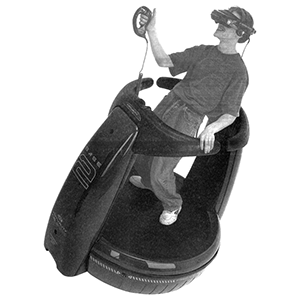
Virtuality is a line of virtual reality gaming machines produced by Virtuality Group, and found in video arcades in the early 1990s. The company was founded by Jonathan D Waldern, a VR researcher supported by IBM Research Labs in Hursley, UK. Virtuality Group began life in 1985 as a garage startup called W Industries. Waldern’s company developed many of the principal components including VR headsets, graphics subsystems, 3D trackers, exoskeleton data gloves and other enclosure designs.
There are two types of units (referred to by the company as ‘pods’): stand up (SU) and sit down (SD). Both unit types utilize head-mounted displays (the ‘Visette’) containing two LCD screens at resolutions of 276 x 372 each, four speakers, and a microphone. The SU units achieve motion tracking via a magnet built into the waist high ring with a receiver in a free-moving joystick (the ‘Space Joystick’). The stereoscopic display was able to react to head movements based on what the player would be ‘looking at’ within the gaming environment. The position of the joystick (also magnetically tracked) controlled movement of the player’s ‘virtual hand,’ and a button on the joystick moves the player forwards in the game arena.
Posted in Games, Technology |
Leave a Comment »
January 24, 2016

Miquela Sousa, better known as Lil Miquela, is a fictional character and digital art project. Miquela is an Instagram model and music artist claiming to be from Downey, California. In 2017, Miquela released her first single, ‘Not Mine.’ Her pivot into music has been compared to virtual musicians Gorillaz and Hatsune Miku.
The project began in 2016 as an Instagram profile. By 2018, the account had amassed more than a million followers. Miquela portrays the lifestyle of an Instagram it-girl over social media. The account also details a fictional narrative which presents her as a sentient robot in conflict with other digital projects.
read more »
Posted in Art, Money, Technology |
Leave a Comment »
January 22, 2016


A warrant canary is a method by which a communications service provider aims to inform its users that the provider has not been served with a secret government subpoena. Secret subpoenas, including those covered under the ‘Patriot Act,’ provide criminal penalties for disclosing the existence of the warrant to any third party, including the service provider’s users. A warrant canary may be posted by the provider to inform users of dates that they have not been served a secret subpoena. If the canary has not been updated in the time period specified by the host, users are to assume that the host has been served with such a subpoena.
The intention is to allow the provider to warn users of the existence of a subpoena passively, without disclosing to others that the government has sought or obtained access to information or records under a secret subpoena. Warrant canaries have been found to be legal by the United States Justice Department, so long as they are passive in their notifications.
read more »
Posted in Politics, Technology |
1 Comment »
January 14, 2016

The ADE 651 is a fake bomb detector produced by ATSC (UK), which claimed that the device could effectively and accurately, from long range, detect the presence and location of various types of explosives, drugs, ivory, and other substances. The device has been sold to 20 countries in the Middle East and Asia, including Iraq and Afghanistan, for as much as US$60,000 each. The Iraqi government is said to have spent £52 million on the devices.
Investigations by the BBC and other organizations found that the device is little more than a ‘glorified dowsing rod’ with no ability to perform its claimed functions. In 2010, export of the device was banned by the British government and the managing director of ATSC was arrested on suspicion of fraud. The company was dissolved in 2013, and the founder, Jim McCormick, was sentenced to ten years’ imprisonment. Similar ‘bomb sniffing’ devices, which are still widely used, have also come under scrutiny in the wake of the revelations about the ADE 651.
read more »
Posted in Money, Technology, War |
Leave a Comment »
January 11, 2016
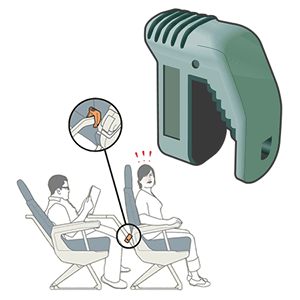
The Knee Defender is a device that an airplane passenger can place on the struts that support his/her drop-down airplane seat tray table to limit the extent to which the seat directly in front of him/her can be reclined. The device was invented by Ira Goldman, and it was first sold to the public in 2003.
In August 2014, on a United Airlines flight from Newark to Denver, an argument developed between a passenger using a Knee Defender and the passenger seated in front of him who wanted to recline. Ultimately the pilot diverted the flight to Chicago and both of those passengers were deplaned.
Posted in Money, Politics, Technology |
Leave a Comment »
December 16, 2015

The Dreamachine is a stroboscopic flicker device that produces visual stimuli. Artist Brion Gysin and William S. Burroughs’s ‘systems adviser’ Ian Sommerville created the device after reading neurophysiologist and robotician William Grey Walter’s 1963 book, ‘The Living Brain.’ In its original form, a Dreamachine is made from a cylinder with slits cut in the sides. The cylinder is placed on a turntable and rotated at 78 or 45 revolutions per minute. A light bulb is suspended in the center of the cylinder and the rotation speed allows the light to come out from the holes at a constant frequency of between 8 and 13 pulses per second.
This frequency range corresponds to alpha waves, electrical oscillations normally present in the human brain while relaxing. A Dreamachine is ‘viewed’ with the eyes closed: the pulsating light stimulates the optic nerve and thus alters the brain’s electrical oscillations. Users experience increasingly bright, complex patterns of color, which become shapes and symbols, swirling around. It is claimed that by using a Dreamachine one may enter a hypnagogic state (the dreamlike transfer from wakefulness to sleep). This experience may sometimes be quite intense, but to escape from it, one needs only to open one’s eyes.
Posted in Art, Technology |
Leave a Comment »
December 15, 2015


Phreaking is a slang term coined to describe the activity of hobbyists who study, experiment with, or explore, telecommunication systems, such as equipment and systems connected to public telephone networks. ‘Phreak,’ ‘phreaker,’ or ‘phone phreak’ are names used for and by individuals who participate in phreaking. The term first referred to groups who had reverse engineered the system of tones used to route long-distance calls. By re-creating these tones, phreaks could switch calls from the phone handset, allowing free calls to be made around the world.
Electronic tone generators known as ‘blue boxes’ became a staple of the phreaker community, including future Apple Inc. cofounders Steve Jobs and Steve Wozniak. The blue box era came to an end with the ever increasing use of computerized phone systems, which sent dialling information on a separate, inaccessible channel. By the 1980s, much of the system in the US and Western Europe had been converted. Phreaking has since become closely linked with computer hacking.
read more »
Posted in Money, Politics, Technology |
Leave a Comment »
December 12, 2015

Smell-O-Vision was a system that released odor during the projection of a film so that the viewer could ‘smell’ what was happening in the movie. The technique was created by inventor Hans Laube and made its only appearance in the 1960 film ‘Scent of Mystery,’ produced by Mike Todd, Jr., son of film producer Mike Todd. The process injected 30 odors, such as freshly-baked bread, pipe tobacco, and salty ocean air, into a movie theater’s seats when triggered by the film’s soundtrack.
The use of scents in conjunction with film dates back to 1906, before the introduction of sound. In this first instance, a 1958 issue of ‘Film Daily’ claims that Samuel Roxy Rothafel of the Family Theatre in Forest City, Pennsylvania, placed a wad of cotton wool that had been soaked in rose oil in front of an electric fan during a newsreel about the Rose Bowl Game. Arthur Mayer installed an in-theater smell system in Paramount’s Rialto Theater on Broadway in 1933, which he used to deliver odors during a film. However, it would take over an hour to clear the scents from the theater, and some smells would linger for days afterward.
read more »
Posted in Art, Humor, Technology |
Leave a Comment »


 The Daily Omnivore