March 27, 2016

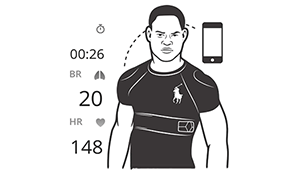
A conductive textile is a fabric which can conduct electricity. Conductive textiles can be made with metal strands woven into the construction of the textile. There is also an interest in semiconducting textiles, made by impregnating normal textiles with carbon- or metal-based powders.
Conductive fibers consist of a non-conductive or less conductive substrate, which is then either coated or embedded with electrically conductive elements, often carbon, nickel, copper, gold, silver, or titanium. Substrates typically include cotton, polyester, nylon, and stainless steel to high performance synthetic fibers like Kevlar and Zylon. Straddling the worlds of textiles and wires, conductive fibers are sold either by weight or length, and measured in gauge.
read more »
Posted in Technology |
Leave a Comment »
March 13, 2016

How to Photograph an Atomic Bomb is a book written by Peter Kuran and published in 2006 by VCE. It documents the stories of the men who photographed US nuclear weapons tests between 1945–1963 and the techniques they used to capture nuclear blasts on film. The book contains 250 photos and 12 technical diagrams, some of which were previously classified.
Research on the book began while Kuran was working as an animator for ‘Star Wars.’ He was able to interview and collect material from photographers who witnessed the blasts, whom he calls unrecognized patriots. A traveling exhibit based on the book was purchased by the Atomic Testing Museum and put on display in 2007. In 2010, the ‘New York Times’ featured a 23-image slideshow on its website with photos taken from the book accompanied by an audio recording of George Yoshitake, then one of the few surviving cameramen.
Posted in Language, Technology, War |
Leave a Comment »
February 28, 2016

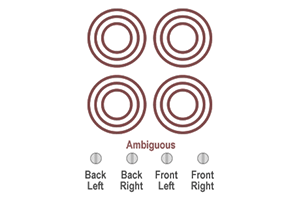
‘The Design of Everyday Things‘ is a 1988 book by cognitive scientist and usability engineer Donald Norman on design’s role in enabling communication been objects and their users, and how to optimize that conduit to make the experience more effective. One of the main premises of the book is that although people are often keen to blame themselves when objects appear to malfunction, it is not the fault of the user but rather the lack of intuitive guidance that should be present in the design. In the book, Norman introduced the term ‘affordance’ as it applied to design, defining it as things that afford the opportunity for an organism to perform an action.
For example, a knob affords twisting, and perhaps pushing, while a cord affords pulling. 20th century American psychologist James J. Gibson originally coined the term ‘affordance’ to describe changes made to one’s environment to make them more usable, such as carving stairs into a steep hill. Norman also popularized the term ‘user-centered design’ to describe design based on the needs of the user, leaving aside what he deemed secondary issues like aesthetics. User-centered design involves simplifying the structure of tasks, making things visible, getting the mapping right, exploiting the powers of constraint, designing for error, and explaining affordances.
Posted in Language, Technology |
Leave a Comment »
February 26, 2016


A reduced-gravity aircraft is a type of fixed-wing aircraft that provides brief near-weightless environments for training astronauts, conducting research and making gravity-free movie shots. Versions of such airplanes, officially nicknamed ‘Weightless Wonders,’ were operated by the NASA Reduced Gravity Research Program.
The aircraft gives its occupants the sensation of weightlessness by following an elliptic flight path relative to the center of the Earth. While following this path, the aircraft and its payload are in free fall at certain points of its flight path. The aircraft is used in this way to demonstrate to astronauts what it is like to orbit the Earth. There are 25 seconds of weightlessness out of 65 seconds of flight in each parabola. The airplane typically flies about 40–60 parabolic maneuvers. In about two thirds of the passengers, these flights produce nausea due to airsickness, giving the plane its nickname ‘vomit comet.
Posted in Humor, Technology |
Leave a Comment »
February 25, 2016
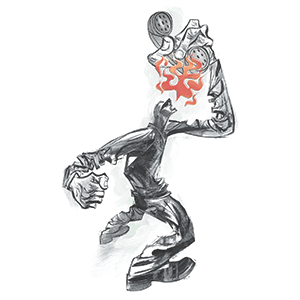
Swatting is the act of deceiving an emergency service into dispatching a police response based on the false report of an ongoing critical incident. The term derives from SWAT (Special Weapons and Tactics), a heavily armored police unit. Swatting has been associated with online harassment campaigns, and episodes range from the deployment of bomb squads and evacuations of schools and businesses, to a single fabricated police report meant to discredit an individual as a prank or personal vendetta.
The action of swatting – linked to the action of ‘doxxing’ (obtaining the address and details of an individual) – has been described as terrorism due to its potential to cause disruption, waste the time of emergency services, divert attention from real emergencies and possibly cause injuries and psychological harm to persons targeted. The act of making false reports to emergency services is punishable by prison sentences in the US and is a crime in many other countries.
read more »
Posted in Politics, Technology |
1 Comment »
February 23, 2016

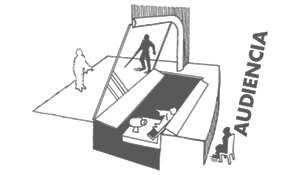
Pepper’s ghost is an illusion technique used in theater, amusement parks, museums, television, and concerts. It is named after John Henry Pepper, a scientist who popularized the effect in a famed demonstration in 1862. It has a long history, dating into the 16th century, and remains widely performed today.
Notable examples of the illusion are the ‘Girl-to-Gorilla’ trick found in old carnival sideshows and the appearance of ‘ghosts’ at the ‘Haunted Mansion’ at Disneyland. Teleprompters are a modern implementation of Pepper’s ghost. They reflect a speech or script and are commonly used for live broadcasts such as news programs. Examples of concert illusions based on Pepper’s ghost are the appearance of Tupac Shakur onstage with Dr. Dre and Snoop Dogg at the 2012 Coachella Music and Arts Festival and Michael Jackson at the 2014 Billboard Music Awards.
read more »
Posted in Art, Technology |
Leave a Comment »
February 15, 2016
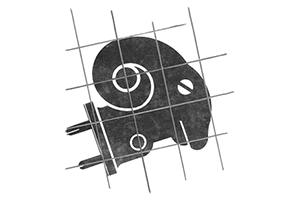

Do Androids Dream of Electric Sheep? is a science fiction novel by American writer Philip K. Dick. First published in 1968, the novel is set in a post-apocalyptic San Francisco, where Earth’s life has been greatly damaged by nuclear global war. Most animal species are endangered or extinct due to extreme radiation poisoning, so that owning an animal is now a sign of status and empathy, an attitude encouraged towards animals. The book served as the primary basis for the 1982 film ‘Blade Runner.’
The main plot follows a single day in the life of Rick Deckard, a bounty hunter hired by the San Francisco Police Department to ‘retire’ (kill) six escaped androids. A secondary plot follows John Isidore, a driver for an electric-animal repair company, who is a ‘special’ (a radioactively-damaged, intellectually slow human whose status prohibits him from emigrating). In connection with Deckard’s mission, the novel explores the issue of what it is to be human. Unlike humans, the androids are claimed to possess no sense of empathy.
read more »
Posted in Art, Language, Technology |
1 Comment »
February 11, 2016

A Shabbat elevator is an elevator which works in a special mode, operating automatically, a way to circumvent the Jewish law requiring observers to abstain from operating electric switches during the Sabbath. In this mode, an elevator will stop automatically at every floor, allowing people to step in and out without having to press any buttons. They are found in Israeli hospitals, hotels, and apartment buildings, and in some synagogues.
The Israeli Knesset passed a special Shabbat elevator law in 2001 ordering the planning and building of all residential buildings, and public buildings which have more than one elevator, to install a control mechanism for Shabbat (Shabbat module) in one of the elevators. In 2009 senior haredi rabbis, led by Rabbi Yosef Shalom Elyashiv, published a religious injunction forbidding the use of Shabbat elevators on the grounds that even in Shabbat mode the user is indirectly violating Shabbat.
Posted in Philosophy, Technology, World |
Leave a Comment »
January 27, 2016

The term infomania is used to describe a sometimes debilitating feeling of ‘information overload,’ caused by the combination of a backlog of information to process (usually in e-mail), and continuous interruptions from technologies like phones and instant messaging. It is also understood as distraction caused by the urge to constantly check on incoming information, which causes the person to neglect other, often more important things—duties, family, etc. (For instance, a typical symptom of infomania is that of checking email frequently during vacation.)
The term was coined by Elizabeth M. Ferrarini, the author of ‘Confessions of an Infomaniac ‘(1984) and ‘Infomania: The Guide to Essential Electronic Services’ (1985). Confessions was an early book about life online. In 2005, British psychologist Glenn Wilson conducted an experimental study which documented the detrimental effects of information overload on problem solving ability. This was described in a press release accompanying a self-report survey of the extent of misuse of modern technology sponsored by Hewlett-Packard (However, in 2010, Wilson published a clarifying note about the study in which he documented its limited size and stated the results were ‘widely misrepresented in the media.’)
Posted in Education, Health, Technology |
Leave a Comment »
January 25, 2016
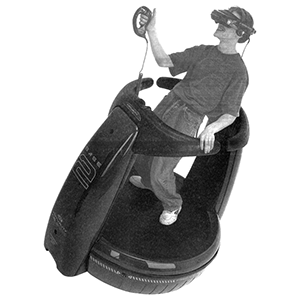
Virtuality is a line of virtual reality gaming machines produced by Virtuality Group, and found in video arcades in the early 1990s. The company was founded by Jonathan D Waldern, a VR researcher supported by IBM Research Labs in Hursley, UK. Virtuality Group began life in 1985 as a garage startup called W Industries. Waldern’s company developed many of the principal components including VR headsets, graphics subsystems, 3D trackers, exoskeleton data gloves and other enclosure designs.
There are two types of units (referred to by the company as ‘pods’): stand up (SU) and sit down (SD). Both unit types utilize head-mounted displays (the ‘Visette’) containing two LCD screens at resolutions of 276 x 372 each, four speakers, and a microphone. The SU units achieve motion tracking via a magnet built into the waist high ring with a receiver in a free-moving joystick (the ‘Space Joystick’). The stereoscopic display was able to react to head movements based on what the player would be ‘looking at’ within the gaming environment. The position of the joystick (also magnetically tracked) controlled movement of the player’s ‘virtual hand,’ and a button on the joystick moves the player forwards in the game arena.
Posted in Games, Technology |
Leave a Comment »
January 24, 2016

Miquela Sousa, better known as Lil Miquela, is a fictional character and digital art project. Miquela is an Instagram model and music artist claiming to be from Downey, California. In 2017, Miquela released her first single, ‘Not Mine.’ Her pivot into music has been compared to virtual musicians Gorillaz and Hatsune Miku.
The project began in 2016 as an Instagram profile. By 2018, the account had amassed more than a million followers. Miquela portrays the lifestyle of an Instagram it-girl over social media. The account also details a fictional narrative which presents her as a sentient robot in conflict with other digital projects.
read more »
Posted in Art, Money, Technology |
Leave a Comment »
January 22, 2016


A warrant canary is a method by which a communications service provider aims to inform its users that the provider has not been served with a secret government subpoena. Secret subpoenas, including those covered under the ‘Patriot Act,’ provide criminal penalties for disclosing the existence of the warrant to any third party, including the service provider’s users. A warrant canary may be posted by the provider to inform users of dates that they have not been served a secret subpoena. If the canary has not been updated in the time period specified by the host, users are to assume that the host has been served with such a subpoena.
The intention is to allow the provider to warn users of the existence of a subpoena passively, without disclosing to others that the government has sought or obtained access to information or records under a secret subpoena. Warrant canaries have been found to be legal by the United States Justice Department, so long as they are passive in their notifications.
read more »
Posted in Politics, Technology |
1 Comment »


 The Daily Omnivore