November 15, 2010

A kytoon [kahy-toon] (kite + balloon) is a kite with a significant amount of aerostatic lift from a lighter than air gas carried within. The primary advantage of a kytoon is that it remains up and at a reasonably stable position above the tether point, irrespective of the wind. Kytoons have been used in peace and war, been employed for raising rescue signals, antennae, and turbines for generating electricity.
Kytoons may be flown in earth or other planetary atmospheres. Any gas may be used to inflate the bladder parts of a kytoon. Hydrogen, methane, air, helium, etc. may be used to inflate the balloon aspect of a kytoon.
Posted in Language, Technology |
Leave a Comment »
November 15, 2010
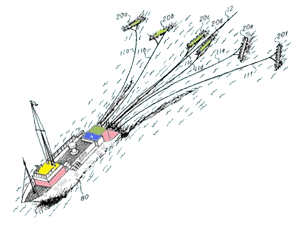

A paravane [par-uh-veyn], also called a water kite, is a towed winged (hydrofoiled) underwater object. Paravanes have applications in sport or commercial fishing, marine exploration, and defense. Navies equip paravanes with cable cutters to sever moored mines, and explosive paravanes are essentially towable mines. Commercial fishers use paravanes to tow bait and lead fish into trolling nets. Paravanes are also used for sampling water chemistry, taking seismic readings, and mapping marine geography.
Human-on-board paravanes are used to transport explorers, scuba divers, and spear-fishers. Foilboards used for recreation are also a type of water kite. Early work in coupling water kites was done by the late J.C. Hagedoorn, a geophysics professor at Delft University. His system coupled manned parafoils with water kites he named ‘hapas.’ Later experimenters also used the terminology ‘chien de mer’ (French for ‘sea dog’).
Posted in Language, Technology |
Leave a Comment »
November 11, 2010

The Lamborghini Countach was a mid-engined sports car produced by Italian automaker Lamborghini from 1974 to 1990. A total of 2,042 cars were built during the Countach’s sixteen year lifetime: Its design both pioneered and popularized the wedge-shaped, sharply angled look popular in many high performance sports cars. The ‘cabin-forward’ design concept, which pushes the passenger compartment forward in order to accommodate a larger engine, was also popularized by the Countach.
The word ‘countach’ is an exclamation of astonishment in the local Piedmontese language — generally used by men on seeing an extremely beautiful woman. The Countach name stuck when Nuccio Bertone first saw ‘Project 112’ in his studio. The prototype was introduced to the world at the 1971 Geneva Motor Show. Most previous and subsequent Lamborghini car names were associated with bulls and bullfighting.
Posted in Language, Technology, World |
Leave a Comment »
November 11, 2010

The Eames [eemz] Lounge Chair, officially titled Eames Lounge (670) and Ottoman (671), were released in 1956 after years of development by designers Charles and Ray Eames for the Herman Miller furniture company. It was the first chair the Eames designed for a high-end market. They are made of molded plywood and leather, and examples of these furnishings are part of the permanent collection of New York’s Museum of Modern Art. They are prized for comfort, aesthetics, and for the pioneering use of new materials and manufacturing methods.
There is a decent used market for these chairs. Some collectors are willing to pay high prices for earlier chairs made with Brazilian Rosewood veneer, which is no longer available due to a worldwide embargo since 1992. Prices for original rosewood chairs have recently reached as much as $7,000 in auction. A new Eames Lounge Chair and ottoman starts at $3,200 for a Herman Miller model. In 2006, to commemorate the 50th anniversary of the chair, Herman Miller released models using a sustainable Palisander Rosewood veneer.
Posted in Art, Money, Technology |
Leave a Comment »
November 11, 2010
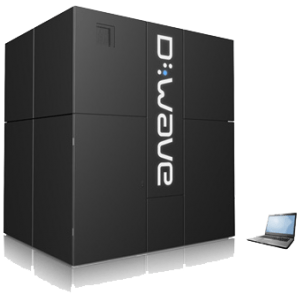
A quantum computer is a device for computation that makes direct use of quantum mechanical phenomena, such as superposition and entanglement, to perform operations on data. Quantum computers are different from traditional computers based on transistors. The basic principle behind quantum computation is that quantum properties can be used to represent data and perform operations on these data. If large-scale quantum computers can be built, they will be able to solve certain problems much faster than any current classical computers (for example Shor’s algorithm). The Bloch sphere is a representation of a qubit, the fundamental building block of quantum computers.
A classical computer has a memory made up of bits, where each bit represents either a one or a zero. A quantum computer maintains a sequence of qubits. A single qubit can represent a one, a zero, or, crucially, a quantum superposition where it is all possible states simultaneously. Although quantum computing is still in its infancy, experiments have been carried out in which quantum computational operations were executed on a very small number of qubits. Both practical and theoretical research continues, and many national government and military funding agencies support quantum computing research to develop quantum computers for both civilian and national security purposes, such as cryptanalysis.
Posted in Technology |
Leave a Comment »
November 11, 2010

Google Dashboard is a service launched by Google that allows a person with a Google Account to compile all the personal information associated with their account, or in their words, ‘Dashboard helps you answer the question: What information does Google have about me?’ The tool pulls together personal information from Google’s applications and services, such as Gmail, YouTube, or Blogger, and indicates whether the information is public or not. The service was launched in November, 2009.
Google created Dashboard in response to privacy concerns about how the company handles personal information. It launched the service at the 31st International Conference of Data Protection and Privacy Commissioners. The service allows a user to review and delete recent Google searches and view documents and other content created using Blogger, Picasa, Google Calendar, and other services.
Posted in Politics, Technology |
Leave a Comment »
November 10, 2010
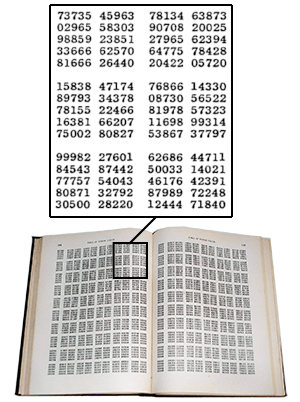
A Million Random Digits with 100,000 Normal Deviates is a 1955 book by the RAND Corporation. The book, comprising primarily of a random number table, was an important 20th century work in the field of statistics and random numbers. It was produced starting in 1947 by an electronic simulation of a roulette wheel attached to a computer, the results of which were then carefully filtered and tested before being used to generate the table. The book was one of the last of a series of random number tables produced from the mid-1920s through the 1950s, after which the development of high speed computers allowed faster operation through the generation of pseudorandom numbers rather than reading them from tables.
The RAND table was an important breakthrough in delivering random numbers, because such a large and carefully prepared table had never before been available. In addition to being available in book form, one could also order the digits on a series of punched cards. The main use of the tables was in statistics and the experimental design of scientific experiments, especially those which employed the ‘Monte Carlo method,’ a class of computational algorithms used in cryptography.
Posted in Language, Technology |
Leave a Comment »
November 9, 2010
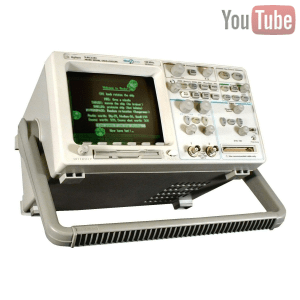
Easter eggs are hidden messages, in-jokes or features in things like video games, web sites, DVDs and other media. For example, the HP 54622D, a professional oscilloscope, has an ‘Asteroids’ clone called ‘Rocks’ that can be accessed by entering a secret sequence of buttons. Google Maps contains an easter egg whereby a user asking for directions from Japan to China would be directed to jetski across the Pacific Ocean.
read more »
Posted in Games, Humor, Technology |
Leave a Comment »
November 9, 2010

Traditional Arabic houses sometimes have a Bab Al-Sirr: a secret door used as an emergency exit built into the walls and hidden with a window sill or a bookcase. The name comes from one of the six gates cut through an ancient wall in Aden (in modern-day Yemen), which was opened only in the event of a state security emergency. In modern-day Spain, the Arab fortress of Benquerencia has a Bab al-Sirr known as the ‘Door of Treason.’
Posted in Technology, World |
Leave a Comment »
November 8, 2010

A sporf is a single eating utensil combining the properties of a spoon, fork, and knife. It was invented by William McArthur in the 1940s in Australia and sold with the brand name ‘Splayd.’ A sporf typically has a spoon shape with fork tines in the middle and flat edges on one or both sides suitable for cutting through soft food.
Posted in Food, Technology |
1 Comment »
November 7, 2010

An orrery [awr-uh-ree] is a mechanical device that illustrates the relative positions and motions of the planets and moons in the solar system in a heliocentric model. They are typically driven by a clockwork mechanism with a globe representing the Sun at the centre, and with a planet at the end of each of the arms. The first modern orrery was built circa 1704 by George Graham and Thomas Tompion. Eisinga’s ‘Planetarium’ (actually, an orrery) was built from 1774 to 1781 by Eise Eisinga in his home in Franeker, in the Netherlands. It displays the planets across the width of a room’s ceiling, and has been in operation almost continually since it was created.
According to Cicero, the Greek philosopher Posidonius constructed an orrery that exhibited the diurnal motions of the sun, moon, and the five known planets. Cicero’s account was written in the first century BCE. The Antikythera mechanism is one of the first orreries. It is an ancient mechanical calculator designed to calculate astronomical positions. It was discovered in an ancient shipwreck off the Greek island of Antikythera, between Kythera and Crete, and has been dated to about 150-100 BC. Technological artifacts of similar complexity would not be common for a thousand years.
Posted in Technology |
Leave a Comment »
November 5, 2010

To get around captchas spammers hire companies employing human solvers in Bangladesh, China and India at about $0.80 to $1.20 for each 1,000 solved captchas. Another approach involves copying the captcha images and using them on another site, often one offering free pornography in exchange for filling out a captcha.
With enough traffic, the attacker can get the solutions in time to relay it back to the target site. These methods have been used by spammers to set up thousands of accounts on free email services such as Gmail and Yahoo!. Since Gmail and Yahoo! are unlikely to be blacklisted by anti-spam systems, spam sent through these compromised accounts is less likely to be blocked.
Posted in Money, Sex, Technology |
Leave a Comment »




