November 22, 2010

Powerbocking is the act of jumping and running with spring-loaded stilts. For some it is an extreme sport, for others it is a form of exercise or even a means of artistic expression. The use of the stilts to perform extreme jumping, running and acrobatics is known as ‘Bocking’ or ‘PowerBocking’ after German inventor, Alexander Boeck. The stilts themselves are often referred to generically as bocks or powerbocks, or by their brand name (e.g. Powerskips, Velocity Stilts, Powerriser, 7 League Boots, Flying Locust, and Skyrunner).
Each boot consists of a foot-plate with snowboard type bindings, rubber foot pad which is also commonly called a hoof, and a fiberglass leaf spring. Using only their weight, and few movements, the user is generally able to jump 3–5 ft off the ground and run up to 20 mph. They also give the ability to take up to 9-foot strides.
Posted in Games, Technology |
Leave a Comment »
November 22, 2010

Givaudan is a Swiss manufacturer of flavorings and fragrances. As of 2008, it is the world’s largest company in the industry. The company’s scents and flavors are developed most often for food and beverage makers, but they are also used frequently in household goods, as well as grooming and personal care products.
Givaudan’s flavors and solutions are usually custom-made and, like their competitors’ formulas, always sold under strict confidentiality agreements. Major competitors include Firmenich, International Flavors and Fragrances, and Symrise. Givaudan was founded as a perfumery company in 1895 in Zurich by Leon and Xavier Givaudan, although some parts of the modern company date back as far as 1796.
Posted in Money, Technology, World |
Leave a Comment »
November 20, 2010

Zero Halliburton is a company which manufactures hard-wearing travel cases and briefcases, mainly out of aluminum that have appeared in over 200 Hollywood movies and television shows, often as a MacGuffin (plot element). In addition to aluminum, Zero Halliburton cases are available in polycarbonate and Texalium (an aluminum-coated fiberglass). Famously, the Nuclear Football, the briefcase containing the launch codes the President of the United States would use to order a nuclear strike, is a modified Zero Halliburton case.
It was originally a Los Angeles metal fabrication company called Zierold, which in 1946 changed its name to Zero Corporation. In 1952 Zero, which until then had no relation to Halliburton, bought the luggage division of Halliburton, the Texas oilfield services company. Today, Zero Halliburton is a wholly-owned subsidiary of Japanese luggage manufacturer ACE. Erle P. Halliburton, the founder of Halliburton, had commissioned the aluminum case in 1938 from aircraft engineers because other luggage could not endure the rough travel through Texas oil fields in a pickup truck. In addition to being more durable than a leather or cloth case due to its rigidity, the aluminum case seals tightly against dust and water.
Posted in Money, Technology |
Leave a Comment »
November 19, 2010

Stephen Wozniak (b. 1950) is an American computer engineer who co-founded Apple Computer, Inc. with Steve Jobs and Ronald Wayne. His inventions and machines are credited with contributing significantly to the personal computer revolution of the 1970s. Wozniak created the Apple I and Apple II computers in the mid-1970s. Wozniak lives in Los Gatos, California. He is a member of a Segway Polo team, the Silicon Valley Aftershocks. His favorite video game is Tetris.] In the 1990s he submitted so many high scores for the game to Nintendo Power that they would no longer print his scores, so he started sending them in under the alphabetically reversed ‘Evets Kainzow.’
In 1980, Apple went public and made Jobs and Wozniak multimillionaires. However, Jobs had refused to allow some employees of Apple to receive stock options, so Wozniak decided to share some of his founder stock with the rest of the team by either giving them away for free or at a heavily discounted price. This was dubbed ‘The Woz Plan.’ Wozniak permanently ended his full-time employment with Apple in 1987, 12 years after creating the company. He still remains an employee (and receives a paycheck) and is a shareholder. He presently works for Fusion-io, a data storage and server company, in Salt Lake City, Utah as their chief scientist.
Posted in Money, Technology |
Leave a Comment »
November 18, 2010

An EyeTap is a device that is worn in front of the eye that acts as a camera to record the scene available to the eye as well as a display to superimpose a computer-generated imagery on the original scene. In order to capture what the eye is seeing as accurately as possible, an EyeTap uses a beam splitter to send the same scene (with reduced intensity) to both the eye and a camera. The camera then digitizes the reflected image of the scene and sends it to a computer. The computer processes the image and then sends it to a projector.
The projector sends the image to the other side of the beam splitter so that this computer-generated image is reflected into the eye to be superimposed on the original scene. Stereo EyeTaps modify light passing through both eyes, but many research prototypes (mainly for reasons of ease of construction) only tap one eye. EyeTap is also the name of an organization founded by inventor Steve Mann to develop and promote EyeTap-related technologies such as wearable computing.
Posted in Technology |
Leave a Comment »
November 18, 2010


Augmented reality (AR) refers to a display in which simulated imagery, graphics, or symbology is superimposed on a view of the surrounding environment. It is related to a more general concept called mediated reality in which a view of reality is modified (possibly even diminished rather than augmented) by a computer. The term is believed to have been coined in 1990 by Thomas Caudell, an employee of Boeing at the time.
read more »
Posted in Technology, War |
Leave a Comment »
November 18, 2010


The Virtuality Continuum is a phrase used to describe a concept that there is a continuous scale ranging between the completely virtual, a Virtual Reality (VR), and the completely real: Reality. The reality-virtuality continuum therefore encompasses all possible variations and compositions of real and virtual objects. It has been somewhat incorrectly described as a concept in new media and computer science, when in fact it could belong closer to anthropology.
The concept was first introduced by industrial engineer Paul Milgram of the University of Toronto. The area between the two extremes, where both the real and the virtual are mixed, is the so-called Mixed reality. This in turn is said to consist of both Augmented Reality (AR), where the virtual augments the real, and Augmented virtuality, where the real augments the virtual.
Posted in Language, Technology |
Leave a Comment »
November 18, 2010

The Buddhabrot is a special rendering of the Mandelbrot set which, when traditionally oriented, resembles to some extent certain depictions of the Buddha. The rendering technique was discovered and later described in a 1993 Usenet post to sci.fractals by Melinda Green. Previous researchers had come very close to finding the precise Buddhabrot technique. In 1988 Linas Vepstas relayed similar images to Cliff Pickover for inclusion in Pickover’s forthcoming book Computers, Pattern, Chaos, and Beauty.
Posted in Art, Technology |
Leave a Comment »
November 18, 2010
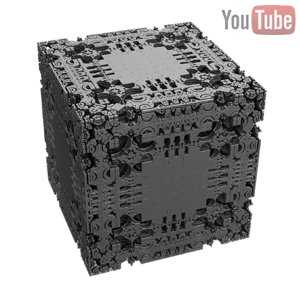
The Mandelbrot [man-del-brot] set is a mathematical fractal named after Benoît Mandelbrot, who studied and popularized it. When computed and graphed it displays an elaborate boundary which, being a fractal, does not simplify at any given magnification, meaning it shows more intricate detail the closer one looks or magnifies the image, usually called ‘zooming in.’
The Mandelbrot set has become popular outside mathematics both for its aesthetic appeal and for being a complicated structure arising from a simple definition, and is one of the best-known examples of mathematical visualization. Many mathematicians, including Mandelbrot, communicated this area of mathematics to the public.
Posted in Art, Technology |
1 Comment »
November 17, 2010
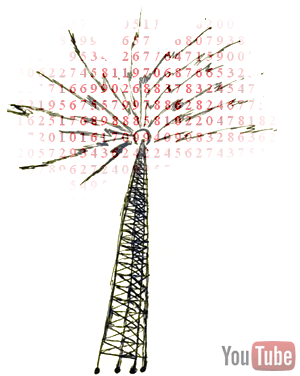
Numbers stations are shortwave radio stations of uncertain origin. They generally broadcast artificially generated voices reading streams of numbers, words, letters (sometimes using a spelling alphabet), tunes or Morse code. They are in a wide variety of languages and the voices are usually female, though sometimes male or children’s voices are used. Numbers stations appear and disappear over time (although some follow regular schedules), and their overall activity has increased slightly since the early 1990s.
Evidence supports popular assumptions that the broadcasts are used to send messages to spies. This usage has not been publicly acknowledged by any government that may operate a numbers station, but in 1892, the United States tried the Cuban Five for spying for Cuba. The group had received and decoded messages that had been broadcast from a Cuban numbers station. In 2009, the United States charged Walter Kendall Myers with conspiracy to spy for Cuba and receiving and decoding messages broadcast from a numbers station operated by the Cuban Intelligence Service.
Posted in Politics, Technology, War |
Leave a Comment »
November 17, 2010
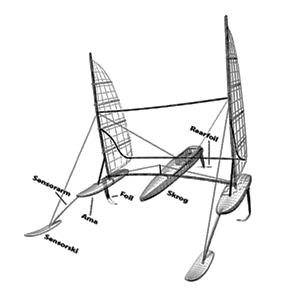
The Hobie TriFoiler is the fastest production sailboat ever created with a top speed of around 35 mph. Designed by the brothers Greg and Dan Ketterman, this trimaran has two sails, one on each ama, and hydrofoils that lift the hulls out of the water at speed. It lifts on the foils at wind speeds between 10 and 11 mph (18 km/h) and quickly accelerates to twice that speed in seconds.
The TriFoiler’s high price-tag ($12,900), fragility, and usage limited to winds between 10 and 25 mph (40 km/h) with low waves, led the Hobie Cat Company to discontinue production. Approximately 30 Trifoilers were built prior to production starting at Hobie in 1995 and another 170 were produced by Hobie before halt of production in 1999.
Posted in Games, Technology |
Leave a Comment »
November 15, 2010

City Hall station, also known as City Hall Loop, was the original southern terminal of the first line of the New York City Subway, built by the Interborough Rapid Transit Company (IRT), named the ‘Manhattan Main Line,’ and now part of the IRT Lexington Avenue Line. Opened on October 27, 1904, this station underneath the public area in front of City Hall was designed to be the showpiece of the new subway. The station was designed by Spanish architect, Rafael Guastavino.
This station is unusually elegant in architectural style, and is unique among the original IRT stations, employing Romanesque Revival architecture. The platform and mezzanine feature Guastavino tile, skylights, colored glass tilework and brass chandeliers. Passenger service was discontinued on December 31, 1945, making it a ghost station, although the station is still used as a turning loop for 6 and <6> trains.
Posted in Art, Technology |
Leave a Comment »





