March 28, 2015

A Notel, also called Notetel, is a type of portable media player made in China which is popular in North Korea. The device has USB and SD ports, can play DVDs and EVDs (Enhanced Versatile Discs, which are physically identical to DVDs but use a different file format), and contains a radio and TV tuner. The name is a portmanteau of ‘notebook’ and ‘television.’ In China, Notels are no longer popular as of 2015, but sell well in the provinces that border on North Korea, where scarce internet and frequent power outages, as well as their ease of concealment make them very useful.
Notetels have been popular in North Korea since around 2005, significantly facilitating the extension of the ‘Korean Wave’ (‘Hallyu,’ the increase of the popularity of South Korean pop culture) into the communist country. After an earlier crackdown that caused black market prices to drop, the devices were legalized in December 2014 (however, they require a license and the government monitors their use). As of 2015 they are available in some government stores as well as on the black market (Jangmadang ) for around 300 Chinese Yuan (ca. US$ 50), and are present in about half of all households.
Posted in Politics, Technology, World |
Leave a Comment »
March 26, 2015

The Truman Show delusion, informally known as Truman Syndrome, is a type of persecutory/grandiose delusion in which patients believe their lives are staged plays or reality television shows. The term was coined in 2008 by brothers Joel and Ian Gold, a psychiatrist and a neurophilosopher, respectively, after the 1998 film ‘The Truman Show,’ about a man who discovers he is living in a constructed reality televised globally around the clock. Since he was in the womb, all the people in Burbank’s life have been paid actors.
The concept predates this particular film. It was based on a 1989 episode of the ‘Twilight Zone,’ ‘Special Service,’ which begins with the protagonist discovering a camera in his bathroom mirror. This man soon learns that his life is being broadcast 24/7 on TV. Author Philip K. Dick has also written short stories and, most notably, a novel, ‘Time Out of Joint’ (1959), in which the protagonist lives in a created world in which his ‘family’ and ‘friends’ are paid to maintain the delusions.
read more »
Posted in Art, Health, Technology |
Leave a Comment »
March 22, 2015
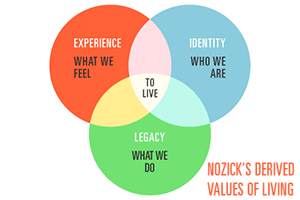

The Experience Machine or Pleasure Machine is a thought experiment put forward by philosopher Robert Nozick in his 1974 book ‘Anarchy, State, and Utopia.’ He describes a choice between everyday reality and an apparently preferable simulated reality as a refutation of ethical hedonism, the idea that people have the right to do everything in their power (that doesn’t infringe on others) to achieve the greatest amount of pleasure possible to them.
If the primary thesis of hedonism is that ‘pleasure is the good,’ then any component of life that is not pleasurable does nothing directly to increase one’s well-being. This is a view held by many value theorists (who study how, why, and to what degree people value things), but most famously by some classical utilitarians (who believe that the morally best action is the one that makes the most overall happiness or ‘utility’ (usefulness). Nozick argues that if he can show that there is something other than pleasure that has value and thereby increases our well-being, then hedonism is defeated.
read more »
Posted in Philosophy, Technology |
1 Comment »
March 20, 2015

In philosophy, Pascal’s mugging is a thought experiment demonstrating a problem in expected utility maximization. A rational agent should choose actions whose outcomes, when weighed by their probability, have higher utility. But some very unlikely outcomes may have very great utilities, and these utilities can grow faster than the probability diminishes. Hence the agent should focus more on vastly improbable cases with implausibly high rewards. The name refers to Pascal’s Wager (an argument by French mathematician Blaise Pascal that the potential cost of not believing in God is higher than the cost of believing), but unlike the wager does not require infinite rewards. This removes any objections to the dilemma that are based on the nature of infinity.
British philosopher Jeremy Bentham’s: ‘The greatest good for the greatest number’ formed the foundation of utilitarianism, which says that the morally best action is the one that makes the most overall happiness or ‘utility’ (usefulness). Pascal’s mugging points out that in extreme case this philosophy can fail. The term for this problem was coined by artificial intelligence researcher Eliezer Yudkowsky in the ‘Less Wrong’ internet forum and his original example was: ‘Now suppose someone comes to me and says, ‘Give me five dollars, or I’ll use my magic powers from outside the Matrix to run a Turing machine that simulates and kills [trillions of] people.’ Even though the chance of this actually happening is negligible, the threatened outcome is so large a rational agent must accede to the demand.
read more »
Posted in Money, Philosophy, Technology |
Leave a Comment »
March 17, 2015

The information explosion is the rapid increase in the amount of published information or data and the effects of this abundance. As the amount of available data grows, the problem of managing the information becomes more difficult, which can lead to information overload. The earliest use of the phrase seems to have been in an IBM advertising supplement to the ‘New York Times’ published on April 30, 1961, and by Frank Fremont-Smith, Director of the American Institute of Biological Sciences Interdisciplinary Conference Program. Techniques to gather knowledge from an overabundance of electronic information (e.g., data fusion may help in data mining) have existed since the 1970s.
Since ‘information’ in electronic media is often used synonymously with ‘data,’ the term ‘information explosion’ is closely related to the concept of ‘data flood’ (also dubbed ‘data deluge’), the ever-increasing amount of electronic data exchanged per time unit. The awareness about non-manageable amounts of data grew along with the advent of ever more powerful data processing since the mid-1960s. By August 2005, there were over 70 million web servers. Two years later there were over 135 million web servers. According to ‘Technorati,’ the number of blogs doubles about every 6 months with a total of 35.3 million blogs as of April 2006. This is an example of the early stages of logistic growth, where growth is approximately exponential, since blogs are a recent innovation. As the number of blogs approaches the number of possible producers (humans), saturation occurs, growth declines, and the number of blogs eventually stabilizes.
Posted in Education, Science, Technology |
Leave a Comment »
March 16, 2015
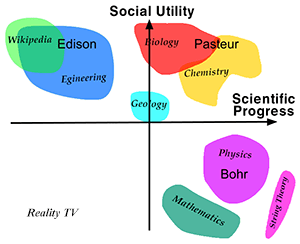

Blue skies research is scientific research in domains where ‘real-world’ applications are not immediately apparent. It has been defined as ‘research without a clear goal’ and ‘curiosity-driven science.’ It is sometimes used interchangeably with the term ‘basic research.’ Proponents of this mode of science argue that unanticipated scientific breakthroughs are sometimes more valuable than the outcomes of agenda-driven research, heralding advances in genetics and stem cell biology as examples of unforeseen benefits of research that was originally seen as purely theoretical in scope. Because of the inherently uncertain return on investment, blue-sky projects are politically and commercially unpopular and tend to lose funding to more reliably profitable or practical research.
Raytheon founder Vannevar Bush’s 1945 report, ‘Science: The Endless Frontier,’ made the argument for the value of basic research in the postwar era, and was the basis for many appeals to the federal funding of basic research. The 1957 launch of Sputnik prompted the United States Air Force Office of Scientific Research to sponsor basic science research into the 1960s. By the 1970s, financial strains brought pressure on public expenditure on the sciences, first in the UK and the Netherlands, and by the 1990s in Germany and the US.
read more »
Posted in Money, Science, Technology |
1 Comment »
March 15, 2015


‘Galápagos syndrome‘ (‘Garapagosu-ka’) is a term of Japanese origin, which refers to an isolated development branch of a globally available product. The term is a reference to similar phenomena Charles Darwin encountered in the Galápagos Islands, with its isolated flora and fauna, which were key observations in the development of Evolutionary Theory. The term was originally coined to refer to Japanese 3G mobile phones, which had developed a large number of specialized features and dominated Japan, but were unsuccessful abroad. The term arose as part of the dialog about Japan’s position as an island nation, and related anxiety about being isolated from the world at large. A derived term is ‘gara-kei’ (‘Galápagos cellphone’), used to refer to Japanese feature phones, which remain popular despite the emergence of smartphones.
The term has since been used for similar phenomena in other markets, such as the outdated usage of magnetic stripe for credit cards in the US, as everywhere else has moved onto using EMV smart cards. ‘It has been claimed that the indigenous American automotive industry has suffered from the Galapagos Syndrome – its products have evolved separately from the rest of the world.’ ‘The Galapagosization of Japan continues. A shocking two-thirds of the country’s white-collar workers said they didn’t want to work abroad…ever.’
Posted in Technology, World |
Leave a Comment »
March 12, 2015
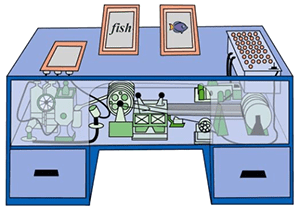

‘As We May Think‘ is an essay by engineer and Raytheon founder Vannevar Bush, first published in ‘The Atlantic’ in July 1945, and republished again as an abridged version two months later — before and after the atomic bombings of Hiroshima and Nagasaki. Bush expresses his concern for the direction of scientific efforts toward destruction, rather than understanding, and explicates a desire for a sort of collective memory machine with his concept of the memex that would make knowledge more accessible, believing that it would help fix these problems. Through this machine, Bush hoped to transform an information explosion into a knowledge explosion.
The article was a reworked and expanded version of Bush’s 1939 essay ‘Mechanization and the Record’ where he described a machine that would combine lower level technologies to achieve a higher level of organized knowledge (like human memory processes). Shortly after the publication of this essay, Bush coined the term ‘memex’ in a letter written to the editor of ‘Fortune’ magazine. That letter became the body of ‘As We May Think,’ adding only an introduction and conclusion.
read more »
Posted in Language, Technology, War |
Leave a Comment »
March 11, 2015


Susan Kare (b. 1954) is an artist and graphic designer who created many of the interface elements for the Apple Macintosh in the 1980s. She left Apple with Steve Jobs in 1985 to be the Creative Director at his new company NeXT.
Kare was born in Ithaca, New York, and is the sister of noted aerospace engineer Jordin Kare. She graduated from Harriton High School in 1971, received her B.A., summa cum laude, in Art from Mount Holyoke College in 1975 and her Ph.D. from New York University in 1978. She next moved to San Francisco and worked for the Museum of Modern Art. Today, the MOMA store in New York City carries stationery and notebooks featuring her designs.
read more »
Posted in Art, Technology |
Leave a Comment »
March 7, 2015


Swarm Intelligence (SI) refers to numerous, simple units working in concert to solve complex problems. It is field in computer science and artificial intelligence based on examples from nature such as an ant colony, made of many animals that communicate with each other to achieve unified goals. In computer models the ‘animals,’ or individual units, are called ‘agents.’ Swarm intelligence emerges from decentralized, self-organizing systems, natural or artificial. The expression was introduced by electrical engineers Gerardo Beni and Jing Wang in 1989, in the context of cellular robotic systems. The application of swarm principles to robots is called ‘swarm robotics,’ while ‘swarm intelligence’ refers to the more general set of algorithms. ‘Swarm prediction’ has been used in the context of forecasting problems.
SI systems consist typically of a population of simple agents or ‘boids’ (named for a 1986 artificial life program that simulates the flocking behavior of birds) interacting locally with one another and with their environment. A number of natural systems have been used as models (e.g. animal herding, bacterial growth, fish schooling and microbial intelligence). The agents follow very simple rules, and although there is no centralized control structure dictating how each unit should behave, local, and to a certain degree random, interactions between such agents lead to the emergence of ‘intelligent’ global behavior, unknown to the individuals.
read more »
Posted in Science, Technology |
Leave a Comment »
March 1, 2015

L’arrivée d’un train en gare de La Ciotat (‘The Arrival of a Train at La Ciotat Station,’ known in the UK as ‘Train Pulling into a Station’) is an 1895 French short black-and-white silent documentary film directed and produced by filmmaking pioneers Auguste and Louis Lumière. Contrary to myth, it was not shown at the Lumières’ first public film screening on December 28th, 1895 in Paris (the first public showing took place in January 1896). The train moving directly towards the camera was said to have terrified spectators at the first screening, a claim that has been called an urban legend.
This 50-second silent film shows the entry of a train pulled by a steam locomotive into a train station in the French coastal town of La Ciotat. Like most of the early Lumière films it consists of a single, unedited view illustrating an aspect of everyday life. There is no apparent intentional camera movement, and the film consists of one continuous real-time shot. This 50-second movie was filmed by means of the Cinématographe, an all-in-one camera, which also serves as a printer and film projector. As with all early Lumière movies, this film was made in a 35 mm format with an aspect ratio of 1.33:1.
read more »
Posted in Art, Technology |
1 Comment »
February 24, 2015

The Comedy of the Commons is an economic concept, developed as an opposite model to the tragedy of the commons (where individuals acting in their own self interest cooperatively deplete a shared resource, to the detriment of the group). In the ‘comedy’ individuals contribute knowledge and content for the good of the community rather than extracting resources for their own personal gain. Examples of this are free and open source software and Wikipedia. This phenomenon is linked to ‘viral’ effects and increases in prominence as individuals contribute altruistically and for social gain. The term appears to have originated in any essay by Yale law professor Carol M. Rose in 1986.
This outcome is more likely when the cost of the contribution is much less than its value over time. Information has this property. For example, it costs very little for a Wikipedia contributor to enter knowledge from their experience into Wikipedia’s servers, and very little for Wikipedia to serve that information over and over again to readers, generating great value over time. Unlike the pasture of a physical commons, information isn’t degraded by use. Thus the value of Wikipedia increases over time, attracting more readers of whom some become contributors, forming a virtuous cycle.
Posted in Money, Technology |
Leave a Comment »


 The Daily Omnivore