March 1, 2015

L’arrivée d’un train en gare de La Ciotat (‘The Arrival of a Train at La Ciotat Station,’ known in the UK as ‘Train Pulling into a Station’) is an 1895 French short black-and-white silent documentary film directed and produced by filmmaking pioneers Auguste and Louis Lumière. Contrary to myth, it was not shown at the Lumières’ first public film screening on December 28th, 1895 in Paris (the first public showing took place in January 1896). The train moving directly towards the camera was said to have terrified spectators at the first screening, a claim that has been called an urban legend.
This 50-second silent film shows the entry of a train pulled by a steam locomotive into a train station in the French coastal town of La Ciotat. Like most of the early Lumière films it consists of a single, unedited view illustrating an aspect of everyday life. There is no apparent intentional camera movement, and the film consists of one continuous real-time shot. This 50-second movie was filmed by means of the Cinématographe, an all-in-one camera, which also serves as a printer and film projector. As with all early Lumière movies, this film was made in a 35 mm format with an aspect ratio of 1.33:1.
read more »
Posted in Art, Technology |
1 Comment »
February 24, 2015

The Comedy of the Commons is an economic concept, developed as an opposite model to the tragedy of the commons (where individuals acting in their own self interest cooperatively deplete a shared resource, to the detriment of the group). In the ‘comedy’ individuals contribute knowledge and content for the good of the community rather than extracting resources for their own personal gain. Examples of this are free and open source software and Wikipedia. This phenomenon is linked to ‘viral’ effects and increases in prominence as individuals contribute altruistically and for social gain. The term appears to have originated in any essay by Yale law professor Carol M. Rose in 1986.
This outcome is more likely when the cost of the contribution is much less than its value over time. Information has this property. For example, it costs very little for a Wikipedia contributor to enter knowledge from their experience into Wikipedia’s servers, and very little for Wikipedia to serve that information over and over again to readers, generating great value over time. Unlike the pasture of a physical commons, information isn’t degraded by use. Thus the value of Wikipedia increases over time, attracting more readers of whom some become contributors, forming a virtuous cycle.
Posted in Money, Technology |
Leave a Comment »
February 17, 2015

Cyberspace is ‘the notional environment in which communication over computer networks occurs.’ The word became popular in the 1990s when the uses of the internet, networking, and digital communication were all growing dramatically. The parent term is ‘cybernetics,’ derived from an Ancient Greek word meaning ‘steersman,’ ‘governor,’ ‘pilot,’ or ‘rudder’ (coined by American mathematician Norbert Wiener for his pioneering work in electronic communication and control science).
According to programmer Chip Morningstar and game developer F. Randall Farmer, cyberspace is defined more by the social interactions involved rather than its technical implementation. In their view, the computational medium in cyberspace is an augmentation of the communication channel between real people; the core characteristic of cyberspace is that it offers an environment that consists of many participants with the ability to affect and influence each other. They derive this concept from the observation that people seek richness, complexity, and depth within a virtual world.
read more »
Posted in Language, Technology |
Leave a Comment »
February 13, 2015


Black Mirror is a British television anthology series created by English broadcaster Charlie Brooker that features speculative fiction with dark and sometimes satirical themes that examine modern society, particularly with regard to the unanticipated consequences of new technologies. Regarding the program’s content and structure, Brooker noted, ‘each episode has a different cast, a different setting, even a different reality. But they’re all about the way we live now – and the way we might be living in 10 minutes’ time if we’re clumsy.’
He explained the series’ title to ‘The Guardian,’ noting: ‘If technology is a drug – and it does feel like a drug – then what, precisely, are the side-effects? This area – between delight and discomfort – is where ‘Black Mirror,’ my new drama series, is set. The ‘black mirror’ of the title is the one you’ll find on every wall, on every desk, in the palm of every hand: the cold, shiny screen of a TV, a monitor, a smartphone.’ The first series has been acclaimed as being innovative and shocking with twists-in-the-tale reminiscent of ‘The Twilight Zone.’ ‘The Daily Telegraph’ described the first episode as ‘a shocking but ballsy, blackly comic study of the modern media. A reporter from ‘The Beijing News’ thought the show was ‘an apocalypse of modern world,’ ‘desperate but profound.’
Posted in Art, Technology, World |
Leave a Comment »
January 18, 2015
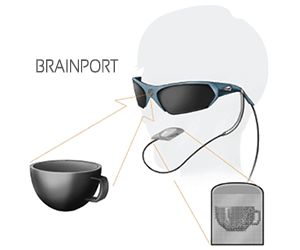
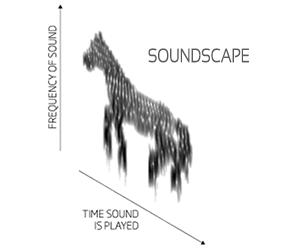
Sensory substitution means to transform the characteristics of one sensory modality (e.g. light, sound, temperature, taste, pressure, smell) into stimuli of another sensory modality (e.g. Tactile–Visual, converting video footage into into tactile information, such as vibration). These systems can help handicapped people by restoring their ability to perceive aspects of a defective physical sense.
A sensory substitution system consists of three parts: a sensor, a coupling system, and a stimulator. The sensor records stimuli and gives them to a coupling system which interprets the signals and transmits them to a stimulator. If the sensor obtains signals of a kind not originally available to the bearer it is called ‘sensory augmentation’ (e.g. implanting magnets under the fingertips imparts magnetoception, sensation of electromagnetic fields). Sensory substitution is based on research in human perception (the organization, identification, and interpretation of sensory information in order to represent and understand the environment) and neuroplasticity (how entire brain structures, and the brain itself, can change from experience).
read more »
Posted in Health, Science, Technology |
Leave a Comment »
January 8, 2015
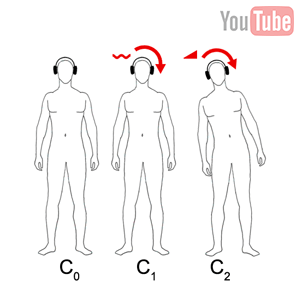
Galvanic [gal-van-ik] vestibular [ve-stib-yuh-ler] stimulation (GVS) is the process of sending electric messages to a nerve in the ear that maintains balance. This technology has been investigated for both military and commercial purposes, and is being applied in Atsugi, Japan, the Mayo Clinic in the US, and a number of other research institutions around the world for use in biomedical engineering, pilot training, and entertainment.
A patient undergoing GVS noted: ‘I felt a mysterious, irresistible urge to start walking to the right whenever the researcher turned the switch to the right. I was convinced — mistakenly — that this was the only way to maintain my balance. The phenomenon is painless but dramatic. Your feet start to move before you know it. I could even remote-control myself by taking the switch into my own hands.’
Posted in Health, Science, Technology |
1 Comment »
December 26, 2014

Yank tank (or máquina) is a slang term referring to American cars, especially large models produced in the 1950s and 1960s common in Cuba today. In 1962 a US embargo against Cuba was introduced, effectively cutting trade between the two countries. This meant that the cars in Cuba could no longer receive new replacement parts when something broke. Currently, the only way to keep these cars on the road today is by using Cuban ingenuity to adapt household products and Soviet technology (such as train parts) for use in these vehicles.
If a car is unable to be repaired at the time, it is usually either ‘parked’ for future repair or ‘parted out’ (to produce extra income for the owner’s family) so that other cars can remain on the road. During the years of Soviet Union influence on Cuba, Ladas, Moskvitchs, and Volgas became the main cars imported by the communist regime, mainly for state use. As a result of these internal economic restrictions, to this day there is no such thing as a new or used private European or Asian automotive dealership branch in Cuba for independent purchasing by regular Cubans.
read more »
Posted in Politics, Technology, World |
1 Comment »
December 16, 2014

Jargon [jahr-guhn], or term of art, is ‘the technical terminology or characteristic idiom of a special activity or group.’ The word ‘jargon’ is French and is believed to have been derived from the Latin ‘gaggire,’ meaning ‘to chatter,’ which was used to describe something in which the speaker did not understand.
An ‘industry term’ is jargon that is associated with one particular industry. Jargon is similar to slang, both are non-standard definitions often created by and for subcultures. It is also common for each generation to create their own jargon. Whether this is because they want to identify with each other and thus create a language of their own, or conversely, if they deliberately do not want to be understood by anybody else (e.g. texting slang used by teens to communicate messages their parents won’t be able to translate).
read more »
Posted in Language, Money, Technology |
Leave a Comment »
December 11, 2014
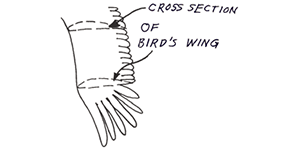

Biomimicry [bahy-oh-mim-ik-ree] is the imitation of biological systems in human technology. Living organisms have evolved well-adapted structures and materials over geological time through natural selection. Nature has solved engineering problems such as self-healing, environmental exposure tolerance, hydrophobicity (waterproofing), self-assembly, and harnessing solar energy.
One of the early examples of biomimicry was the study of birds to enable human flight. Although never successful in creating a ‘flying machine,’ Leonardo da Vinci (1452–1519) was a keen observer of the anatomy and flight of birds, and made numerous notes and sketches on his observations as well as designs of rudimentary ornithopters based on bats. The Wright Brothers, who succeeded in flying the first heavier-than-air aircraft in 1903, derived inspiration from observations of pigeons in flight. Their airfoil was based on a design by German ‘Glider King’ Otto Lilienthal who published ‘Birdflight as the Basis of Aviation.’ Velcro, another famous example, was inspired by the tiny hooks found on the surface of burs.
read more »
Posted in Science, Technology |
Leave a Comment »
December 5, 2014

Body worn video (BWV), including what is referred to as a body worn camera (BWC), is a video recording system that is typically utilized by law enforcement to record their interactions with the public, gather video evidence at crime scenes, and has been known to increase both officer and citizen accountability. BWCs are notable because their placement, often on the front of a shirt, provides for first person perspective and ultimately a more complete chain of evidence.
Body worn video was first adopted by British police in 2005, appearing in the form of small-scale tests conducted by the Devon and Cornwall Police. In 2006, the first significant deployments of BWV were undertaken as part of the Domestic Violence Enforcement Campaign. The basic command units equipped with the head cameras recorded everything that happened during an incident from the time of arrival which led to the ‘preservation of good-quality first disclosure evidence from the victim.’
read more »
Posted in Politics, Technology, World |
1 Comment »
December 2, 2014
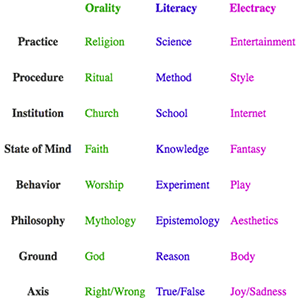

Electracy [ee-lek-truh-see] is a theory by Gregory Ulmer, a professor of English and electronic languages, that describes the skills necessary to access and utilize electronic media such as multimedia (audio, visual, and text), hypermedia (linked material), social networks, and virtual worlds. According to Ulmer, electracy ‘is to digital media what literacy is to print.’ However, ‘If literacy focused on universally valid methodologies of knowledge (sciences), electracy focuses on the individual state of mind within which knowing takes place (arts).’ It is his attempt to describe the transition from a culture of print literacy to a culture saturated with electronic media.
Ulmer sees this shift as a positive step, writing, ‘The near absence of art in contemporary schools is the electrate equivalent of the near absence of science in medieval schools for literacy. The suppression of empirical inquiry by religious dogmatism during the era sometimes called the ‘dark ages’ (reflecting the hostility of the oral apparatus to literacy), is paralleled today by the suppression of aesthetic play by empirical utilitarianism (reflecting the hostility of the literate apparatus to electracy). The ambivalent relation of the institutions of school and entertainment today echoes the ambivalence informing church-science relations throughout the era of literacy.’ He concludes that the sociological changes will be profound: ‘What literacy is to the analytical mind, electracy is to the affective body: a prosthesis that enhances and augments a natural or organic human potential. Alphabetic writing is an artificial memory that supports long complex chains of reasoning impossible to sustain within the organic mind. Digital imaging similarly supports extensive complexes of mood atmospheres beyond organic capacity.’
Posted in Language, Philosophy, Technology |
Leave a Comment »
November 12, 2014


Form follows function, a principle associated with modernist architecture and industrial design in the 20th century, holds that the shape of a building or object should be primarily based upon its intended purpose, not aesthetics or tradition. The authorship of the phrase is often, though wrongly, ascribed to the American sculptor Horatio Greenough, whose thinking to a large extent predates the later functionalist approach to architecture. Greenough’s writings were for a long time largely forgotten, and were rediscovered only in the 1930s; in 1947 a selection of his essays was published under the title ‘Form and Function: Remarks on Art by Horatio Greenough.’
American architect, Louis Sullivan, Greenough’s much younger compatriot, who admired rationalist thinkers like Greenough, Thoreau, Emerson, Whitman, and Melville, coined the phrase in his article ‘The Tall Office Building Artistically Considered’ in 1896 (some fifty years after Greenough’s death), though Sullivan later attributed the core idea to Marcus Vitruvius Pollio the Roman architect, engineer and author who first asserted in his book ‘De architectura’ that a structure must exhibit the three qualities of ‘firmitas, utilitas, venustas’ – that is, it must be solid, useful, beautiful. Here Sullivan actually said ‘form ever follows function,’ but the simpler (and less emphatic) phrase is the one usually remembered.
read more »
Posted in Art, Language, Technology |
1 Comment »



