December 26, 2014

Yank tank (or máquina) is a slang term referring to American cars, especially large models produced in the 1950s and 1960s common in Cuba today. In 1962 a US embargo against Cuba was introduced, effectively cutting trade between the two countries. This meant that the cars in Cuba could no longer receive new replacement parts when something broke. Currently, the only way to keep these cars on the road today is by using Cuban ingenuity to adapt household products and Soviet technology (such as train parts) for use in these vehicles.
If a car is unable to be repaired at the time, it is usually either ‘parked’ for future repair or ‘parted out’ (to produce extra income for the owner’s family) so that other cars can remain on the road. During the years of Soviet Union influence on Cuba, Ladas, Moskvitchs, and Volgas became the main cars imported by the communist regime, mainly for state use. As a result of these internal economic restrictions, to this day there is no such thing as a new or used private European or Asian automotive dealership branch in Cuba for independent purchasing by regular Cubans.
read more »
Posted in Politics, Technology, World |
1 Comment »
December 16, 2014

Jargon [jahr-guhn], or term of art, is ‘the technical terminology or characteristic idiom of a special activity or group.’ The word ‘jargon’ is French and is believed to have been derived from the Latin ‘gaggire,’ meaning ‘to chatter,’ which was used to describe something in which the speaker did not understand.
An ‘industry term’ is jargon that is associated with one particular industry. Jargon is similar to slang, both are non-standard definitions often created by and for subcultures. It is also common for each generation to create their own jargon. Whether this is because they want to identify with each other and thus create a language of their own, or conversely, if they deliberately do not want to be understood by anybody else (e.g. texting slang used by teens to communicate messages their parents won’t be able to translate).
read more »
Posted in Language, Money, Technology |
Leave a Comment »
December 11, 2014
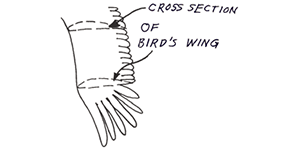

Biomimicry [bahy-oh-mim-ik-ree] is the imitation of biological systems in human technology. Living organisms have evolved well-adapted structures and materials over geological time through natural selection. Nature has solved engineering problems such as self-healing, environmental exposure tolerance, hydrophobicity (waterproofing), self-assembly, and harnessing solar energy.
One of the early examples of biomimicry was the study of birds to enable human flight. Although never successful in creating a ‘flying machine,’ Leonardo da Vinci (1452–1519) was a keen observer of the anatomy and flight of birds, and made numerous notes and sketches on his observations as well as designs of rudimentary ornithopters based on bats. The Wright Brothers, who succeeded in flying the first heavier-than-air aircraft in 1903, derived inspiration from observations of pigeons in flight. Their airfoil was based on a design by German ‘Glider King’ Otto Lilienthal who published ‘Birdflight as the Basis of Aviation.’ Velcro, another famous example, was inspired by the tiny hooks found on the surface of burs.
read more »
Posted in Science, Technology |
Leave a Comment »
December 5, 2014

Body worn video (BWV), including what is referred to as a body worn camera (BWC), is a video recording system that is typically utilized by law enforcement to record their interactions with the public, gather video evidence at crime scenes, and has been known to increase both officer and citizen accountability. BWCs are notable because their placement, often on the front of a shirt, provides for first person perspective and ultimately a more complete chain of evidence.
Body worn video was first adopted by British police in 2005, appearing in the form of small-scale tests conducted by the Devon and Cornwall Police. In 2006, the first significant deployments of BWV were undertaken as part of the Domestic Violence Enforcement Campaign. The basic command units equipped with the head cameras recorded everything that happened during an incident from the time of arrival which led to the ‘preservation of good-quality first disclosure evidence from the victim.’
read more »
Posted in Politics, Technology, World |
1 Comment »
December 2, 2014
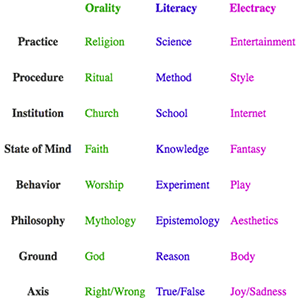

Electracy [ee-lek-truh-see] is a theory by Gregory Ulmer, a professor of English and electronic languages, that describes the skills necessary to access and utilize electronic media such as multimedia (audio, visual, and text), hypermedia (linked material), social networks, and virtual worlds. According to Ulmer, electracy ‘is to digital media what literacy is to print.’ However, ‘If literacy focused on universally valid methodologies of knowledge (sciences), electracy focuses on the individual state of mind within which knowing takes place (arts).’ It is his attempt to describe the transition from a culture of print literacy to a culture saturated with electronic media.
Ulmer sees this shift as a positive step, writing, ‘The near absence of art in contemporary schools is the electrate equivalent of the near absence of science in medieval schools for literacy. The suppression of empirical inquiry by religious dogmatism during the era sometimes called the ‘dark ages’ (reflecting the hostility of the oral apparatus to literacy), is paralleled today by the suppression of aesthetic play by empirical utilitarianism (reflecting the hostility of the literate apparatus to electracy). The ambivalent relation of the institutions of school and entertainment today echoes the ambivalence informing church-science relations throughout the era of literacy.’ He concludes that the sociological changes will be profound: ‘What literacy is to the analytical mind, electracy is to the affective body: a prosthesis that enhances and augments a natural or organic human potential. Alphabetic writing is an artificial memory that supports long complex chains of reasoning impossible to sustain within the organic mind. Digital imaging similarly supports extensive complexes of mood atmospheres beyond organic capacity.’
Posted in Language, Philosophy, Technology |
Leave a Comment »
November 12, 2014


Form follows function, a principle associated with modernist architecture and industrial design in the 20th century, holds that the shape of a building or object should be primarily based upon its intended purpose, not aesthetics or tradition. The authorship of the phrase is often, though wrongly, ascribed to the American sculptor Horatio Greenough, whose thinking to a large extent predates the later functionalist approach to architecture. Greenough’s writings were for a long time largely forgotten, and were rediscovered only in the 1930s; in 1947 a selection of his essays was published under the title ‘Form and Function: Remarks on Art by Horatio Greenough.’
American architect, Louis Sullivan, Greenough’s much younger compatriot, who admired rationalist thinkers like Greenough, Thoreau, Emerson, Whitman, and Melville, coined the phrase in his article ‘The Tall Office Building Artistically Considered’ in 1896 (some fifty years after Greenough’s death), though Sullivan later attributed the core idea to Marcus Vitruvius Pollio the Roman architect, engineer and author who first asserted in his book ‘De architectura’ that a structure must exhibit the three qualities of ‘firmitas, utilitas, venustas’ – that is, it must be solid, useful, beautiful. Here Sullivan actually said ‘form ever follows function,’ but the simpler (and less emphatic) phrase is the one usually remembered.
read more »
Posted in Art, Language, Technology |
1 Comment »
November 12, 2014

An affordance is something that provides the opportunity to perform an action. It is often described as a relationship between an object (or environment) and an organism. For example, a knob affords twisting, and perhaps pushing, while a cord affords pulling. As a relation, an affordance exhibits the possibility of some action, and is not a property of either an organism or its environment alone.
Different definitions of the term have developed. The original definition described all actions that are physically possible, but was later limited to only those an actor is aware of. The term has further evolved for use in the context of human–computer interaction (HCI) to indicate the easy discoverability of possible actions. The concept has application in several fields: perceptual, cognitive, and environmental psychology, industrial design, instructional design, science, technology and society (STS), and artificial intelligence.
read more »
Posted in Language, Science, Technology |
Leave a Comment »
October 25, 2014

LOVEINT is the practice of intelligence service employees making use of their extensive monitoring capabilities to spy on their love interest or spouse. The term was coined in resemblance to intelligence terminology such as SIGINT (signals intelligence) or HUMINT (human intelligence). The term originated at the NSA, where at least one incident is reported every year. They are the lion’s share of unauthorized accesses reported by the NSA. Most incidents are self-reported, for example during a polygraph test.
The NSA sanctions include administrative action, up to termination of employment. In five of the cases, the NSA employee resigned, preempting any administrative action. In two other cases, they retired. The worst administrative sanction handed out was a ‘a reduction in pay for two months, a reduction in grade, and access to classified information being revoked.’ One case was forwarded to the Department of Justice, which however declined to prosecute.
Posted in Love, Politics, Technology |
1 Comment »
October 20, 2014


In engineering, fiction, and thought experiments, unobtainium [uhn-uhb-tey-nee-uhm] is any fictional, extremely rare, costly, or impossible material, or (less commonly) device needed to fulfill a given design for a given application. The properties of any particular unobtainium depend on the intended use. For example, a pulley made of unobtainium might be massless and frictionless; however, if used in a nuclear rocket, unobtainium would be light, strong at high temperatures, and resistant to radiation damage. The concept of unobtainium is often applied flippantly or humorously.
Since the late 1950s, aerospace engineers have used the term when referring to unusual or costly materials, or when theoretically considering a material perfect for their needs in all respects, except that it does not exist. By the 1990s, the term was in wide use, even in formal engineering papers such as ‘Towards unobtainium [new composite materials for space applications].’ The word may well have been coined in the aerospace industry to refer to materials capable of withstanding the extreme temperatures expected in reentry. Aerospace engineers are frequently tempted to design aircraft which require parts with strength or resilience beyond that of currently available materials.
read more »
Posted in Art, Humor, Technology |
Leave a Comment »
September 11, 2014


Simulator sickness is a condition where a person exhibits symptoms similar to motion sickness (e.g. headache, drowsiness, nausea, dizziness, vomiting, sweating) caused by playing computer/simulation/video games. Researchers the University of Minnesota had students play the first person shooter ‘Halo’ for less than an hour, and found that up to 50 percent felt sick afterwards. The phenomenon was well known in popular culture before it was known as simulation sickness. In the 1983 comedy film ‘Joysticks,’ the manager of a local video arcade says, ‘The reason why I never play any of these games, well, they make me physically ill. I mean, every time I look in one of the screens, they make me dizzy.’
In 1995, the US Army Research Institute for the Behavioral and Social Sciences published the results of a study of 742 pilot exposures from 11 military flight simulators. Half of the pilots reported post-effects of some kind. Symptoms dissipated in under an hour for one third, after four hours for six percent, after six hours for four percent, and one percent reported cases of spontaneously occurring flashbacks.
read more »
Posted in Health, Technology, War |
Leave a Comment »
September 8, 2014
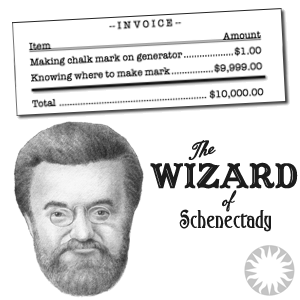
Charles Proteus Steinmetz (1865 – 1923) was a mathematician and electrical engineer known as the Wizard of Schenectady. He fostered the development of alternating current that made possible the expansion of the electric power industry in the US, formulating mathematical theories for engineers.
He made ground-breaking discoveries in the understanding of hysteresis (the lag time when magnetizing a ferromagnetic material) that enabled engineers to design better electromagnetic apparatus equipment, especially electric motors for use in industry.
read more »
Posted in Science, Technology |
Leave a Comment »
August 26, 2014

The Congress is a 2013 French-Israeli live-action/animation science fiction drama film written and directed by Ari Folman. The film premiered at the Cannes Film Festival. Independent film distributor Drafthouse Films announced, along with Films We Like In Toronto, their co-acquisition of the North American rights to the film and a US theatrical and VOD/digital release planned for 2014.
Robin Wright plays an aging actress with a reputation for being fickle and unreliable, so much so that nobody is willing to offer her roles anymore. She agrees to sell the film rights to her digital image to Miramount Studios (a portmanteau of Miramax and Paramount) in exchange for a hefty sum and the promise to never act again. After her body is digitally scanned, the studio will be able to make films starring her using only computer-generated characters.
read more »
Posted in Art, Technology |
Leave a Comment »


 The Daily Omnivore