July 24, 2013

‘What Technology Wants‘ is a 2010 nonfiction book by ‘Wired’ magazine co-founder Kevin Kelly focused on technology as an extension of life. In his young adulthood Kelly spent many years traveling remote parts of the developing world, an experience which helped inform his perspective on what he has coined the ‘technium.’ The opening chapter, entitled ‘My Question,’ chronicles this period in Kelly’s life and gives the reader a sense of how Kelly went from being a nomadic traveler with few possessions to a tech guru.
Kelly focuses on human-technology relations and argues for the existence of technology as the emerging seventh kingdom of life on earth. He offers the anthropomorphic conception that technology is one giant force – the technium, ‘…a word to designate the greater, global, massively interconnected system of technology vibrating around us.’
Posted in Language, Technology |
Leave a Comment »
July 23, 2013

Technological determinism [dih-tur-muh-niz-uhm] is a reductionist theory that presumes that a society’s technology drives the development of its social structure and cultural values. The term is believed to have been coined by American economist and sociologist Thorstein Veblen (1857–1929). The most radical technological determinist in the United States in the twentieth century was most likely economist Clarence Ayres who was a follower of Veblen and American philosopher and psychologist John Dewey. Sociologist William Ogburn was also known for espousing theories of radical technological determinism.
Veblen’s contemporary, popular historian Charles A. Beard, said of the concept: ‘Technology marches in seven-league boots from one ruthless, revolutionary conquest to another, tearing down old factories and industries, flinging up new processes with terrifying rapidity.’
read more »
Posted in Philosophy, Politics, Technology |
1 Comment »
July 23, 2013

The term ‘media ecology‘ was formally introduced in 1968 by cultural critic Neil Postman (who would later become well known for his 1985 book about television, ‘Amusing Ourselves to Death’), but the concept was originally proposed four years earlier by Canadian philosopher of communication theory Marshall McLuhan. Media ecology theory centers on the principles that technology not only profoundly influences society, it also controls virtually all walks of life. It is a study of how media and communication processes affect human perception and understanding.
To strengthen this theory, McLuhan and graphic designer Quentin Fiore claim that it is the media of the epoch that defines the essence of the society by presenting four epochs, inclusive of Tribal Era, Literate Era, Print Era, and Electronic Era, which corresponds to the dominant mode of communication of the time respectively. McLuhan argues that media act as extensions of the human senses in each era, and communication technology is the primary cause of social change.
read more »
Posted in Language, Science, Technology |
Leave a Comment »
July 17, 2013

Etoy is a European digital art group. Their slogan is: ‘leaving reality behind.’ Etoy routinely experiments with the boundaries of art, such as selling shares of ‘stock’ in the etoy.corporation, a registered company in Switzerland and travelling the world as well as living in ‘etoy.tanks’ (cargo containers).
The group was founded in 1994 and is owned now by hundreds of etoy.shareholders such as international art collectors, the etoy.agents and toywar.soldiers (who protected the etoy.brand during the toywar — a legal fight with an online toy retailer over the etoy.com domain). The etoy.inventors own, control and protect the corporate ‘sculpture.’
read more »
Posted in Art, Money, Technology |
Leave a Comment »
July 16, 2013

Douglas Rushkoff (b. 1961) is an American media theorist, graphic novelist, and documentarian. He is best known for his association with the early cyberpunk culture, and his advocacy of open source solutions to social problems. Rushkoff coined the terms: viral media (or media virus), digital native, and social currency. He has written ten books on media, technology, and culture.
He wrote the first syndicated column on cyberculture for ‘The New York Times Syndicate,’ as well as a regular column for ‘The Guardian of London.’ Rushkoff currently teaches in the Media Studies department at The New School University in Manhattan. He has previously lectured at the ITP at New York University’s Tisch School of the Arts and taught a class called ‘Narrative Lab.’
read more »
Posted in Language, Money, Technology |
Leave a Comment »
June 17, 2013

Mark Dery (b. 1959) is an American author, lecturer and cultural critic. He writes about ‘media, the visual landscape, fringe trends, and unpopular culture.’ From 2001 to 2009, he taught media criticism and literary journalism in the Department of Journalism at New York University. In 2000, he was appointed Chancellor’s Distinguished Fellow at the University of California, Irvine. In 2009, he was awarded a scholar-in-residence position at the American Academy in Rome.
He identifies his politics as ‘unrepentantly leftist’ and his religion as the parodic Church of the SubGenius. Dery’s books include ‘The Pyrotechnic Insanitarium: American Culture on the Brink’ and ‘Escape Velocity: Cyberculture at the End of the Century.’ He edited the anthology ‘Flame Wars: The Discourse of Cyberculture’ and wrote the monograph ‘Culture Jamming: Hacking, Slashing, and Sniping in the Empire of Signs.’ His essay collection ‘I Must Not Think Bad Thoughts: Drive-By Essays on American Dread, American Dreams’ was published in 2012.
read more »
Posted in Language, Technology |
Leave a Comment »
June 17, 2013
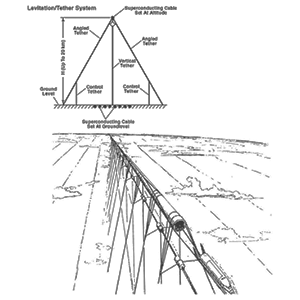
StarTram is a proposal for a maglev space launch system. The initial Generation 1 facility would be cargo only, launching from a mountain peak at 3 to 7 km (1.9 to 4.3 mi) altitude with an evacuated tube staying at local surface level; it has been claimed that about 150,000 tons could be lifted to orbit annually. More advanced technology would be required for the Generation 2 system for passengers, with a longer track instead gradually curving up at its end to the thinner air at 22 km (14 mi) altitude, supported by magnetic levitation, reducing g-forces when each capsule transitions from the vacuum tube to the atmosphere.
American physicist James R. Powell invented the superconducting maglev concept in the 1960s with a colleague, Gordon Danby, also at Brookhaven National Laboratory, which was subsequently developed into modern maglev trains. Later, Powell co-founded StarTram, Inc. with Dr. George Maise, an aerospace engineer was at Brookhaven from 1974 to 1997, with particular expertise in reentry heating and hypersonic vehicle design.
read more »
Posted in Technology, World |
1 Comment »
June 17, 2013

A vactrain (or vacuum tube train) is a proposed, as-yet-unbuilt design for future high-speed railroad transportation. It is a maglev line run through evacuated (air-less) or partly evacuated tubes or tunnels. The lack of air resistance could permit vactrains to use little power and to move at extremely high speeds, up to 4,000–5,000 mph (6,400–8,000 km/h). At that speed, the trip between London and New York would take less than an hour, supplanting aircraft as the world’s fastest mode of public transportation.
Travel through evacuated tubes allows supersonic speed without the penalty of sonic boom found with supersonic aircraft. The trains could operate faster than Mach 1 without noise. However, without major advances in tunnelling and other technology, vactrains would be prohibitively expensive. Alternatives such as elevated concrete tubes with partial vacuums have been proposed to reduce costs. In 2010, researchers at Southwest Jiaotong University in China began developing a vactrain to reach speeds of 1,000 km/h (620 mph), intended to be completed in 2020.
read more »
Posted in Technology, World |
1 Comment »
June 14, 2013

A transatlantic tunnel is a theoretical tunnel that would span the Atlantic Ocean between North America and Europe possibly for such purposes as mass transit. Many variations of the concept exist, including a tube above the seabed, a tunnel beneath the ocean floor, or some combination of the two.
Some proposals envision technologically advanced trains reaching speeds of 500 to 8,000 km/h (310 to 5,000 mph). The main barriers to constructing such a tunnel are cost with estimates of between $175 billion to $12 trillion as well as the limits of current materials science. Additionally, existing major tunnels, such as the Channel Tunnel and Seikan Tunnel in Japan, despite using less expensive technology than any yet proposed for the transatlantic tunnel, struggle financially.
read more »
Posted in Technology |
Leave a Comment »
June 14, 2013

‘Tunnel Through the Deeps‘ (also published as ‘A Transatlantic Tunnel, Hurrah!’) is a 1972 alternate history/science fiction novel by Harry Harrison. It was serialized in ‘Analog’ magazine beginning in the April 1972 issue.
The title refers to the construction of a submerged floating-tube pontoon bridge/tunnel across the Atlantic Ocean.
read more »
Posted in Language, Technology, World |
Leave a Comment »
June 12, 2013

The Fairness Doctrine was a policy of the FCC, introduced in 1949, that required the holders of broadcast licenses to both present controversial issues of public importance and to do so in a manner that was, in the Commission’s view, honest, equitable and balanced (i.e. air contrasting views regarding those matters).
The FCC decided to eliminate the Doctrine in 1987, and in 2011, formally removed the language that implemented it. Stations were given wide latitude as to how to provide contrasting views: It could be done through news segments, public affairs shows, or editorials. The doctrine did not require equal time for opposing views but required that contrasting viewpoints be presented. (The Fairness Doctrine should not be confused with the ‘Equal Time’ rule, which deals only with political candidates.)
read more »
Posted in Language, Politics, Technology |
Leave a Comment »
June 10, 2013

Chilling Effects is a collaborative archive created by Wendy Seltzer and founded along with several law school clinics and the Electronic Frontier Foundation (a digital rights group) to protect lawful online activity from legal threats.
Its website, ‘Chilling Effects Clearinghouse,’ allows recipients of cease-and-desist notices to submit them to the site and receive information about their legal rights and responsibilities. The archive was founded in 2001 by Internet activists who were concerned that the unregulated private practice of sending cease-and-desist letters seemed to be increasing and was having an unstudied, but potentially significant, ‘chilling effect’ on speech.
read more »
Posted in Money, Politics, Technology |
Leave a Comment »


 The Daily Omnivore