June 17, 2013
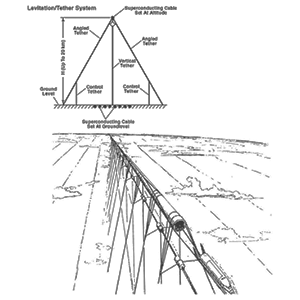
StarTram is a proposal for a maglev space launch system. The initial Generation 1 facility would be cargo only, launching from a mountain peak at 3 to 7 km (1.9 to 4.3 mi) altitude with an evacuated tube staying at local surface level; it has been claimed that about 150,000 tons could be lifted to orbit annually. More advanced technology would be required for the Generation 2 system for passengers, with a longer track instead gradually curving up at its end to the thinner air at 22 km (14 mi) altitude, supported by magnetic levitation, reducing g-forces when each capsule transitions from the vacuum tube to the atmosphere.
American physicist James R. Powell invented the superconducting maglev concept in the 1960s with a colleague, Gordon Danby, also at Brookhaven National Laboratory, which was subsequently developed into modern maglev trains. Later, Powell co-founded StarTram, Inc. with Dr. George Maise, an aerospace engineer was at Brookhaven from 1974 to 1997, with particular expertise in reentry heating and hypersonic vehicle design.
read more »
Posted in Technology, World |
1 Comment »
June 17, 2013
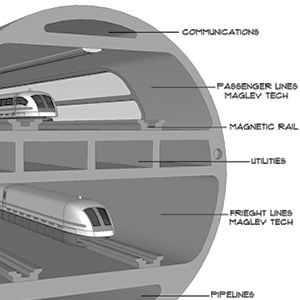
A vactrain (or vacuum tube train) is a proposed, as-yet-unbuilt design for future high-speed railroad transportation. It is a maglev line run through evacuated (air-less) or partly evacuated tubes or tunnels. The lack of air resistance could permit vactrains to use little power and to move at extremely high speeds, up to 4,000–5,000 mph (6,400–8,000 km/h). At that speed, the trip between London and New York would take less than an hour, supplanting aircraft as the world’s fastest mode of public transportation.
Travel through evacuated tubes allows supersonic speed without the penalty of sonic boom found with supersonic aircraft. The trains could operate faster than Mach 1 without noise. However, without major advances in tunnelling and other technology, vactrains would be prohibitively expensive. Alternatives such as elevated concrete tubes with partial vacuums have been proposed to reduce costs. In 2010, researchers at Southwest Jiaotong University in China began developing a vactrain to reach speeds of 1,000 km/h (620 mph), intended to be completed in 2020.
read more »
Posted in Technology, World |
1 Comment »
June 14, 2013
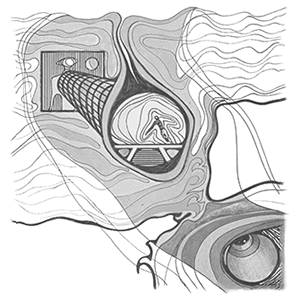
A transatlantic tunnel is a theoretical tunnel that would span the Atlantic Ocean between North America and Europe possibly for such purposes as mass transit. Many variations of the concept exist, including a tube above the seabed, a tunnel beneath the ocean floor, or some combination of the two.
Some proposals envision technologically advanced trains reaching speeds of 500 to 8,000 km/h (310 to 5,000 mph). The main barriers to constructing such a tunnel are cost with estimates of between $175 billion to $12 trillion as well as the limits of current materials science. Additionally, existing major tunnels, such as the Channel Tunnel and Seikan Tunnel in Japan, despite using less expensive technology than any yet proposed for the transatlantic tunnel, struggle financially.
read more »
Posted in Technology |
Leave a Comment »
June 14, 2013
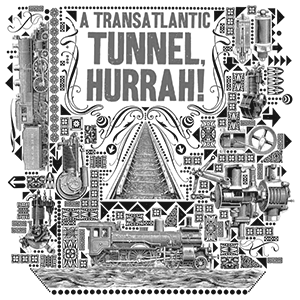
‘Tunnel Through the Deeps‘ (also published as ‘A Transatlantic Tunnel, Hurrah!’) is a 1972 alternate history/science fiction novel by Harry Harrison. It was serialized in ‘Analog’ magazine beginning in the April 1972 issue.
The title refers to the construction of a submerged floating-tube pontoon bridge/tunnel across the Atlantic Ocean.
read more »
Posted in Language, Technology, World |
Leave a Comment »
June 12, 2013

The Fairness Doctrine was a policy of the FCC, introduced in 1949, that required the holders of broadcast licenses to both present controversial issues of public importance and to do so in a manner that was, in the Commission’s view, honest, equitable and balanced (i.e. air contrasting views regarding those matters).
The FCC decided to eliminate the Doctrine in 1987, and in 2011, formally removed the language that implemented it. Stations were given wide latitude as to how to provide contrasting views: It could be done through news segments, public affairs shows, or editorials. The doctrine did not require equal time for opposing views but required that contrasting viewpoints be presented. (The Fairness Doctrine should not be confused with the ‘Equal Time’ rule, which deals only with political candidates.)
read more »
Posted in Language, Politics, Technology |
Leave a Comment »
June 10, 2013

Chilling Effects is a collaborative archive created by Wendy Seltzer and founded along with several law school clinics and the Electronic Frontier Foundation (a digital rights group) to protect lawful online activity from legal threats.
Its website, ‘Chilling Effects Clearinghouse,’ allows recipients of cease-and-desist notices to submit them to the site and receive information about their legal rights and responsibilities. The archive was founded in 2001 by Internet activists who were concerned that the unregulated private practice of sending cease-and-desist letters seemed to be increasing and was having an unstudied, but potentially significant, ‘chilling effect’ on speech.
read more »
Posted in Money, Politics, Technology |
Leave a Comment »
June 10, 2013

There are a number of disputes relating to the Church of Scientology’s efforts to suppress material critical of Scientology on the Internet through the use of lawsuits and legal threats. In late 1994, the Church of Scientology began using various legal tactics to stop distribution of unpublished documents written by L. Ron Hubbard.
The Church of Scientology is often accused of barratry (litigation for the purpose of harassment or profit) through the filing of SLAPP suits (lawsuits intended to censor, intimidate, and silence critics by burdening them with the cost of a legal defense until they abandon their criticism or opposition). The official church response is that its litigious nature is solely to protect its copyrighted works and the unpublished status of certain documents.
read more »
Posted in Philosophy, Politics, Technology |
Leave a Comment »
June 4, 2013

Patent monetization refers to the generation of revenue or the attempt to generate revenue by a person or company by selling or licensing the patents it owns.
The so-called patent trolls—which is a pejorative term—attempt to generate revenue by buying and enforcing patents against one or more alleged infringers in a manner considered by the target or observers as unduly aggressive or opportunistic, often with no intention to further develop, manufacture or market the patented invention. Other persons or companies, which are not regarded as patent trolls, also try to make money from patents on inventions they develop, manufacture or market.
Posted in Money, Politics, Technology |
Leave a Comment »
June 4, 2013

Nathan Myhrvold (b. 1959), formerly Chief Technology Officer at Microsoft, is co-founder and 40% owner of Intellectual Ventures, a patent portfolio holding company.
Myhrvold, usually with coinventors, holds 17 U.S. patents assigned to Microsoft and has applied for more than 500 patents. In addition, Myhrvold and coinventors hold 115 U.S. patents assigned mostly to The Invention Science Fund I, LLC.
read more »
Posted in Food, Money, Technology |
Leave a Comment »
June 4, 2013

Intellectual Ventures is a private company notable for being one of the top-five owners of U.S. patents, as of 2011. Its business model has a focus on buying patents and aggregating them into a large patent portfolio and licensing this ‘IV’ portfolio to companies.
Publicly, it states that a major goal is to assist small inventors against corporations. In practice, the vast majority of IV’s revenue comes from buying patents, aggregating them into a large portfolio and licensing this portfolio to other companies or filing lawsuits for infringement of patents, a controversial practice known as patent trolling.
read more »
Posted in Money, Politics, Technology |
Leave a Comment »
June 4, 2013

Chris Bathgate is a self-taught metal sculptor working and residing in Baltimore. He has spent the last several years learning how to build and use a variety of metalworking tools. In addition to exploring the finer intricacies of both manual and computer-assisted machining, he also has applied electroplating and heat coloring techniques to his intricate and precise sculptures.
Bathgate’s sculptures are as much about the processes he uses as they are about his imagination. He is represented by Gallery Imperato, located in Baltimore, and a member of Viridian Artists Inc, an artist cooperative in the Chelsea District of New York City.
Posted in Art, Technology |
1 Comment »
June 3, 2013
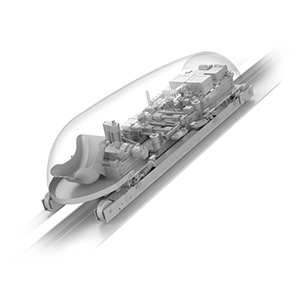
Hyperloop is a hypothetical mode of high-speed transportation proposed by inventor and SpaceX founder Elon Musk. Musk has envisioned the system as a ‘fifth mode’ of transportation, an alternative to boats, planes, automobiles and trains. The system would, in theory, be able to travel from downtown Los Angeles to downtown San Francisco in under 30 minutes (at more than 685 mph).
In 2013, Musk said that the hyperloop would be like a ‘cross between a Concorde and a railgun and an air hockey table,’ but no further details have been released. Musk is quoted as saying, ‘I think we could actually make it self-powering if you put solar panels on it, you generate more power than you would consume in the system. There’s a way to store the power so it would run 24/7 without using batteries. Yes, this is possible, absolutely.’
Posted in Technology |
Leave a Comment »