November 1, 2011
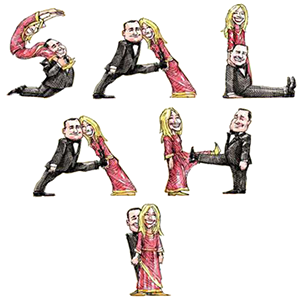
Gate-crashing, gatecrashing or party crashing is the act of attending an invite-only event without invitation. The person doing the gate-crashing is known as a gate-crasher. Gate crashing is also the act of tracing a signal through logic gates in electronics. Reasons for gate-crashing include avoiding entry fees, gaining access to free food and beverages (often alcoholic) , gaining access to a party that they wanted to be invited to, taking pictures of famous people, having pictures taken with famous people, and more serious crimes like stalking, kidnapping, murder, theft, fraud, and causing general disruptions.
Various techniques that involve blending in with the crowd can be used to gain access to some events. Various measures can be taken to prevent gate-crashers from gaining access such as collecting invitations at the door and employing staff to identify potential uninvited guests, but such measures can still be thwarted by a skilled gate-crasher. The 2009 U.S. state dinner security breaches occurred when Michaele and Tareq Salahi, from Virginia, allegedly gate-crashed the state dinner between President Barack Obama and Indian Prime Minister Manmohan Singh.
Posted in Language, Politics, Technology |
1 Comment »
November 1, 2011

In security, piggybacking refers to when a person tags along with another person who is authorized to gain entry into a restricted area, or pass a certain checkpoint. The act may be legal or illegal, authorized or unauthorized, depending on the circumstances. However, the term more often has the connotation of being an illegal or unauthorized act.
To describe the act of an unauthorized person who follows someone to a restricted area without the consent of the authorized person, the term tailgating is also used. ‘Tailgating’ implies without consent (similar to a car tailgating another vehicle on the freeway), while ‘piggybacking’ usually implies consent of the authorized person.
read more »
Posted in Politics, Technology |
Leave a Comment »
October 31, 2011
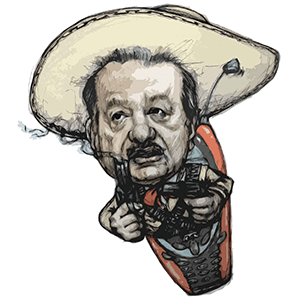
Carlos Slim (b. 1940) is a Mexican businessman, and the richest person in the world, worth more than US$60 billion. He owns the Mexican phone company Telmex, which provides a telephone service to most Mexicans. After graduating, Slim expanded on his father’s ownings of real estate in Mexico City. By age 26, he was worth $40 million. During the 1980s and 1990s, Slim bought several companies that were bankrupt or being privatized. Slim owns about 7% of the New York Times.
The Mexican magnate’s growing fortune has caused a controversy because it has been amassed in a developing country where per capita income does not surpass $14,500 a year, and nearly 17% of the population lives in poverty. Critics claim that Slim is a monopolist, pointing to Telmex’s control of 90% of the Mexican landline telephone market. Slim’s wealth is the equivalent of roughly 5% of Mexico’s annual economic output. Telmex, of which 49.1% is owned by Slim and his family, charges among the highest usage fees in the world, according to the Organisation for Economic Co-operation and Development.
read more »
Posted in Money, Technology, World |
Leave a Comment »
October 29, 2011
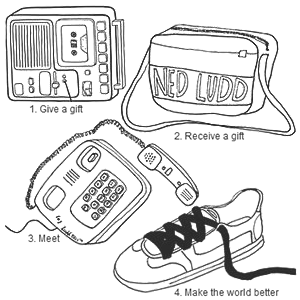
DaruDar is an international community where people give away things, their skills and time to each other for absolutely free requiring nothing in return. The community is based on principles of self-organization. Main condition of participation is following the rules of gift giving and communication set on the site. The global mission of DaruDar is to create a widespread social practice of gift-giving, to make it a daily and routine act. Words like ‘lot,’ ‘exchange,’ ‘freebie,’ ‘junk,’ or ‘crap’ are considered obscene on DaruDar. The service was launched in Russian in 2008. It was created by four friends who had worked with Habrahabr project earlier, a collaborative blog. They were inspired by flashmobs, Russian philosopher Peter Kropotkin and Gandhi.
Darudar users call themselves comembers (‘community members’). DaruDar gift is a thing, skill or service of a comember that he/she wants to give away to someone. In order to offer a gift a comember creates a publication describing what he gives. Other comembers can wish it. Later the gift giver chooses someone to promise their gift. Every gift can be commented, wished, promised and thanked. Only those offers which simultaneously satisfy all three of the following conditions and cannot exist without them should be considered gifts on Darudar: It can be wished; It can be promised; and It can be given.
Posted in Money, Technology, World |
Leave a Comment »
October 29, 2011

CouchSurfing is a corporation based in San Francisco that offer its users hospitality exchange and social networking services. It recently suffered significant criticism from thousands of users after becoming a for-profit corporation after having been been a non-profit for many years. Couchsurfing is a neologism referring to the practice of moving from one friend’s house to another, sleeping in whatever spare space is available, floor or couch, generally staying a few days before moving on to the next house.
The CouchSurfing project was conceived by Casey Fenton in 1999. According to Fenton’s account, the idea arose after finding an inexpensive flight from Boston to Iceland. Fenton randomly e-mailed 1,500 students from the University of Iceland asking if he could stay. He ultimately received more than 50 offers of accommodation. On the return flight to Boston, he began to develop the ideas that would underpin the CouchSurfing project.
read more »
Posted in Money, Technology, World |
Leave a Comment »
October 29, 2011
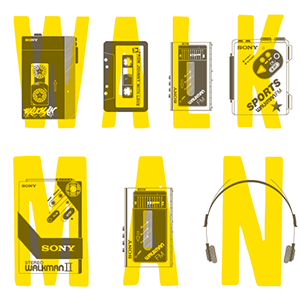
The Walkman Effect refers to the way music listened to via headphones allows the user to gain more control over their environment. It was coined by International Research Center for Japanese Studies Professor Shuhei Hosokawa in an article of the same name published in the journal ‘Popular Music’ in 1984. While the term was named after the dominant portable music technology of the time, the Sony Walkman, it applies to all such devices and has been cited numerous times to refer to more current products such as the Apple iPod.
When Sony released the first Walkmans, they featured two headphone jacks and a ‘talk button.’ When pressed, this button activated a microphone and lowered the volume to enable those listening to have a conversation without removing their headphones. Sony Chairman Akio Morita added these features to the design for fear the technology would be isolating. Though he ‘thought it would be considered rude for one person to be listening to his music in isolation,’ however, people bought their own units rather than share and these features were removed for later models.
read more »
Posted in Health, Technology |
1 Comment »
October 28, 2011
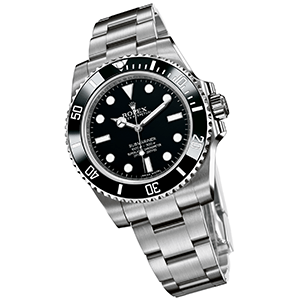
Rolex is a Swiss watchmaking manufacturer of high-quality, luxury wristwatches. Rolex watches are popularly regarded as status symbols. Rolex is also the largest single luxury watch brand, producing about 2,000 watches per day, with estimated revenues of around US$3 billion in 2003. Among the company’s innovations are: the first waterproof wristwatch (Oyster, 1923); the first wristwatch with an automatically changing date on the dial (Rolex Datejust, 1945); the first wristwatch with an automatically changing day and date on the dial (Rolex Day-Date); the first wristwatch case waterproof to 100 m (330 ft) (Rolex Oyster Perpetual Submariner); and the first wristwatch to show two time zones at once (Rolex GMT Master, 1954).
Rolex produced specific models suitable for the extremes of deep-sea diving, mountain climbing and aviation. Early sports models included the Rolex Submariner and the Rolex Oyster Perpetual Date Sea Dweller. The latter watch has a helium release valve, co-invented with Swiss watchmaker Doxa, to release helium gas build-up during decompression. The Explorer and Explorer II were developed specifically for explorers who would navigate rough terrain, such as the world famous Mount Everest expeditions. Another iconic model is the Rolex GMT Master, which was originally developed in 1954 at the request of Pan Am Airways to assist its pilots with the problem of crossing multiple time zones when on transcontinental flights (GMT standing for Greenwich Mean Time).
read more »
Posted in Money, Technology |
Leave a Comment »
October 28, 2011

A Zippo lighter is a refillable, metal lighter manufactured by Zippo Manufacturing Company of Pennsylvania. Thousands of different styles and designs have been made in the seven decades since their introduction including military ones for specific regiments. George G. Blaisdell founded Zippo Manufacturing Company in 1932, and produced the first Zippo lighter in early 1933, being inspired by an Austrian cigarette lighter of similar design. It got its name because Blaisdell liked the sound of the word ‘zipper’ and ‘zippo’ sounded more modern.
Zippo lighters became popular in the United States military, especially during World War II when Zippo ceased production of lighters for consumer markets and dedicated all manufacturing to the U.S. military. The Zippo at that time was made of brass, but as this commodity was unobtainable, Zippo used steel during the war years. While the Zippo Manufacturing Company never had an official contract with the military, soldiers and armed forces personnel insisted that Base exchange (BX) stores carry this sought-after lighter. While it had previously been common to have Zippos with authorized badges, unit crests and division insignia, it became popular among the American soldiers of the Vietnam War, to get their Zippos engraved with personal mottos. These lighters are now sought after collectors items and popular souvenirs for visitors to Vietnam.
read more »
Posted in Money, Technology, War |
Leave a Comment »
October 27, 2011


Megacorporation is a term popularized by science fiction author William Gibson. It has become a term popularly used in cyberpunk literature, referring to a corporation that is a massive conglomerate, holding monopolistic or near-monopolistic control over multiple markets (thus exhibiting both a horizontal and a vertical monopoly). Megacorps are so powerful that they can ignore the law, possess their own heavily-armed (often military-sized) private armies, hold ‘sovereign’ territory, and possibly even act as outright governments. They often exercise a large degree of control over their employees, taking the idea of ‘corporate culture’ to an extreme.
Such organizations are a staple of science fiction long predating cyberpunk, appearing in the works of writers such as Philip K. Dick (‘Do Androids Dream of Electric Sheep?’), Thea von Harbou (‘Metropolis’), and Robert Heinlein (‘Citizen of the Galaxy’).
read more »
Posted in Money, Politics, Technology |
Leave a Comment »
October 26, 2011

Siri is a personal assistant application for Apple iOS. The application uses natural language processing to answer questions, make recommendations, and perform actions by delegating requests to an expanding set of web services. Siri claims that the software adapts to the user’s individual preferences over time and personalizes results, as well as accomplishing tasks such as making dinner reservations and reserving a cab. Siri was acquired by Apple in 2010, and is now an integrated part of iOS 5. It offers conversational interaction with many applications, including reminders, weather, stocks, messaging, email, calendar, contacts, notes, music, clocks, web browser, Wolfram Alpha, and maps. Currently, Siri only supports English (US, UK, and Australian), German and French, and has limited functionality outside of the US. Siri’s actions and answers rely upon a growing ecosystem of partners, including: OpenTable, CitySearch, Yelp, Yahoo Local, StubHub, RottenTomatoes, New York Times, and Google.
Siri is a spin-off from the Stanford Research Institute (SRI) Artificial Intelligence Center, and is an offshoot of the Defense Advanced Research Projects Agency (DARPA)-funded CALO project, described as perhaps the largest artificial-intelligence project ever launched. CALO was an attempted to integrate numerous AI technologies into a cognitive assistant; it is an acronym for ‘Cognitive Assistant that Learns and Organizes.’ The name was inspired by the Latin word ‘alonis,’ which means ‘soldier’s servant.’ Siri has many easter eggs. Most are answers to common catchphrases from popular culture. For example, if asked to ‘Open the pod bay door,’ a question David Bowman asks HAL 9000 in ‘2001: A Space Odyssey,’ the program gives the same response as HAL: ‘I’m sorry (username), I can’t do that.’ If the request is repeated, it draws other responses, such as a threat to report the user to the Intelligent Agents Union.
Posted in Money, Technology |
Leave a Comment »
October 26, 2011

Ubik [ew-bik] is a 1969 science fiction novel by Philip K. Dick. It has been described as ‘a deeply unsettling existential horror story, a nightmare you’ll never be sure you’ve woken up from.’ The novel takes place in the ‘North American Confederation’ of 1992, wherein technology has advanced to the extent of permitting civilians to reach the Moon and psi phenomena are common. The protagonist is Joe Chip, a debt-ridden technician for Glen Runciter’s ‘prudence organization,’ which employs people with the ability to block certain psychic powers (as in the case of an anti-telepath, who can prevent a telepath from reading a client’s mind) to enforce privacy by request. Runciter runs the company with the assistance of his deceased wife Ella, who is kept in a state of ‘half-life,’ a form of cryonic suspension that gives the deceased person limited consciousness and communication ability. In the novel Ubiq, a product whose name is derived from the word ‘ubiquity,’ has the property of preserving people who are in half-life.
Dick’s former wife Tessa remarked that ‘Ubik is a metaphor for God. Ubik is all-powerful and all-knowing, and Ubik is everywhere. The spray can is only a form that Ubik takes to make it easy for people to understand it and use it. It is not the substance inside the can that helps them, but rather their faith in the promise that it will help them.’ She also interpreted the ending by writing, ‘Many readers have puzzled over the ending of Ubik, when Glen Runciter finds a Joe Chip coin in his pocket. [It] is meant to tell you that we can’t be sure of anything in the world that we call ‘reality.’ It is possible that they are all dead and in cold pac or that the half-life world can affect the full-life world. It is also possible that they are all alive and dreaming.’
Posted in Art, Language, Technology |
Leave a Comment »
October 26, 2011

Ubiquitous computing [yoo-bik-wi-tuhs] (ubicomp) is a post-desktop model of human-computer interaction in which information processing has been thoroughly integrated into everyday objects and activities. In the course of ordinary activities, someone ‘using’ ubiquitous computing engages many computational devices and systems simultaneously, and may not necessarily even be aware that they are doing so. This model is usually considered an advancement from the desktop paradigm. More formally ubiquitous computing is defined as ‘machines that fit the human environment instead of forcing humans to enter theirs.’
Mark Weiser coined the phrase ‘ubiquitous computing’ around 1988, during his tenure as Chief Technologist of the Xerox Palo Alto Research Center (PARC). Both alone and with PARC Director and Chief Scientist John Seely Brown, Weiser wrote some of the earliest papers on the subject, largely defining it and sketching out its major concerns. Recognizing that the extension of processing power into everyday scenarios would necessitate understandings of social, cultural and psychological phenomena beyond its proper ambit, Weiser was influenced by many fields outside computer science, including ‘philosophy, phenomenology, anthropology, psychology, post-Modernism, sociology of science and feminist criticism.’ He was explicit about ‘the humanistic origins of the ‘invisible ideal in post-modernist thought,” referencing as well the ironically dystopian Philip K. Dick novel ‘Ubik.’
read more »
Posted in Technology |
2 Comments »


 The Daily Omnivore