February 16, 2011
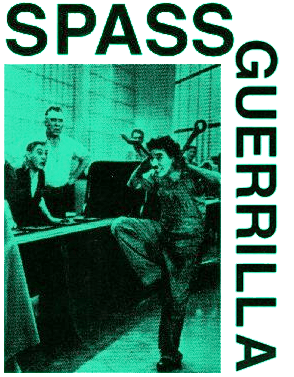
The Spassguerilla (fun guerrilla) was a grouping within the student protest movement of the 1960s in Germany that agitated for social change, in particular for a more libertarian, less authoritarian, and less materialistic society, using tactics characterized by disrespectful humor and provocative and disruptive actions of a minimally violent nature. Events organized by the groups included such actions as attacking politicians or the police with custard pies. One of the main proponents was Fritz Teufel, sometimes referred to as the political clown of the Extraparliamentary Opposition.
The lack of respect for traditional, ‘bourgeois,’ ‘repressive’ forms of authority and ritual, countered by irony and humour, was typified by Fritz Teufel’s reply when told to stand for the judge at a trial: ‘If it helps the search for the truth’ (Wenn’s der Wahrheitsfindung dient). The forms of provocative and disruptive protest invented by the Spassguerilla were later adopted by the peace movement of the 1980s[4] and later by youth protest movements in the reunified Germany. Similar forms of disruption have also been adopted by Cyberspace activists (‘hacktivists’).
Posted in Humor, Politics, War |
Leave a Comment »
February 14, 2011

The Marshall Plan (officially the European Recovery Program, ERP) was a large-scale economic program, from 1947–51 by the US to rebuild post-war Europe. The initiative was named after Secretary of State George Marshall and was largely the creation of State Department officials. The same aid was offered to the Soviet Union and its allies, but they did not accept it. $13 billion ($124 billion in 2009 dollars) in economic and technical assistance were given to help the recovery of the European countries that had joined in the Organization for European Economic Co-operation. This $13 billion was in the context of a U.S. GDP of $258 billion in 1948, and was on top of $12 billion in American aid to Europe between the end of the war and the start of the Plan that is counted separately from the Marshall Plan.
By 1952 as the funding ended, the economy of every participant state had surpassed pre-war levels; for all Marshall plan recipients, output in 1951 was 35% higher than in 1938. Over the next two decades, Western Europe enjoyed unprecedented growth and prosperity, but economists are not sure what proportion was due directly to the ERP, what proportion indirectly, and how much would have happened without it. The Marshall Plan was one of the first elements of European integration, as it erased trade barriers and set up institutions to coordinate the economy on a continental level—that is, it stimulated the total political reconstruction of western Europe.
Posted in Money, Politics, War |
Leave a Comment »
February 13, 2011

Marine Corps Base Camp Lejeune [luh-joon] is a 246-square-mile United States military training facility in North Carolina. The base’s 14 miles of beaches make it a major area for amphibious assault training, and its location between two deep-water ports (Wilmington and Morehead City) allows for fast deployments.
Posted in War |
Leave a Comment »
February 10, 2011

Killing Hope: U.S. Military and C.I.A. Interventions since World War II is a history book on covert CIA operations and U.S. military interventions during the second half of the 20th century, written by former State Department employee William Blum. The book takes a strongly critical view of American foreign policy. The book covers various US foreign policy ventures from just after World War II onward.
Its basic premise is that the Soviet Union occupied the Warsaw Pact states only to better defend its territory and the American Cold War-era activities abroad were done with imperialist motives. It is an updated and revised version of one of Blum’s previous works, ‘The CIA – A Forgotten History.’ Noam Chomsky called it ‘Far and away the best book on the topic.’ First published in the mid-1980s, it has since been updated several times by the author.
Posted in Politics, War, World |
Leave a Comment »
February 9, 2011

The Nuclear Football (also called ‘The Button’) is a black briefcase, the contents of which are to be used by the President of the United States of America to authorize a nuclear attack while away from fixed command centers, such as the White House Situation Room. It functions as a mobile hub in the strategic defense system. Russia and the United Kingdom have similar briefcases. Reputedly, there are four things in the Football: the ‘Black Book’ containing the retaliatory options, a book listing classified site locations, a manila folder with eight or ten pages stapled together giving a description of procedures for the Emergency Broadcast System, and a three-by-five inch card with authentication codes.
The ‘Black Book’ is 9 by 12 inches and has 75 loose-leaf pages printed in black and red. On the ‘vital’ page listing possible responses to a nuclear attack, retaliatory options appear in red and were labeled: ‘Rare, Medium or Well Done.’ The book with classified site locations was about the same size as the Black Book, and was black. It contained information on sites around the country where the president could be taken in an emergency.
Posted in Politics, Technology, War |
Leave a Comment »
February 8, 2011
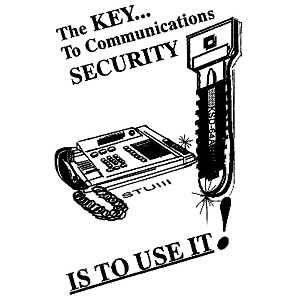
A secure telephone is a telephone that provides voice security in the form of end-to-end encryption for the telephone call, and in some cases also the mutual authentication of the call parties, protecting them against a man-in-the-middle attack. Concerns about massive growth of telephone tapping incidents lead to growing demand for secure telephones. Additionally, as the popularity of VoIP grows, secure telephony is becoming more of commonplace and less the lonely domain of spies and civil libertarians.
Posted in Politics, Technology, War |
Leave a Comment »
February 8, 2011
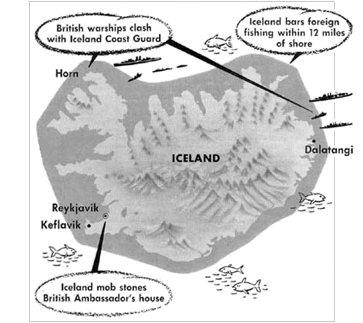
The Cod Wars were a series of confrontations in the 1950s and 1970s between the United Kingdom and Iceland regarding fishing rights in the North Atlantic. In 1972, Iceland unilaterally declared an Exclusive Economic Zone extending beyond its territorial waters, before announcing plans to reduce overfishing. It policed its quota system with the coast guard, leading to a series of net-cutting incidents with British trawlers that fished the areas. As a result, a fleet of Royal Naval warships and tug-boats were employed to act as a deterrent against any future harassment of British fishing crews by the Icelandic craft.
The conflict involved several cases of vessels ramming each other. The dispute ended in 1976 after Iceland threatened to close a major NATO base in retaliation for Britain’s deployment of naval vessels within the disputed 200 nautical mile (370 km) limit. The British government conceded, and agreed that after 1 December 1976 British vessels would not fish within the previously disputed area.
Posted in Food, Money, War |
Leave a Comment »
February 3, 2011

Defenestration [dee-fen-uh-strey-shuhn] is the act of throwing someone or something out of a window. The term originates from two incidents in history, both occurring in Prague. In 1419, seven town officials were thrown from the Town Hall, precipitating the Hussite War. In 1618, two Imperial governors and their secretary were tossed from Prague Castle, sparking the Thirty Years War. These incidents, particularly in 1618, were referred to as the Defenestrations of Prague and gave rise to the term and the concept. The word comes from the Latin de- (down or away from) and fenestra (window or opening).
The act carries the connotation of forcibly or peremptorily removing an adversary, and the term is sometimes used in just that sense; it also suggests breaking the windows in the process (de- also means removal). Although defenestrations can be fatal due to the height of the window through which a person is thrown or throws oneself or due to lacerations from broken glass, the act of defenestration need not carry the intent or result of death. Self-defenestration (autodefenestration) is the act of jumping, propelling oneself, or causing oneself to fall, out of a window.
Posted in Language, War |
Leave a Comment »
February 2, 2011

Victory gardens, also called war gardens, were vegetable, fruit and herb gardens planted at private residences and public parks in United States, United Kingdom, Canada and Germany during World War I and World War II to reduce the pressure on the public food supply brought on by the war effort. In addition to indirectly aiding the war effort these gardens were also considered a civil ‘morale booster’ — in that gardeners could feel empowered by their contribution of labor and rewarded by the produce grown. This made victory gardens become a part of daily life on the home front.
Posted in Food, Money, War |
Leave a Comment »
January 30, 2011
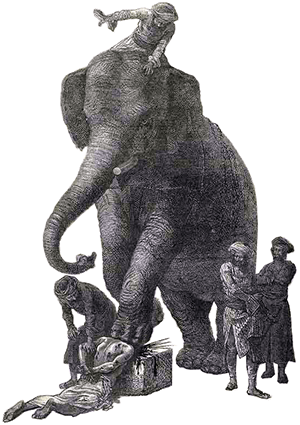
Execution by elephant was, for thousands of years, a common method of capital punishment in South and Southeast Asia, and particularly in India. Asian Elephants were used to crush, dismember, or torture captives in public executions. The animals were trained and versatile, both able to kill victims immediately or to torture them slowly over a prolonged period. Employed by royalty, the elephants were used to signify both the ruler’s absolute power and his ability to control wild animals.
The sight of elephants executing captives attracted the interest of usually horrified European travellers, and was recorded in numerous contemporary journals and accounts of life in Asia. The practice was eventually suppressed by the European empires that colonised the region in the 18th and 19th centuries. While primarily confined to Asia, the practice was occasionally adopted by Western powers, such as Rome and Carthage, particularly to deal with mutinous soldiers.
Posted in Death, War, World |
Leave a Comment »
January 28, 2011

Cabinet noir (French for ‘black room’) was the name given in France to the office where the letters of suspected persons were opened and read by public officials before being forwarded to their destination. This practice had been in use since the establishment of posts, and was frequently used by the ministers of Louis XIII and Louis XIV; but it was not until the reign of Louis XV that a separate office for this purpose was created. Although declaimed against at the time of the French Revolution, it was used both by the revolutionary leaders and by Napoleon.
read more »
Posted in Politics, Technology, War |
Leave a Comment »
January 28, 2011

Room 641A is an intercept facility operated by AT&T for the U.S. National Security Agency (NSA), beginning in 2003. It is fed by fiber optic lines from beam splitters installed in fiber optic trunks carrying Internet backbone traffic and, therefore, presumably has access to all Internet traffic that passes through the building.The existence of the room was revealed by a former AT&T technician, Mark Klein, and was the subject of a 2006 class action lawsuit by the Electronic Frontier Foundation (EFF) against AT&T. Klein claims he was told that similar black rooms are operated at other facilities around the country.
The EFF suit accused the telecommunication company of violating the law and the privacy of its customers by collaborating with the NSA in a massive, illegal program to wiretap and data-mine Americans’ communications. Room 641A is located in the SBC Communications building at 611 Folsom Street, San Francisco, three floors of which were occupied by AT&T before SBC purchased AT&T. The room was referred to in internal AT&T documents as the SG3 (Study Group 3) Secure Room. The room measures about 24 by 48 feet (7.3 by 15 m) and contains several racks of equipment, including a Narus STA 6400, a device designed to intercept and analyze Internet communications at very high speeds.
Posted in Politics, Technology, War |
Leave a Comment »





 The Daily Omnivore