August 31, 2013

Search and Destroy, Seek and Destroy, or even simply S&D, refers to a military strategy that became a large component of the Vietnam War. The idea was to insert ground forces into hostile territory, search out the enemy, destroy them, and withdraw immediately afterward. The strategy was the result of a new technology, the helicopter, which resulted in a new form of warfare, air cavalry, and was thought to be ideally suited to counter-guerrilla jungle warfare.
The complementary conventional strategy, which entailed attacking and conquering an enemy position, then fortifying and holding it indefinitely, was known as ‘clear and hold’ or ‘clear and secure.’ In theory, the traditional methods of ‘taking ground’ could not be used in this war. Therefore the U.S. pursued a war of attrition instead, in which raw ‘body count’ would be the measuring tool to determine the success of a strategy.
read more »
Posted in Death, War, World |
Leave a Comment »
August 31, 2013

A Vietnam veteran is someone who served in the armed forces of participating countries during the Vietnam War. Common usage distinguishes between those who served ‘in country’ as ‘Vietnam veterans’ and the others as ‘Vietnam-era veterans.’ The U.S. government officially refers to all as ‘Vietnam-era veterans.’ According to the U.S. Department of Labor, the Vietnam Era Veterans’ Readjustment Assistance Act of 1974 (VEVRAA), ‘A Vietnam era veteran is a person who: ‘served on active duty for a period of more than 180 days, any part of which occurred between August 5, 1964 and May 7, 1975, and was discharged or released with other than a dishonorable discharge.’
The U.S. Census Bureau (2004) reports there are 8.2 million ‘Vietnam Era Veterans.’ Of these 2.59 million are reported to have served ‘in country.’ More than 58,000 US personnel died as a result of the conflict (this comprises deaths from all categories including deaths while missing, captured, non-hostile deaths, homicides, and suicides).
read more »
Posted in Health, War, World |
Leave a Comment »
August 18, 2013

Yellow Arrow is a public art project that was active from 2004-2006 and was created by Christopher Allen, Brian House, and Jesse Shapins, collectively known as Counts Media. The project was an important example of locative media and mobile phone art and draws concepts from psychogeography (emphasizing playfulness and ‘drifting’ around urban environments).
Yellow Arrow stickers were obtained from the project website and placed anywhere in the public realm. When encountering a sticker on the street, individuals could send the unique code printed on it as a text message to the project phone number. Moments later a message would be received that was left by the person who placed the sticker.
read more »
Posted in Games, Technology, World |
Leave a Comment »
August 11, 2013

Dosa [doh-sa] is a fermented Indian crepe or pancake made from rice batter and black lentils. This staple dish is widely popular in southern Indian states, as well as other countries like Sri Lanka and Singapore. ‘The Story of our Food,’ a book written by K. T. Achaya, an eminent Indian food scientist and food historian, states that foods like Appam, Idiyappam, Dosai and Adai were already known in Tamil country around 1st century CE, as per references in Tamil Sangam literature. It is a common breakfast dish and street food, served hot, either folded in half or rolled like a wrap.
Dosa can be stuffed with fillings of vegetables and sauces to make a quick meal. They are typically served with a vegetarian side dish which varies according to regional and personal preferences. Though dosa typically refers to the version made with rice and lentils, many other versions exist, often specific to an Indian region. Some variations include egg dosa, which is spread with an omelette, and cheese dosa, which is stuffed with cheese. Masala dosa is dosa wrapped around an onion and potato curry or sabji (cauliflower with peas and carrots) originally invented by Udupi Hotels.
Posted in Food, World |
Leave a Comment »
August 9, 2013

A bon viveur [bawn vee-vur] is a person who enjoys the good things of life.
The phrase is derived from the French ‘bon vivant,’ meaning ‘good living,’ a bon viveur being a ‘good liver,’ or one who lives well. The phrase is not derogatory but conveys a sense of overindulgence. In his book, ‘Mind the Gaffe,’ linguist Larry Trask advised that the phrase is pretentious.
Posted in Language, World |
Leave a Comment »
July 14, 2013

Machismo [mah-cheez-moh] is a negative descriptor of, for example, sexism, misogyny, chauvinism and hypermasculinity and hegemonic masculinity.
Scholars characterize such macho men as violent, rude, womanizing, and prone to alcoholism; domineering through intimidation, seducing and controlling women and children through violence and intimidation. However, some societies and academics place traditional gender roles – social norm for certain communities, followed by others by admiration or convention – as the most important component of machismo.
read more »
Posted in Politics, Sex, World |
1 Comment »
July 3, 2013

An open secret is a concept or idea that is ‘officially’ secret or restricted in knowledge but is actually widely known; or it refers to something that is widely known to be true but which none of the people most intimately concerned is willing to categorically acknowledge in public.
The existence of the British Secret Intelligence Service (MI6) was widely known for several decades before the government’s official acknowledgement of the organization in 1994. Likewise, Delta Force, the elite US Army unit, can be considered an open secret, since its existence has been denied in the past by the government. Israel is widely acknowledged to possess nuclear weapons. This can be considered an open secret, because the Israeli government has never explicitly stated whether or not it possesses a nuclear stockpile, officially maintaining a policy of deliberate ambiguity.
read more »
Posted in Language, Politics, World |
1 Comment »
June 17, 2013
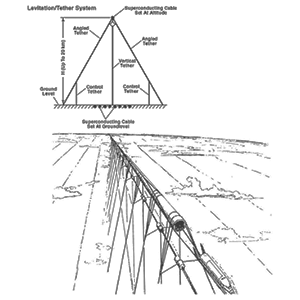
StarTram is a proposal for a maglev space launch system. The initial Generation 1 facility would be cargo only, launching from a mountain peak at 3 to 7 km (1.9 to 4.3 mi) altitude with an evacuated tube staying at local surface level; it has been claimed that about 150,000 tons could be lifted to orbit annually. More advanced technology would be required for the Generation 2 system for passengers, with a longer track instead gradually curving up at its end to the thinner air at 22 km (14 mi) altitude, supported by magnetic levitation, reducing g-forces when each capsule transitions from the vacuum tube to the atmosphere.
American physicist James R. Powell invented the superconducting maglev concept in the 1960s with a colleague, Gordon Danby, also at Brookhaven National Laboratory, which was subsequently developed into modern maglev trains. Later, Powell co-founded StarTram, Inc. with Dr. George Maise, an aerospace engineer was at Brookhaven from 1974 to 1997, with particular expertise in reentry heating and hypersonic vehicle design.
read more »
Posted in Technology, World |
1 Comment »
June 17, 2013

A vactrain (or vacuum tube train) is a proposed, as-yet-unbuilt design for future high-speed railroad transportation. It is a maglev line run through evacuated (air-less) or partly evacuated tubes or tunnels. The lack of air resistance could permit vactrains to use little power and to move at extremely high speeds, up to 4,000–5,000 mph (6,400–8,000 km/h). At that speed, the trip between London and New York would take less than an hour, supplanting aircraft as the world’s fastest mode of public transportation.
Travel through evacuated tubes allows supersonic speed without the penalty of sonic boom found with supersonic aircraft. The trains could operate faster than Mach 1 without noise. However, without major advances in tunnelling and other technology, vactrains would be prohibitively expensive. Alternatives such as elevated concrete tubes with partial vacuums have been proposed to reduce costs. In 2010, researchers at Southwest Jiaotong University in China began developing a vactrain to reach speeds of 1,000 km/h (620 mph), intended to be completed in 2020.
read more »
Posted in Technology, World |
1 Comment »
June 14, 2013
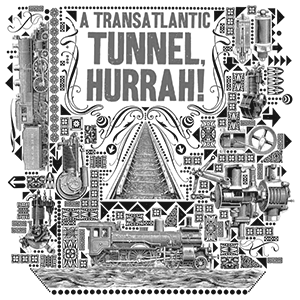
‘Tunnel Through the Deeps‘ (also published as ‘A Transatlantic Tunnel, Hurrah!’) is a 1972 alternate history/science fiction novel by Harry Harrison. It was serialized in ‘Analog’ magazine beginning in the April 1972 issue.
The title refers to the construction of a submerged floating-tube pontoon bridge/tunnel across the Atlantic Ocean.
read more »
Posted in Language, Technology, World |
Leave a Comment »
June 6, 2013
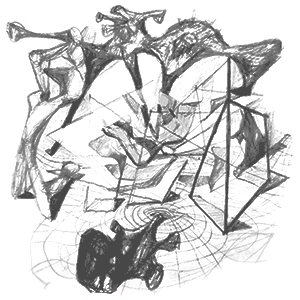
Roberto Matta (1911 – 2002) was one of Chile’s best-known painters and a seminal figure in 20th century abstract expressionist and surrealist art. Born in Santiago, he initially studied architecture at the Pontificia Universidad Católica de Chile in Santiago, but became disillusioned with this occupation and left for Paris in 1933. His travels in Europe and the USA led him to meet artists such as Arshile Gorky, René Magritte, Salvador Dalí, André Breton, and Le Corbusier. Matta was of Spanish, Basque, and French descent.
It was Breton who provided the major spur to the Chilean’s direction in art, encouraging his work and introducing him to the leading members of the Paris Surrealist movement. Matta produced illustrations and articles for Surrealist journals such as ‘Minotaure.’ During this period he was introduced to the work of many prominent contemporary European artists, such as Pablo Picasso and Marcel Duchamp.
read more »
Posted in Art, World |
Leave a Comment »
June 3, 2013
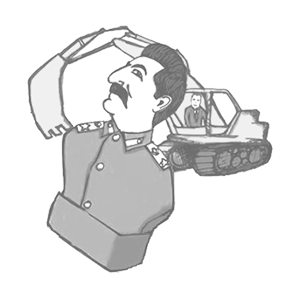
De-Stalinization refers to the process of eliminating the cult of personality, Stalinist political system and the Gulag labor-camp system created by Soviet leader Joseph Stalin. Stalin was succeeded by a collective leadership after his death in 1953. The central Soviet strongmen at the time were Lavrentiy Beria, head of the Ministry of the Interior; Nikita Khrushchev, First Secretary of the Central Committee of the Communist Party of the Soviet Union (CPSU); and Georgi Malenkov, Premier of the Soviet Union.
Contemporary historians regard the process of de-Stalinization as a significant turning point in the history of modern Russia. References to Stalin were embedded in the lyrics of the National Anthem of the Soviet Union, after which the Stalin-centric and World War II-era references were excised where an instrumental version was used.
read more »
Posted in Politics, War, World |
Leave a Comment »


 The Daily Omnivore