March 24, 2013
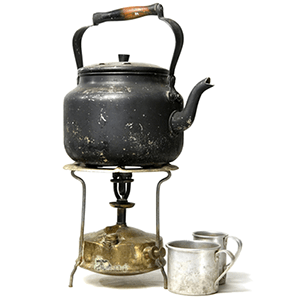
Chifir’ is a type of strong tea brewed in Russia. The etymology is uncertain but is thought to come from the word ‘chikhir” meaning a strong Caucasian wine, or a Siberian word for spoiled wine that has become sour and acidic. Chifir’ is typically prepared with either two or three tablespoons of loose tea per person poured on top of the boiled water. It is brewed for 10–15 minutes without stirring – until the leaves drop to the bottom of the cup. Chifir’ drunk without sugar is highly unpleasant; sweets can be held in the mouth before, during or after drinking to soften its bitter taste.
It is similar to Egyptian Sa’idi tea, a somewhat similar beverage (essentially a 1/9-strength recipe, but consumed in larger quantities).
Posted in Drugs, Food, World |
Leave a Comment »
March 22, 2013
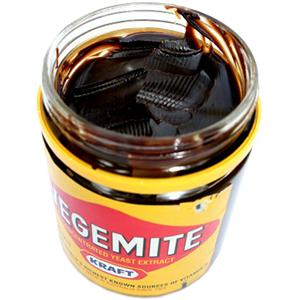
Vegemite [vej-uh-mahyt] is a dark brown Australian food paste made from yeast extract. It is a spread for sandwiches and a filling for pastries. A common method of eating Vegemite is on toasted bread with one layer of butter before spreading a thin layer of Vegemite. It is similar to British, New Zealand and South African Marmite, Australian Promite, Swiss Cenovis and German Hefeextrakt. More recently, other spreads – which are Australian-owned – have come on the market to provide an alternative to the now US-owned product, such as the yeast-based AussieMite.
Vegemite is made from brewers’ yeast extract, a by-product of beer manufacturing, various vegetables, wheat and spice additives. It is salty, slightly bitter and malty, and rich in umami (savory flavor) – similar to beef bouillon. The texture is smooth and the product is a paste. It is not as intensely flavored as British Marmite and it is less sweet than the New Zealand version of Marmite.
read more »
Posted in Food, Health, World |
Leave a Comment »
March 21, 2013

Poutine [poo-teen] (French: ‘a mess’) is a typical Canadian dish (originally from Quebec), made with french fries, topped with brown gravy (meat stock based) and cheese curds (solid parts of soured milk).
Poutine is sold by fast food chains, in small ‘greasy spoon’ type diners (commonly known as ‘cantines’ or ‘casse-croûtes’ in Quebec) and pubs, as well as by roadside chip wagons (commonly known as ‘cabanes à patates,’ literally meaning ‘potato shacks’). International chains like McDonald’s and KFC sell mass-produced poutine in Canada.
read more »
Posted in Food, World |
Leave a Comment »
March 20, 2013

The Nureongi is a yellowish, local dog breed from Korea. It is most often used as a livestock dog, raised for its meat and not commonly kept as a pet. This dog has no formal name in the Korean language. ‘Nureongi’ and ‘hwangu’ are informal Korean words meaning ‘yellow one,’ and might best translate as ‘Brownie’ or ‘Blackie. Another common term is the Korean slang ‘ddong-gae,’ meaning ‘dung dogs’ or ‘shit dogs,’ which refers to the common dogs’ habit of eating feces.
The consumption of dog meat in South Korea, where it is known as ‘Gaegogi,’ has a long history in that country, as well as that of other East Asian cultures. In recent years, it has been controversial both in South Korea and around the world, due to animal rights and sanitary concerns. There is a large and vocal group of Korean people that are against the practice of eating dog meat. There is also a large population of people in South Korea that do not eat or enjoy the meat, but do feel strongly that it is the right of others to do so. There is a smaller but still vocal group of pro-dog cuisine people in South Korea who want to popularize the consumption of dog in Korea and the rest of the world, considering it to be part of the traditional culture of Korea with a long history worth preserving.
Posted in Food, Politics, World |
1 Comment »
March 20, 2013
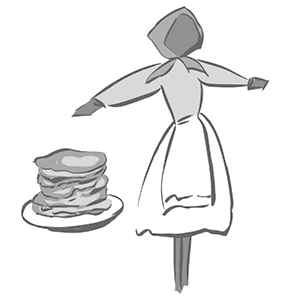
Maslenitsa (also known as Butter Week) is an Eastern Slavic religious and folk holiday. It is celebrated during the last week before Great Lent—that is, the seventh week before Eastern Orthodox Pascha (Easter). Maslenitsa corresponds to the Western Christian Carnival, except that Orthodox Lent begins on a Monday instead of a Wednesday, and the Orthodox date of Easter can differ greatly from the Western Christian date.
Maslenitsa has its origins in both pagan and Christian traditions. In Slavic mythology, Maslenitsa is a celebration of the imminent end of the winter. As the culmination of the celebration, on Sunday evening, Lady Maslenitsa is stripped of her finery and put to the flames of a bonfire. Any remaining blintzes are also thrown on the fire and Lady Maslenitsa’s ashes are buried in the snow (to ‘fertilize the crops’).
read more »
Posted in Food, Philosophy, World |
Leave a Comment »
March 20, 2013

The rasputitsa refers to the biannual mud seasons when unpaved roads become difficult to traverse in parts of Belarus, Russia, and Ukraine. The word may be translated as the ‘quagmire season’ because during this period the large flatlands become extremely muddy and marshy, as do most unpaved roads. The rasputitsa occurs more strongly in the spring due to the melting snow but it usually recurs in the fall due to frequent heavy rains. The rasputitsa seasons of Russia are well known as a great defensive advantage in wartime. Napoleon found the mud in Russia to be a very great hindrance in 1812.
During the Second World War the month-long muddy period slowed down the German advance during the Battle of Moscow, and may have helped save the Soviet capital, as well as the presence of ‘General Winter,’ that followed the autumn rasputitsa period – this sort of wintertime hindrance to German military motor vehicle transport on the Eastern Front partly inspired the design and mass production of a unique fully tracked artillery tractor for such conditions.
read more »
Posted in Language, War, World |
Leave a Comment »
March 20, 2013
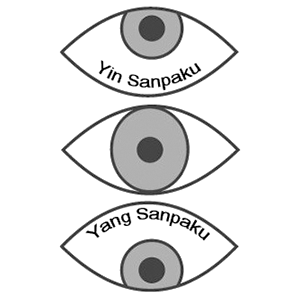
Sanpaku is a Japanese term that means ‘three whites’ and is generally referred to in English as ‘Sanpaku eyes.’ The term refers to the iris being rather small, so that it only covers about two-thirds or less of the vertical axis of the eye; e.g. delineate an eye into four portions; the iris would only occupy one portion of the divided four sections; thus leaving the other three in white, hence ‘three whites.’
When the bottom of the white part of the eye, known as the sclera, is visible it is referred to as ‘Yin Sanpaku’ in Chinese lore. According to the myth, it represents physical imbalance in the body and is claimed to be present in alcoholics, drug addicts and people who overconsume sugar or grain. Conversely when the upper sclera is visible this is called ‘Yang Sanpaku.’ This is said to be an indication of mental imbalance in people such as psychotics, murderers, and anyone rageful. Stress and fatigue may also be a cause.
read more »
Posted in Health, Philosophy, World |
Leave a Comment »
March 19, 2013

Yoshiro Nakamatsu (b. 1928), also known as Dr. NakaMats, is Japanese inventor who has become something of a minor celebrity for the dubious science behind his inventions and his eccentricity. He regularly appears on Japanese talk shows which, in conjunction with his appearance, usually craft a humorous segment based on one or more of his inventions. He is a prolific inventor, and he even claims to hold the world record for number of inventions with over 4,000 patents.
In his interviews, Nakamatsu described his ‘creativity process,’ which includes listening to music and concludes with diving underwater, where he says he comes up with his best ideas and records them while underwater. Nakamatsu claims to benefit from lack of oxygen to the brain, making inventions ‘0.5 seconds before death.’ He also built a million dollar toilet room made completely out of gold that he claims helps make him think better. Nakamatsu also has an elevator in his house that he claims helps him think better. He strictly denies that it is an elevator, but rather a ‘vertical moving room.’ Nakamatsu’s goal is to live at least 144 years.
read more »
Posted in Humor, Technology, World |
Leave a Comment »
March 18, 2013
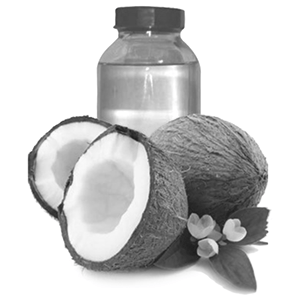
Coconut oil is an edible oil extracted from the kernel or meat of matured coconuts harvested from the coconut palm. Throughout the tropical world, it has provided the primary source of fat in the diets of millions of people for generations.
It has various applications in food, medicine, and industry. Coconut oil is very heat-stable, which makes it suited to methods of cooking at high temperatures like frying. Because of its stability, it is slow to oxidize and, thus, resistant to rancidity, lasting up to two years owing to the high saturated fat content.
read more »
Posted in Food, Health, World |
Leave a Comment »
March 18, 2013

The World Sauna Championships were an annual endurance contest held in Heinola, Finland, from 1999 to 2010. They originated from unofficial sauna-sitting competitions that resulted in a ban from a swimming hall in Heinola. The Championships were first held in 1999 and grew to feature contestants from over 20 countries.
Sauna bathing at extreme conditions is a severe health risk: all competitors competed at their own risk, and had to sign a form agreeing not to take legal action against the organizers. Notably, the Finnish Sauna Society strongly opposed the event. After the death of one finalist and near-death of another during the 2010 championship, the organizers announced that they would not hold another event. This followed an announcement by prosecutors that the organizing committee would not be charged for negligence, as their investigation revealed that the contestant who died may have used painkillers and ointments that were forbidden by the organizers.
read more »
Posted in Death, Games, World |
Leave a Comment »
March 18, 2013

The Roman salute (Saluto Romano) is a gesture in which the arm is held out forward straight, with palm down, and fingers touching. In some versions, the arm is raised upward at an angle; in others, it is held out parallel to the ground. The former is a well known symbol of fascism that is commonly perceived to be based on a custom in ancient Rome. However, no Roman text gives this description and the Roman works of art that display gestures of salutation bear little resemblance to the modern Roman salute.
Jacques-Louis David’s painting ‘The Oath of the Horatii’ (1784) provided the starting point for the gesture that became later known as the Roman salute. The gesture and its identification with Roman culture was further developed in other French neoclassic artworks.
read more »
Posted in Politics, War, World |
1 Comment »
March 18, 2013

The Bellamy salute is a salute chosen by American socialist Francis Bellamy to accompany the American Pledge of Allegiance, which he wrote. During the period when it was used with the Pledge of Allegiance, it was sometimes known as the ‘flag salute.’ During the 1920s and 1930s, Italian fascists and Nazis adopted salutes which were similar in form, resulting in controversy over the use of the Bellamy salute in the United States.
It was officially replaced by the hand-over-heart salute when Congress amended the Flag Code in December of 1942. The inventor of the saluting gesture was James B. Upham, junior partner and editor of ‘The Youth’s Companion.’ Bellamy recalled Upham, upon reading the pledge, came into the posture of the salute, snapped his heels together, and said ‘Now up there is the flag; I come to salute; as I say ‘I pledge allegiance to my flag,’ I stretch out my right hand and keep it raised while I say the stirring words that follow.’
read more »
Posted in Politics, War, World |
1 Comment »


 The Daily Omnivore