March 2, 2012


Corinthian leather is a term coined by the advertising agency Bozell to describe the upholstery used in certain Chrysler luxury vehicles beginning in 1974. Although the term suggests that the product has a relationship to or origination from Corinth, Greece, there is no relationship; the term is a marketing concept. Some sources say it was a blend of leather and vinyl (seat surfaces were leather and seat sides were vinyl), while other sources say it was simply a trade name for American produced leather, much of which was produced at a plant outside Newark, New Jersey.
The term was first used during the marketing campaign of the 1974 Chrysler Imperial, but the it is usually associated with the marketing campaign for the 1975 Chrysler Cordoba and that campaign’s celebrity spokesperson, Ricardo Montalban, who described the car’s seats as being covered with ‘soft Corinthian leather.’
Posted in Humor, Money, World |
Leave a Comment »
March 1, 2012

White Dot is an anti-television organization based in the UK. It encourages people to not watch television, and also to switch off televisions in cafés and pubs with devices such as the TV-B-Gone. It also organizes what it calls zocalo (a Mexican term for a town square) events where people are requested to turn off their televisions, go outside and talk to their neighbors.
The organization is named after the white dot that appeared in the middle of old CRT television screens when switched off—as the capacitors discharged, the cathode ray would continue to emit electrons although no longer being controlled horizontally or vertically.
Posted in Politics, Technology, World |
1 Comment »
February 29, 2012

The Edelweiss Pirates (Edelweißpiraten) were a loose group of youth culture in Nazi Germany. They emerged in western Germany out of the German Youth Movement of the late 1930s in response to the strict regimentation of the Hitler Youth.
Similar in many ways to the Leipzig Meuten (anti-Nazi, pro-communist gangs of young adults in Germany), they consisted of young people, mainly between the ages of 14 and 17, who had evaded the Hitler Youth by leaving school (which was allowed at 14.) and were also young enough to avoid military conscription, which was only compulsory from the age of 17 onward.
read more »
Posted in Politics, War, World |
Leave a Comment »
February 29, 2012

The Raspberry Pi (or RasPi) is a $35 single-board computer developed in the UK by the Raspberry Pi Foundation which aims to ‘promote the study of computer science and related topics, especially at school level, and to put the fun back into learning computing.’ The design is based around a Broadcom BCM2835 system on a chip (SoC), which includes a 700 MHz ARM CPU, VideoCore IV GPU, and 256 Megabytes of RAM. The design does not include a built-in hard disk or solid-state drive, instead relying on an SD card for booting and long-term storage.
The foundation has released one model (Model B) initially, and a second model (Model A) will be released sometime later. Model A will have one USB port and no Ethernet controller, and will cost $25, while Model B contains two USB ports and a 10/100 Ethernet controller and costs $35. Though the Model A doesn’t have an RJ45 Ethernet port, it can connect to a network by using a user-supplied USB Ethernet or Wi-Fi adapter. As is typical of modern computers, generic USB keyboards and mice are compatible with the Raspberry Pi. The system will use a Linux kernel-based operating systems.
Posted in Money, Technology, World |
Leave a Comment »
February 29, 2012

Xenophilia [zen-uh-fil-ee-uh] means an affection for unknown objects or peoples. It is the opposite of xenophobia. Xenophilia is a theme found in science fiction, primarily the space opera sub-genre, in which one explores the consequences of love and sexual intercourse between humans and extraterrestrials, particularly humanoid ones. A satirical example is ‘XXXenophile,’ an X-rated comic book written by Phil Foglio. A more somber example is the relationship of Sarek and Amanda Grayson (Spock’s parents) in ‘Star Trek.’
The 1970 film ‘Watermelon Man’ centers in part around a white man trying to have sex with a white woman he works with. His efforts fail until he is magically turned into an African American, at which point she is more than willing to sleep with him. It is only the following day that the protagonist realizes, to his horror, that the woman is a xenophile and only had sex with him because of his race; she had no interest in him as a person. George Washington, in his 1796 Farewell Address, described the influence of xenophilia in politics, which he saw as negative: ‘Such an attachment of a small or weak towards a great and powerful nation dooms the former to be the satellite of the latter.’
Posted in Language, Sex, World |
Leave a Comment »
February 27, 2012


‘…the terrorists have won‘ is a rhetorical phrase which was widely used in the United States in the wake of the September 11 attacks. The phrase takes the form of ‘if we pursue some particular course of action, then, the terrorists have won.’ One of the most famous instances was on November 4, 2001 by Ellen DeGeneres, who was hosting the Emmy Awards, which had been postponed twice that year for worries that a showy celebration would seem inappropriate in the wake of the attacks. To lighten the mood, she quipped: ‘We’re told to go on living our lives as usual, because to do otherwise is to let the terrorists win, and really, what would upset the Taliban more than a gay woman wearing a suit in front of a room full of Jews?’
In December 2001, humorist Steve Symanovich commented on the overuse of the expression, writing in the ‘Washington Business Journal’: ‘In recent months I had heard about any number of things that would allow the terrorists to win. Early on, I learned that if America plays fast and loose with the Bill of Rights, the terrorists will have won. I couldn’t agree more, but that was just the start. Later, I found out that if we stop working/shopping/eating out, the terrorists will have won. I took the message to heart. I’m not opposed to work; I don’t mind shopping; and, although I’m on a diet, I can still eat out and order light. But there was more. Finally, I ran into this headline: ‘If you don’t read this article, the terrorists will have won.”
Posted in Politics, War, World |
1 Comment »
February 27, 2012

‘Mean world syndrome‘ is a term coined by professor of communications George Gerbner to describe a phenomenon whereby violence-related content of mass media makes viewers believe that the world is more dangerous than it actually is. Mean world syndrome is one of the main conclusions of cultivation theory (which states that those who spend more time watching TV are more likely to perceive the real world in ways that reflect the most common messages of the TV world). Gerbner, a pioneer researcher on the effects of television on society, argued that people who watched a large amount of television tended to think of the world as an intimidating and unforgiving place.
The number of opinions, images, and attitudes that viewers tend to make when watching television will have a direct influence on what the viewer perceives the real world as. They will reflect and refer to the most common images or recurrent messages thought to impact on their own real life. Gerbner once said ‘You know, who tells the stories of a culture really governs human behavior,’ he said. ‘It used to be the parent, the school, the church, the community. Now it’s a handful of global conglomerates that have nothing to tell, but a great deal to sell.’ Individuals who watch television infrequently and adolescents who talk to their parents about reality are claimed to have a more accurate view of the real world than those who do not, and they may be able to more accurately assess their vulnerability to violence.
Posted in Politics, Technology, World |
1 Comment »
February 27, 2012

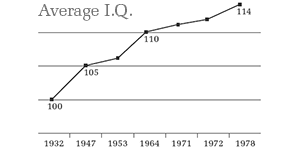
The Flynn effect is the name given to the observed rise in average IQ scores since the beginning of measurements. The rise in most industrialized countries is about three IQ points per decade. In 1984, based political scientist James R. Flynn described the phenomenon, which is named after him.
The rise is mostly due to the test scores of those who scored an IQ below 100. The number of those who are classified as mentally handicapped diminishes from year to year. In contrast, the test scores of those who scored more than 100, does not seem to be affected.
read more »
Posted in Education, Science, World |
Leave a Comment »
February 23, 2012

Free speech zones (also known as ‘First Amendment Zones’) are areas set aside in public places for political activists to exercise their right of free speech in the US. The First Amendment states that ‘Congress shall make no law… abridging… the right of the people peaceably to assemble, and to petition the Government for a redress of grievances.’ The existence of free speech zones is based on court decisions stipulating that the government may regulate the time, place, and manner—but not content—of expression.
The stated purpose is to protect the safety of those attending the political gathering, or for the safety of the protesters themselves. Critics, however, suggest that such zones are ‘Orwellian,’ and that authorities use them in a heavy-handed manner to censor protesters by putting them literally out of sight of the mass media, hence the public, as well as visiting dignitaries. Civil libertarians claim that such areas are used as a form of censorship and public relations management to conceal the existence of popular opposition from the mass public and elected officials.
Posted in Language, Politics, World |
Leave a Comment »
February 22, 2012
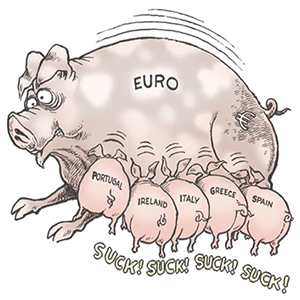
PIGS is a pejorative acronym used to refer to the economies of Portugal, Italy, Greece and Spain which are facing a financial crisis.
Since 2008, the term has included Ireland, either in place of Italy or with an additional I. Some news organizations have limited or banned use of the term because of criticism regarding perceived offensive connotations. The term has been used since at least the mid-1990s as an epithet.
Posted in Money, Politics, World |
1 Comment »
February 21, 2012

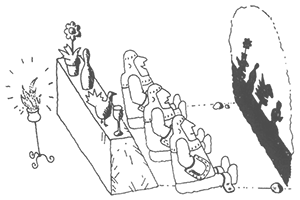
Simulated reality is the proposition that reality could be simulated—perhaps by computer simulation—to a degree indistinguishable from ‘true’ reality. It could contain conscious minds which may or may not be fully aware that they are living inside a simulation.
This is quite different from the current, technologically achievable concept of virtual reality. Virtual reality is easily distinguished from the experience of actuality; participants are never in doubt about the nature of what they experience. Simulated reality, by contrast, would be hard or impossible to separate from ‘true’ reality.
read more »
Posted in Philosophy, Technology, World |
3 Comments »
February 19, 2012

Tank Man, or the Unknown Rebel, is the nickname of an anonymous man who stood in front of a column of Chinese Type 59 tanks the morning after the Chinese military forcibly removed protestors from in and around Beijing’s Tiananmen Square in the summer of 1989. The man achieved widespread international recognition due to the videotape and photographs taken of the incident. Despite his anonymity, he is commonly (though not necessarily correctly) referred to in Chinese as Wang Weilin.
The man placed himself alone in the middle of the street as the tanks approached, directly in the path of the armored vehicles. He held two shopping bags, one in each hand. As the tanks came to a stop, the man gestured towards the tanks with his bags. In response, the lead tank attempted to drive around the man, but the man repeatedly stepped into the path of the tank in a show of nonviolent action. After repeatedly attempting to go around rather than crush the man, the lead tank stopped its engines, and the armored vehicles behind it seemed to follow suit. There was a short pause with the man and the tanks having reached a quiet, still impasse.
read more »
Posted in Politics, War, World |
2 Comments »


 The Daily Omnivore