November 22, 2010

Givaudan is a Swiss manufacturer of flavorings and fragrances. As of 2008, it is the world’s largest company in the industry. The company’s scents and flavors are developed most often for food and beverage makers, but they are also used frequently in household goods, as well as grooming and personal care products.
Givaudan’s flavors and solutions are usually custom-made and, like their competitors’ formulas, always sold under strict confidentiality agreements. Major competitors include Firmenich, International Flavors and Fragrances, and Symrise. Givaudan was founded as a perfumery company in 1895 in Zurich by Leon and Xavier Givaudan, although some parts of the modern company date back as far as 1796.
Posted in Money, Technology, World |
Leave a Comment »
November 18, 2010
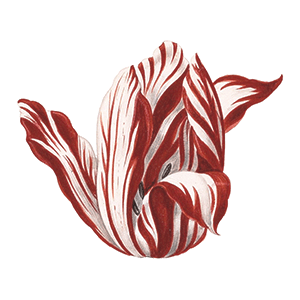
Tulip mania was a period in the Dutch Golden Age during which contract prices for bulbs of the recently introduced tulip reached extraordinarily high levels and then suddenly collapsed. At the peak of tulip mania in February 1637, some bulbs sold for more than 10 times the annual income of a skilled craftsman. The most sought after variety of tulip was the Semper Augustus; as much as 12 acres of land was reportedly offered in exchange for a single bulb. It is generally considered the first recorded speculative bubble (or economic bubble). The term ‘tulip mania’ is now often used metaphorically to refer to any large economic bubble (when asset prices deviate from intrinsic values).
Research on the tulip mania is difficult because of the limited data from the 1630s. Although these explanations are not generally accepted, some modern economists have proposed rational explanations, rather than a speculative mania, for the rise and fall in prices. For example, other flowers, such as the hyacinth, also had high prices on the flower’s introduction, which then fell dramatically. The high prices may also have been driven by expectations of a parliamentary decree that contracts could be voided for a small cost—thus lowering the risk to buyers.
Posted in Money, World |
Leave a Comment »
November 16, 2010

Vladimir Grigoryevich Tretchikoff (1913 – 2006) was one of the most commercially successful artists of all time – his painting Chinese Girl (popularly known as ‘The Green Lady’) is one of the best selling art prints ever. Tretchikoff was a self-taught artist who painted realistic figures, portraits, still life and animals, with subjects often inspired by his early life in China and Malaysia, and later life in South Africa. Tretchikoff’s work was immensely popular with the general public, but is often seen by art critics as the epitome of kitsch (indeed, he was nicknamed the ‘King of Kitsch’).
He worked in oil, watercolour, ink, charcoal and pencil but is best known for his reproduction prints which sold worldwide in huge numbers. The reproductions were so popular that it was said Tretchikoff was second only to Picasso in his popularity. Tretchikoff once said that the only difference between himself and Vincent Van Gogh was that Van Gogh had starved whereas he had become rich.
Posted in Art, Money, World |
Leave a Comment »
November 15, 2010

Lee’s Sandwiches is an American fast food restaurant chain specializing in Vietnamese cuisine. While originally famous for selling French baguette bánh mì (Vietnamese sandwiches), the chain has expanded its offering to many other goods, including packaged spring rolls, desserts, and other food to go items.
The first Lee’s opened in San Jose, California in 1980. There are now over three dozen locations in California, Arizona, Texas, and Oklahoma, as well as a new restaurant in Ho Chi Minh City, Vietnam. The company has plans to expand in the Pacific states of Nevada, Oregon, and Washington.
Posted in Food, Money, World |
Leave a Comment »
November 15, 2010
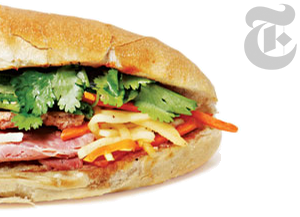
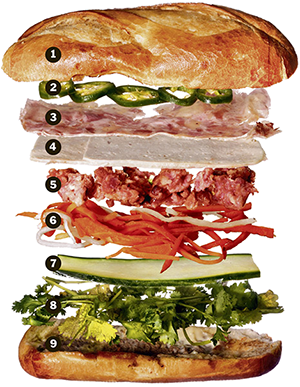
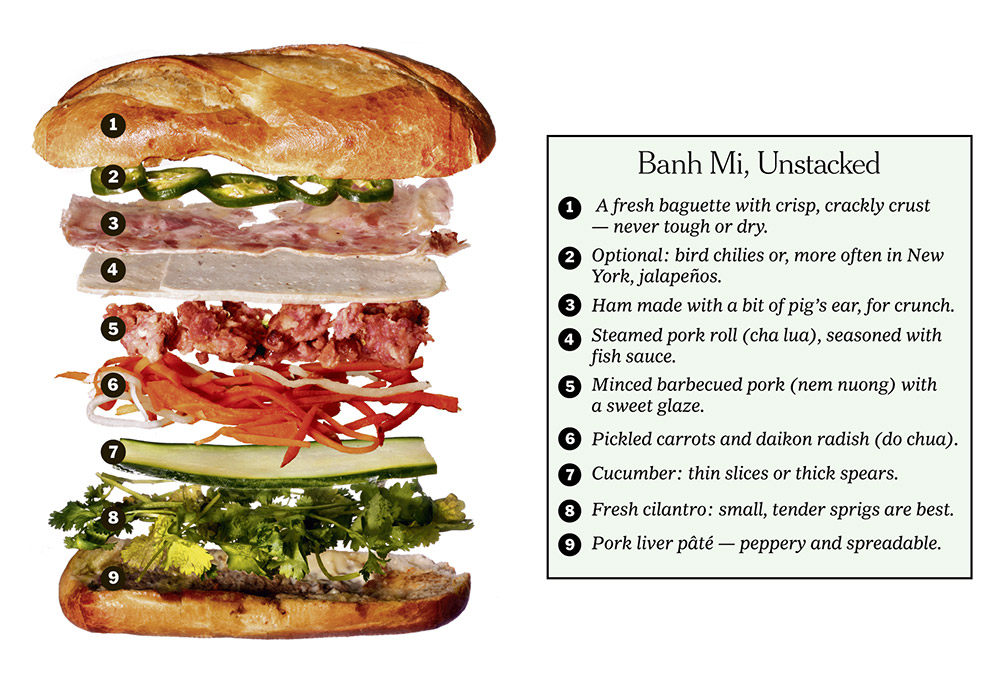
Bánh mì [ban-me] is a Vietnamese baguette made with both wheat and rice flour. The term also refers to what is sometimes called a ‘Vietnamese sandwich’ or a ‘Saigon sub,” which is made up of thinly sliced pickled carrots and daikon, cucumbers, cilantro, chili peppers, pâté, mayonnaise and various meat fillings or tofu. Popular fillings include roasted pork, steamed pork belly, Vietnamese sausage, chicken, head cheese and ham.
Posted in Food, World |
Leave a Comment »
November 11, 2010

The Lamborghini Countach was a mid-engined sports car produced by Italian automaker Lamborghini from 1974 to 1990. A total of 2,042 cars were built during the Countach’s sixteen year lifetime: Its design both pioneered and popularized the wedge-shaped, sharply angled look popular in many high performance sports cars. The ‘cabin-forward’ design concept, which pushes the passenger compartment forward in order to accommodate a larger engine, was also popularized by the Countach.
The word ‘countach’ is an exclamation of astonishment in the local Piedmontese language — generally used by men on seeing an extremely beautiful woman. The Countach name stuck when Nuccio Bertone first saw ‘Project 112’ in his studio. The prototype was introduced to the world at the 1971 Geneva Motor Show. Most previous and subsequent Lamborghini car names were associated with bulls and bullfighting.
Posted in Language, Technology, World |
Leave a Comment »
November 9, 2010

Traditional Arabic houses sometimes have a Bab Al-Sirr: a secret door used as an emergency exit built into the walls and hidden with a window sill or a bookcase. The name comes from one of the six gates cut through an ancient wall in Aden (in modern-day Yemen), which was opened only in the event of a state security emergency. In modern-day Spain, the Arab fortress of Benquerencia has a Bab al-Sirr known as the ‘Door of Treason.’
Posted in Technology, World |
Leave a Comment »
November 9, 2010

A spider hole is U.S. military parlance for a camouflaged one-man foxhole, used for observation. They are typically a shoulder-deep, protective, round hole, often covered by a camouflaged lid, in which a soldier can stand and fire a weapon. A spider hole differs from a foxhole in that a foxhole is usually deeper and designed to emphasize cover rather than concealment.
The term is usually understood to be an allusion to the camouflaged hole constructed by the trapdoor spider. According to United States Marine Corps historian Major Chuck Melson, the term originated in the American Civil War, when it meant a hastily-dug foxhole. Spider holes were used during World War II by Japanese forces in many Pacific battlefields, including Leyte in the Philippines and Iwo Jima. The Japanese called them ‘octopus pots.’ On 13 December 2003, U.S. troops in Iraq undertaking Operation Red Dawn discovered Iraqi dictator Saddam Hussein hiding in what was characterized as a spider hole in a farmhouse near his hometown of Tikrit.
Posted in Language, War, World |
Leave a Comment »
November 8, 2010

A bialy [bee-ah-lee] is a small roll that is a traditional dish in Polish Ashkenazi cuisine. A traditional bialy has a diameter of up to 15 cm (6 inches) and is a chewy yeast roll similar to a bagel. Unlike a bagel, which is boiled before baking, a bialy is simply baked, and instead of a hole in the middle it has a depression. Before baking, this depression is filled with diced onions and other ingredients, including garlic, poppy seeds, or bread crumbs. The name bialy is Yiddish and short for ‘bialystoker kuchen’ (Bialystok Cake). Białystok is a city in Poland. The bialy was formerly little known outside of New York City, but has started to move into the larger market. They were originally brought into the United States by Ashkenazi Jewish immigrants during the late 19th and early 20th centuries.
The bialy was first marketed in the United States during the early 1900s in the state of New York by Harry Cohen, a proprietor of a bagel (and later bialy) establishment. In 2002, former New York Times food writer Mimi Sheraton wrote a book dedicated to the bialy, called The Bialy Eaters: The Story of a Bread and a Lost World. She examined bialy making and used Kossar’s Bialys as the background, and its long-time union bakers as key references for her research that took her to Poland in search of the original bialy bakers.
Posted in Food, World |
Leave a Comment »
November 8, 2010

Jainism [jahy-niz-uhm] is an Indian religion that prescribes a path of non-violence towards all living beings. Its philosophy and practice emphasize the necessity of self-effort to move the soul towards divine consciousness and liberation. Any soul that has conquered its own inner enemies and achieved the state of supreme being is called Jina (Conqueror or Victor). Jainism, which its followers consider to have always existed, has prehistoric origins dating before 3000 BC, and before the beginning of Indo-Aryan culture. Organized Jainism is believed by historians to have arisen between the ninth and the sixth centuries BCE. Some have speculated that the religion may have its roots in much earlier times, reflecting native spirituality prior to the Indo-Aryan migration into India.
In the modern world, it is a small but influential religious minority with as many as 4.2 million followers in India, and successful growing immigrant communities in North America, Western Europe, the Far East, Australia and elsewhere. Jains have successfully sustained this longstanding religion to the present day and have significantly influenced and contributed to ethical, political and economic spheres in India. Jains have an ancient tradition of scholarship and have the highest degree of literacy in India; Jain libraries are the oldest in the country.
Posted in Philosophy, World |
Leave a Comment »
November 4, 2010
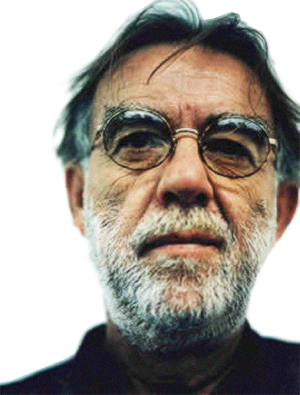
The Qatsi trilogy is the informal name given to a series of three films produced by Godfrey Reggio and scored by Philip Glass: Koyaanisqatsi: Life out of balance (1983), Powaqqatsi: Life in transformation (1988), and Naqoyqatsi: Life as war (2002). The titles of all three films are words from the language of the Hopi people; ‘qatsi’ means life. See Also: Baraka (1992) – an experimental documentary film directed by Ron Fricke, cinematographer on Koyaanisqatsi, and Chronos (1985) – an experimental film about the passage of time on different scales, also by Fricke.
Posted in Art, Philosophy, World |
1 Comment »
November 3, 2010

Valrhona is a French chocolate manufacturer based in the small town of Tain-l’Hermitage in Hermitage, a wine-growing district near Lyon. The company was founded in 1922 by a French pastry chef, Albéric Guironne, and is today one of the leading producers of chocolate in the world. The company also maintains the École du Grand Chocolat, a school for professional chefs with a focus on chocolate-based dishes and pastries. Valrhona focuses mainly on high-grade luxury chocolate marketed for professional as well as for private consumption. Though considered one of the foremost chocolate makers in the world, Valrhona is in roughly the same price range as Godiva and Neuhaus.
The product line includes chocolate confectionery, plain and flavored chocolate bars and bulk chocolate in bars or pellets. Valrhona produces vintage chocolate made from beans of a single year’s harvest from a specific plantation, primarily the Grand Crus which is grown in South America, the Oceania and the Caribbean. Currently three brands of vintage chocolates – Ampamakia, Gran Couva and Palmira – are in production with plantations on Madagascar, Trinidad and in Venezuela respectively.
Posted in Food, Money, World |
Leave a Comment »


 The Daily Omnivore