August 25, 2013
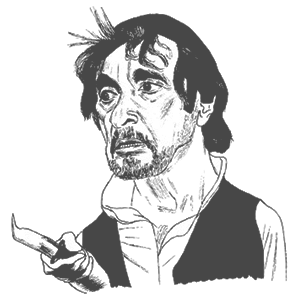
Shylock [shahy-lok] is a fictional Jewish moneylender in Shakespeare’s ‘The Merchant of Venice’ who lends money to his Christian rival, Antonio, setting the security at a pound of Antonio’s flesh. When a bankrupt Antonio defaults on the loan, Shylock demands the pound of flesh as revenge for Antonio having previously insulted and spat on him.
Meanwhile, Shylock’s daughter, Jessica, elopes with Antonio’s friend Lorenzo and becomes a Christian, further fuelling his rage. She also takes money and jewels from Shylock. During Shakespeare’s day, money lending was a fairly common occupation among Jews because usury, charging interest on a loan, was a sin for Christians at the time. Continue reading →
Posted in Money, Philosophy, Politics |
1 Comment »
August 24, 2013

Syd Mead (b. 1933), is a ‘visual futurist’ and concept artist. He is best known for his designs for science-fiction films such as ‘Blade Runner,’ ‘Aliens,’ and ‘Tron.’ Of his work, Mead was once moved to comment: ‘I’ve called science fiction ‘reality ahead of schedule.” Sydney Jay Mead was born in Saint Paul Minnesota, but spent only a few years there before moving to what would be the second of many homes throughout the western United States prior to graduating from high school in Colorado Springs, Colorado in 1951.
After serving a three-year enlistment in the U.S. Army, Syd Mead continued on to the Art Center School in Los Angeles, (now the Art Center College of Design, Pasadena) where he graduated in 1959. He was recruited by the Ford Motor Company’s Advanced Styling Studio under the management of Elwood Engel. Mead left the studio after two years to accept a variety of assignments to illustrate books and catalogues for large corporate entities such as United States Steel, Celanese, Allis Chalmers and Atlas Cement.
Continue reading →
Posted in Art, Technology |
Leave a Comment »
August 23, 2013
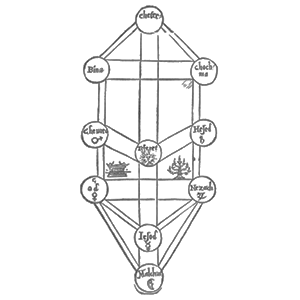
The Illuminati [ih-loo-muh-nah-tee] (‘enlightened’) was a secret society founded by university professor Adam Weishaupt in 1776, in Upper Bavaria, Germany. The movement consisted of advocates of freethought, secularism, liberalism, republicanism and gender equality, recruited in the German Masonic Lodges (Freemasonry is a fraternal organization that traces its origins to the loose organization of medieval Stonemasonry), who sought to teach rationalism through mystery schools (Western esotericism, which places emphasis on spiritual ‘knowledge’ or Gnosis and the rejection of blind faith).
In 1785, the order was infiltrated, broken up and suppressed by the government agents of Charles Theodore, Elector of Bavaria, in his preemptive campaign to neutralize the threat of secret societies ever becoming hotbeds of conspiracies to overthrow the Bavarian monarchy and its state religion, Roman Catholicism.
Continue reading →
Posted in Philosophy, Politics |
Leave a Comment »
August 22, 2013

Otto Rahn (1904 – 1939) was a German medievalist and First Lieutenant of the SS. Speculation still surrounds Rahn and his research. From an early age, he became interested in the legends of Parsifal, the Holy Grail, Lohengrin, and the Nibelungenlied. While attending the University of Giessen he was inspired by his professor, the Baron von Gall, to study the Albigensian (Catharism) movement, and the massacre that occurred at Montségur. Rahn is quoted as saying that ‘It was a subject that completely captivated me.’
In 1931 he travelled to the Pyrenees region of southern France where he conducted most of his research. Aided by the French mystic and historian Antonin Gadal, Rahn argued that there was a direct link between Wolfram Von Eschenbach’s Parzival and the Cathar Grail mystery. He believed that the Cathars held the answer to this sacred mystery and that the keys to their secrets lay somewhere beneath the mountain pog where the fortress of Montségur remains, the last Cathar fortress to fall during the Albigensian Crusade.
Continue reading →
Posted in Philosophy, War |
Leave a Comment »
August 21, 2013
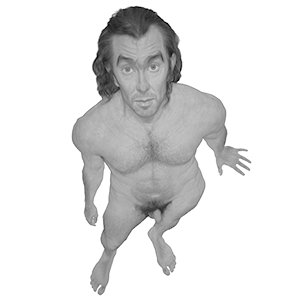
Evan Penny (b. 1953) is a South African-Canadian artist currently living and working in Toronto (he completed a postgraduate degree from the Alberta College of Art and Design in 1978). He makes sculptures of human forms out of silicone, pigment, hair and aluminium.
His pieces range from the almost precisely lifelike, to the blurred or stretched. Penny says one of his interests ‘is to situate the sculptures perceptually between the way we might see each other in real time and space and the way we imagine our equivalent in a photographic representation.’ Though his creations are lifelike, Penny believes that ‘the real can’t be represented or symbolized,’ leaving everything to be a representation.
Continue reading →
Posted in Art |
Leave a Comment »
August 20, 2013
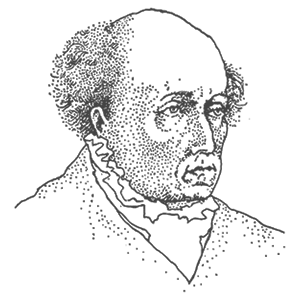
The dose makes the poison, a principle of toxicology, was first expressed by German-Swiss Renaissance physician Paracelsus. It means that a substance can produce the harmful effect associated with its toxic properties only if it reaches a susceptible biological system within the body in a high enough concentration (dose).
The principle relies on the finding that all chemicals—even water and oxygen—can be toxic if too much is eaten, drunk, or absorbed. ‘The toxicity of any particular chemical depends on many factors, including the extent to which it enters an individual’s body.’ This finding provides also the basis for public health standards, which specify maximum acceptable concentrations of various contaminants in food, public drinking water, and the environment.
Continue reading →
Posted in Drugs, Health |
Leave a Comment »
August 19, 2013

‘More popular than Jesus‘ was a controversial remark made by musician John Lennon of the Beatles in 1966: Lennon said that Christianity was in decline and that the Beatles had become more popular than Jesus Christ.
When the quote appeared in the American teen magazine ‘Datebook,’ angry reactions flared up from Christian communities. Lennon had originally made the remark in March 1966 during interviews with Maureen Cleave on the lifestyles of the four individual Beatles. When Lennon’s words were first published, in the ‘London Evening Standard’ in the United Kingdom, they had provoked no public reaction. Continue reading →
Posted in Language, Philosophy, Politics |
Leave a Comment »
August 18, 2013

Yellow Arrow is a public art project that was active from 2004-2006 and was created by Christopher Allen, Brian House, and Jesse Shapins, collectively known as Counts Media. The project was an important example of locative media and mobile phone art and draws concepts from psychogeography (emphasizing playfulness and ‘drifting’ around urban environments).
Yellow Arrow stickers were obtained from the project website and placed anywhere in the public realm. When encountering a sticker on the street, individuals could send the unique code printed on it as a text message to the project phone number. Moments later a message would be received that was left by the person who placed the sticker. Continue reading →
Posted in Games, Technology, World |
Leave a Comment »
August 18, 2013

Muscle worship is a social behavior, usually with a sexual aspect (a form of body worship), in which a participant, the worshiper, touches the muscles of another participant, the dominator, in sexually arousing ways, which can include rubbing, massaging, kissing, licking, ‘lift and carry,’ and various wrestling holds. The dominator is almost always either a bodybuilder, a fitness competitor, or wrestler—an individual with a large body size and a high degree of visible muscle mass. The worshiper is often, but not always, skinnier, smaller, and more out of shape.
Muscle worship can include participants of both sexes and all sexual orientations, however, it is a widespread practice amongst many gay men that view bodybuilders as sexual objects (bodybuilding is common in the gay community).
Continue reading →
Posted in Games, Sex |
1 Comment »
August 18, 2013

Muscle dysmorphia (or more informally bigorexia) is a disorder in which a person becomes obsessed with the idea that he or she is not muscular enough. Those who suffer from muscle dysmorphia tend to hold delusions that they are ‘skinny’ or ‘too small’ but are often above average in musculature.
Sometimes referred to as reverse anorexia nervosa, or the Adonis Complex, muscle dysmorphia is strictly connected with selective attention: individuals selectively focus their attention on perceived defect (too skinny body, underweight etc.). They are hypervigilant to even small deviations from perceived ideal and they ignore information that their body image is not consistent with reality.
Continue reading →
Posted in Health |
Leave a Comment »
August 17, 2013
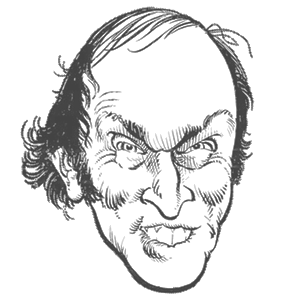
‘Just watch me‘ is a phrase made famous by Canadian Prime Minister Pierre Trudeau on October 13, 1970, during the October Crisis (two kidnappings of government officials by Québécois separatists). The term is still regularly used in Canadian political discussion. Trudeau, who had in previous years been a strong proponent of civil liberties, spoke of the need for drastic action to restore order in Quebec.
When questioned by CBC reporter Tim Ralfe on how far he would go in the suspension of civil liberties to maintain order, Trudeau replied ‘Well, just watch me.’ Three days later he invoked the ‘War Measures Act,’ which led to police action against many Quebec dissidents and great public controversy.
Posted in Language, Politics |
1 Comment »
August 17, 2013

SodaStream is the maker of a consumer home carbonation product based on the principles of making a carbonated drink as originally invented by Guy Gilbey in 1903. The device allows users to take ordinary tap water and carbonate it to create soda water (or carbonated water) to drink.
With the addition of one of over 100 different types of concentrated syrups and flavorings produced by Sodastream, owners can create carbonated beverages. After the company merged with Soda-Club in 1998, it was relaunched with an emphasis on healthier drinks. It went public on the Nasdaq stock exchange in 2010. Sodastream is currently headquartered in Israel, and has 13 production plants. Continue reading →
Posted in Food, Money |
Leave a Comment »


 The Daily Omnivore