August 1, 2013

A thought-terminating cliché is a commonly used phrase, sometimes passing as folk wisdom, used to propagate cognitive dissonance (discomfort caused by holding conflicting thoughts). Though the phrase in and of itself may be valid in certain contexts, its application as a means of dismissing dissent or justifying fallacious logic is what makes it thought-terminating.
The term was popularized by American psychiatrist Robert Jay Lifton in his 1956 book ‘Thought Reform and the Psychology of Totalism.’ Lifton said, ‘The language of the totalist environment is characterized by the thought-terminating cliché. The most far-reaching and complex of human problems are compressed into brief, highly reductive, definitive-sounding phrases, easily memorized and easily expressed. These become the start and finish of any ideological analysis.’
Continue reading →
Posted in Humor, Language |
Leave a Comment »
August 1, 2013

A platitude [plat-i-tood] is a trite, meaningless, or prosaic statement, generally directed at quelling social, emotional, or cognitive unease. The word derives from ‘plat,’ French word for ‘flat.’ Platitudes are geared towards presenting a shallow, unifying wisdom over a difficult topic. However, they are too overused and general to be anything more than undirected statements with ultimately little meaningful contribution towards a solution.
Examples could be statements such as ‘Meet in the middle,’ ‘Everybody has a right to an opinion,’ ‘Everything happens for a reason,’ ‘It is what it is,’ and ‘Do what you can.’ Platitudes are generally a form of thought-terminating cliché.
Posted in Language |
Leave a Comment »
July 31, 2013

The Hulkbuster armor is a heavy-duty exo-frame (an add-on to the Mk. XI Modular Armor) designed for maximum strength amplification at the cost of reduced versatility and mobility. As its name suggests, it was specifically designed for hand-to-hand combat with the rampaging Hulk.
The armor was rated with a lift (press) capacity of 175 tons. During its maiden run, the armor enabled its creator Tony Stark to hold his own in sustained physical combat with the Hulk. Its first appearance was in ‘Iron Man’ (vol. 1) #304 (May 1994).
Posted in Art |
Leave a Comment »
July 31, 2013

Hulkbusters is the name of three fictional organizations that have appeared in various comic book series published by Marvel Comics. The original Hulkbusters were a large joint task force consisting of both U.S. Army and Air Force personnel, whose primary purpose was to capture or if necessary, destroy the Hulk.
Their headquarters was the Hulkbuster Base in New Mexico, resembling a peace sign (also known as Gamma Base). After Bruce Banner, the Hulk’s alter-ego, achieved a state in which his normal intelligence and personality remained dominant while in Hulk form, he received a presidential pardon and the Hulkbusters ceased to exist.
Posted in Art |
Leave a Comment »
July 31, 2013

Tit for tat is an English saying meaning ‘equivalent retaliation.’ It is also a highly effective strategy in game theory for the iterated prisoner’s dilemma (shows why two individuals might not cooperate, even if it appears that it is in their best interests to do so). The strategy was first introduced by mathematical psychologist Anatol Rapoport in political scientist Robert Axelrod’s two tournaments, held around 1980. Notably, it was (on both occasions) both the simplest strategy and the most successful.
An agent using this strategy will first cooperate, then subsequently replicate an opponent’s previous action. If the opponent previously was cooperative, the agent is cooperative. If not, the agent is not. This is similar to superrationality and reciprocal altruism in biology. The success of the tit-for-tat (TFT) strategy (which is largely cooperative despite that its name emphasizes an adversarial nature) took many by surprise. In successive competitions various teams produced complex strategies which attempted to ‘cheat’ in a variety of cunning ways, but TFT eventually prevailed in every competition.
Continue reading →
Posted in Games |
Leave a Comment »
July 30, 2013

‘The evolution of cooperation‘ is the title of a 1981 paper by political scientist Robert Axelrod and evolutionary biologist W. D. Hamilton on the emergence and persistence of cooperation (also known as cooperation theory) as elucidated by application of game theory.
Three years later, Axelrod discussed the topic at length in a similarly titled book. He was interested in how game theory and computer modeling were illuminating certain aspects of moral and political philosophy, particularly the role of individuals in groups, the ‘biology of selfishness and altruism,’ and the evolutionary advantages of cooperation.
Continue reading →
Posted in Games, Language, Science |
Leave a Comment »
July 29, 2013

Pagani is an Italian manufacturer of sports cars and carbon fiber components. The company was founded in 1992 by Horacio Pagani and is based in San Cesario sul Panaro, near Modena, Italy.
Horacio Pagani, who formerly managed Lamborghini’s composites department, founded Pagani Composite Research in 1988. This new company worked with Lamborghini on numerous projects, including the restyling of the 25th Anniversary Countach, the Lamborghini LM002, the Lamborghini P140 design concept, and the Diablo. In the late 1980s, Pagani began designing his own car, then referred to as the ‘C8 Project.’ Continue reading →
Posted in Money, Technology |
Leave a Comment »
July 25, 2013

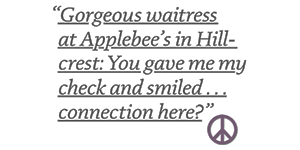
A missed connection is a type of personal advertisement which arises after two people meet but are too shy or otherwise unable to exchange contact details. The ‘Missed Connections’ section of Craigslist gets thousands of ads of this type every month for cities such as New York and San Francisco.
The feature was started by Jim Buckmaster, Craigslist’s CEO, after he noticed a common type of posting in their personal ads, which he characterised as ‘you-smiled-at-me-on-the-subway-platform.’ He sees the format as addressing a common human need and being ideal for romantic comedy, ‘Missed Connections give people that second chance … They represent persistence in the face of long odds, which definitely adds to their artistic appeal.’
Continue reading →
Posted in Humor, Love, Technology |
1 Comment »
July 25, 2013

Fear of Missing Out or FoMO is a form of social anxiety — a compulsive concern that one might miss an opportunity for social interaction, a novel experience, profitable investment or other satisfying event. This is especially associated with modern technologies such as mobile phones and social networking services.
A study by Andrew Przybylski found that the condition was most common in those who had unsatisfied psychological needs such as wanting to be loved and respected. The condition is also associated with social networks such as Facebook and LinkedIn, which provide constant opportunity for comparison of one’s status.
Posted in Health, Language |
Leave a Comment »
July 25, 2013
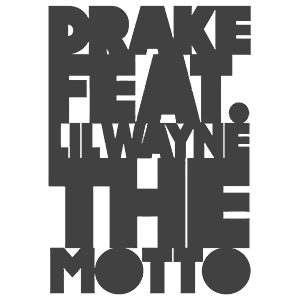
YOLO is an acronym for ‘you only live once.’ Similar to ‘carpe diem’ (‘seize the day’) or ‘memento mori’ (‘remember that you will die’), it implies that one should enjoy life, even if that entails taking risks. The expression’ is commonly attributed to Golden Age film star Mae West, but variations of the phrase have been in use for over 100 years, including as far back as (the German equivalent of) ‘one lives but once in the world’ by Johann Wolfgang von Goethe in his 1774 play ‘Clavigo’ and as the title of a waltz, ‘Man lebt nur einmal!’ (‘You Only Live Once!’) by Johann Strauss II in 1855.
The acronym is in youth culture and music, and was popularized by the 2011 song ‘The Motto’ by Canadian rapper Drake (who later claimed to want royalties due to the proliferation of merchandise bearing the phrase). Actor Zac Efron has a tattoo with the acronym. The expression has been criticized for its use in conjunction with reckless behavior, most notably in a Twitter post by aspiring rapper Ervin McKinness just prior to his death: ‘Drunk af going 120 drifting corners #FuckIt YOLO.’
Posted in Humor, Language, Philosophy |
Leave a Comment »
July 25, 2013
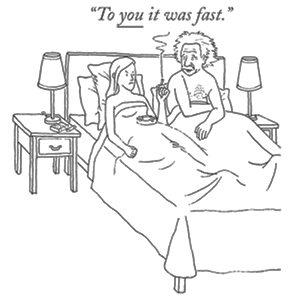
Relativism [rel-uh-tuh-viz-uhm] is the concept that points of view have no absolute truth or validity, having only relative, subjective value according to differences in perception and consideration. The term is often used to refer to the context of moral principle, where in a relativistic mode of thought, principles and ethics are regarded as applicable in only limited context.
There are many forms of relativism which vary in their degree of controversy. The term often refers to ‘truth relativism,’ which is the doctrine that there are no absolute truths, i.e., that truth is always relative to some particular frame of reference, such as a language or a culture (cultural relativism). Another widespread and contentious form is moral relativism (which argues that morality is context-bound, not objective).
Continue reading →
Posted in Philosophy |
Leave a Comment »
July 25, 2013


Sheng-Hung (Sam) Wang (b. 1967) is an American professor, neuroscientist and author known for the books ‘Welcome to Your Brain’ and ‘Welcome to Your Child’s Brain,’ as well as for the Princeton Election Consortium psephology (study of elections) web site. Wang was raised in California.
His parents emigrated from Taiwan to the United States in the 1960s. He attended the California Institute of Technology and graduated in 1986 with a B.S. in physics with honors at the age of 19, making him the youngest member of his graduating class. He went on to earn a Ph.D. in neuroscience at Stanford University.
Continue reading →
Posted in Politics, Science |
1 Comment »